What makes a real hamon different from an etched hamon?
Updated Feb 2026
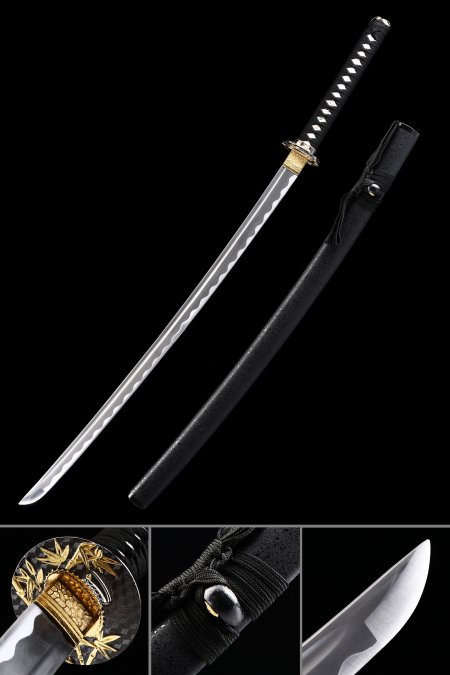
A real hamon is created through differential clay tempering during the quenching process. The smith coats the spine and flat of the blade with a thick layer of refractory clay while leaving the edge thinly coated or exposed. When the heated blade is plunged into water or oil, the edge cools rapidly and forms hard martensite, while the insulated spine cools slowly into softer pearlite. The visible boundary between these two crystalline structures is the hamon. An etched hamon, by contrast, is a cosmetic pattern applied with acid on a uniformly hardened blade — it has no structural significance. You can distinguish a genuine hamon by examining it under different lighting angles: the line will show depth and subtle texture changes rather than a flat, printed appearance, because it reflects an actual transition in the steel's microstructure.