
Ceramics Japanese Style Teaware
Each piece in our Japanese-style ceramic teaware collection is shaped by skilled hands and fired to bring out the quiet beauty of traditional East Asian craft. From hand-thrown teapots with natural glaze variations to delicately painted cups bearing seasonal motifs, these sets honor centuries of ceramic artistry. Explore the collection and enjoy free standard shipping on your order, backed by our hassle-free return policy.
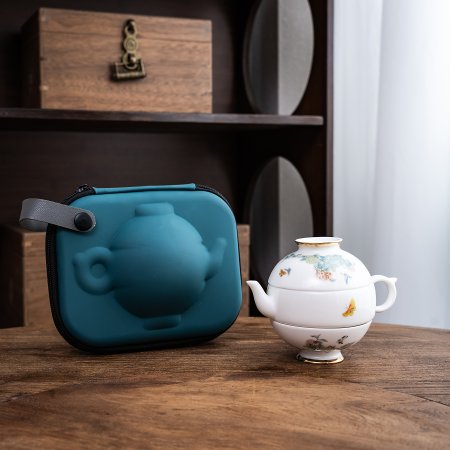
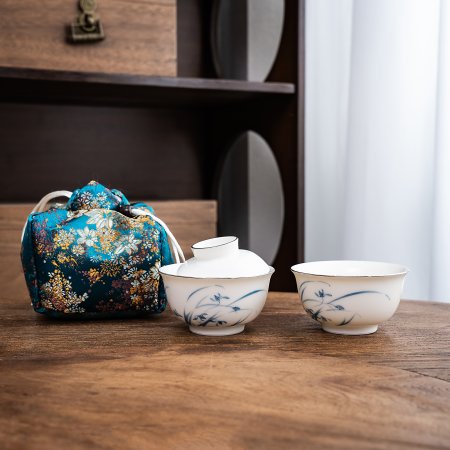
Free Shipping
69.00 USD
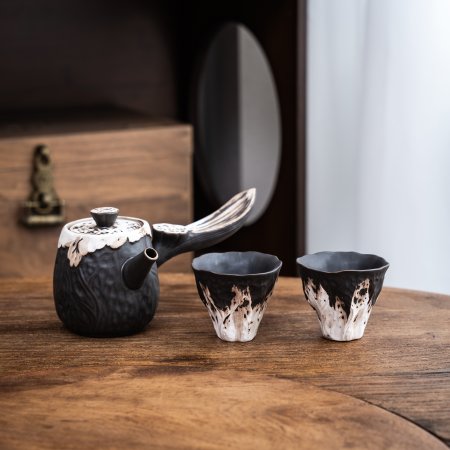
Free Shipping
119.00 USD
Frequently Asked Questions
What makes Japanese-style ceramic teaware different from regular porcelain sets?
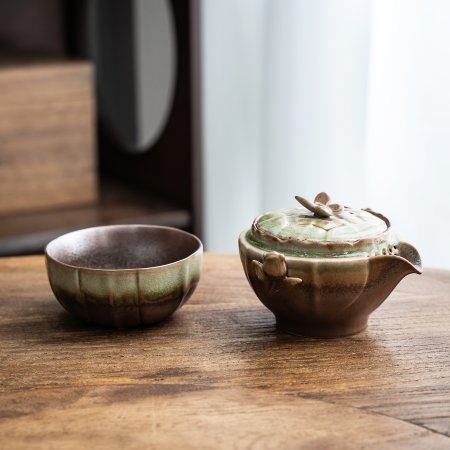
Japanese-style ceramic teaware is distinguished primarily by its approach to imperfection and materiality. While standard porcelain sets prioritize uniformity and a bright, smooth finish, Japanese ceramic traditions - particularly those influenced by wabi-sabi aesthetics - celebrate natural variation in glaze pooling, slight irregularities in form, and textures that emerge from the firing process itself. Stoneware bodies used in many Japanese-style sets are fired at higher temperatures than standard earthenware, producing a denser, more heat-retentive material. Decorative motifs also differ: nature imagery such as blossoms, birds, persimmon branches, and seasonal botanicals are drawn from classical East Asian painting traditions rather than purely ornamental Western patterns. The overall effect is a set that feels more meditative and handcrafted than its mass-produced counterparts.
How should I store a ceramic tea set to keep it in display condition?
Proper storage is essential for preserving the finish and structural integrity of a ceramic tea set displayed long-term. Always keep pieces separated with soft cloth or felt pads to prevent glaze chipping from contact friction. Avoid storing sets in areas with high humidity fluctuations, as repeated thermal expansion and contraction can stress fine hairline details in painted glazes over time. If the set came with a travel pouch or fitted case, using it for storage - even at home - provides consistent cushioning and protection from dust. For porcelain sets with hand-painted overglaze decoration, indirect light display is preferable to direct sunlight, which can gradually fade enamel pigments. Periodic gentle dusting with a dry microfiber cloth is sufficient for maintenance between displays.
Is stoneware or porcelain better for a Japanese-style tea set collection?
The answer depends on what qualities you prioritize in your collection. Stoneware, fired at temperatures between 1,200-1,300°C, produces a denser, more textured body that is highly heat-retentive and carries a distinctly tactile, earthy character aligned with Japanese folk pottery and wabi-sabi sensibility. Its glaze behavior is less predictable, which is precisely what gives each piece its individuality. Porcelain, fired to similar or higher temperatures, results in a smoother, semi-translucent body that serves as an ideal canvas for detailed hand-painted motifs - florals, birds, and classical landscape scenes appear crisper and more luminous on porcelain. For collectors seeking decorative precision and refined detail, porcelain sets offer greater visual elegance. For those drawn to the raw, grounded character of traditional Japanese ceramic craft, stoneware provides an authenticity that is difficult to replicate.
Are portable ceramic tea sets practical as display pieces or gifts?
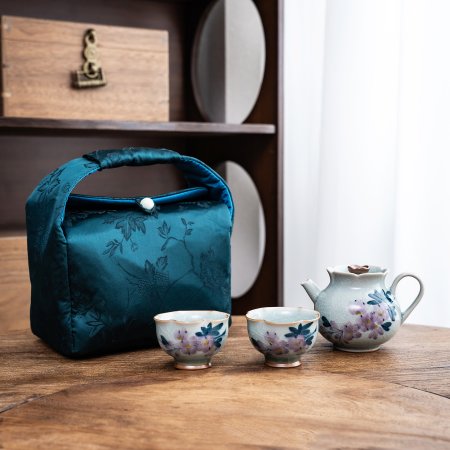
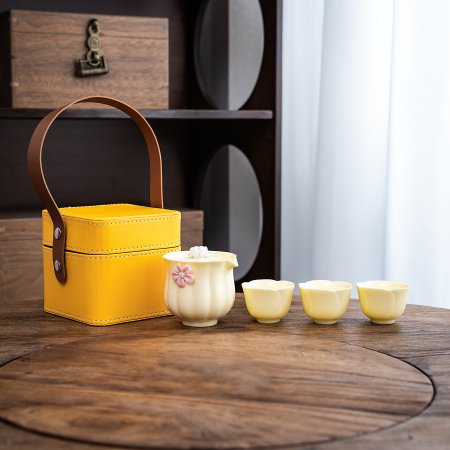
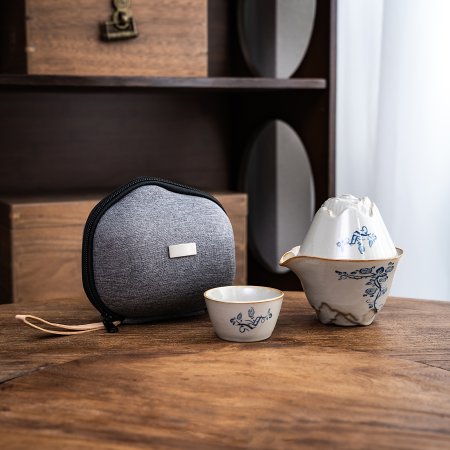
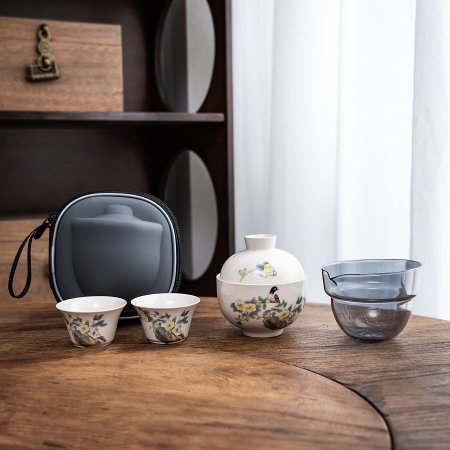
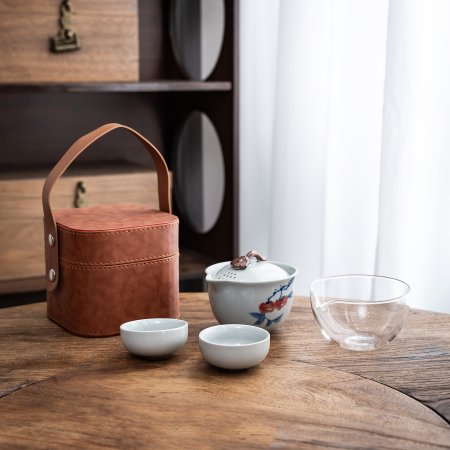
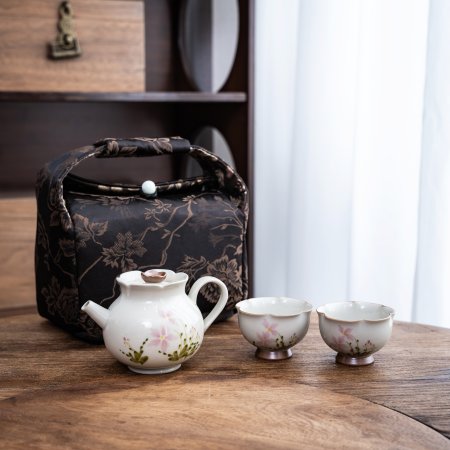
Portable ceramic tea sets that include a fitted travel pouch or structured carrying case offer a dual appeal that makes them particularly well-suited as display pieces and gifts. For display purposes, the coordinated set - teapot, cups, tray, and case - can be arranged as a composed vignette that communicates the full aesthetic intention of the design. The accompanying case also signals craftsmanship and intentionality to a viewer, reinforcing the collectible character of the set. As gifts for fellow tea culture enthusiasts or East Asian art collectors, portable sets present an immediately complete package: there is nothing additional required for appreciation or display. Sets featuring distinctive hand-painted motifs such as hydrangea, persimmon, or blossom patterns also carry seasonal and symbolic resonance in East Asian cultural tradition, adding a layer of meaning that elevates them beyond purely decorative objects.
What does the side-handle teapot style signify in East Asian tea culture?
The side-handle teapot - known in Japanese as a kyusu - is one of the most recognizable forms in East Asian tea culture and carries specific functional and aesthetic significance. Unlike Western teapots with overhead handles, the side handle allows the user to pour with a natural wrist rotation that provides greater control over flow rate and pour angle, which is especially valued in Japanese green tea preparation where precise temperature and pour speed affect flavor extraction. From a display and collectible perspective, the kyusu form is immediately legible as a marker of Japanese ceramic tradition, making it a strong visual anchor in a curated teaware collection. When paired with a lotus tray and coordinated teacups, as seen in several sets within this collection, the side-handle teapot becomes the compositional centerpiece of a fully realized display arrangement.