
Blue Red Handle Katana
Blue and red handle katana bring together striking visual contrast and traditional Japanese sword-making craft - making each piece a standout addition to any serious collection. From hand-wrapped tsuka ito in layered hues to ornate bronze alloy tsuba and lacquered saya, every detail is selected for its aesthetic and historical resonance. Explore our curated selection and enjoy free standard shipping on all orders, backed by our hassle-free return policy.
Frequently Asked Questions
What steel is used in blue red handle katana blades?
The katana in this collection are crafted from manganese steel, a material valued in display swordsmithing for its hardness and distinctive surface character. Manganese steel takes on a naturally dark, near-charcoal tone that distinguishes it visually from conventional carbon or stainless steel blades. This darker surface makes hamon activity - the undulating temper line along the blade's edge - appear with strong contrast and visual clarity, which is particularly desirable for collectors who prioritize aesthetic detail. It is a material choice that supports both visual impact and structural integrity in a display-grade collectible.
How is the blue and red tsuka ito wrap constructed?
The tsuka ito wrap on these katana follows the traditional hishigumi diamond-weave method, in which cord is interlaced over a same-kawa ray skin base in a repeating geometric pattern. This technique creates the characteristic raised diamond shapes along the length of the handle and provides a structured, layered texture. When executed in blue and red tones - whether alternating colors or a gradient blend - the wrap produces a handle that reads differently depending on the viewing angle and light source. The same-kawa ray skin underneath adds a pebbly tactile foundation that both secures the cord and contributes to the grip's overall visual depth.
How does the white lacquer saya complement this color scheme?
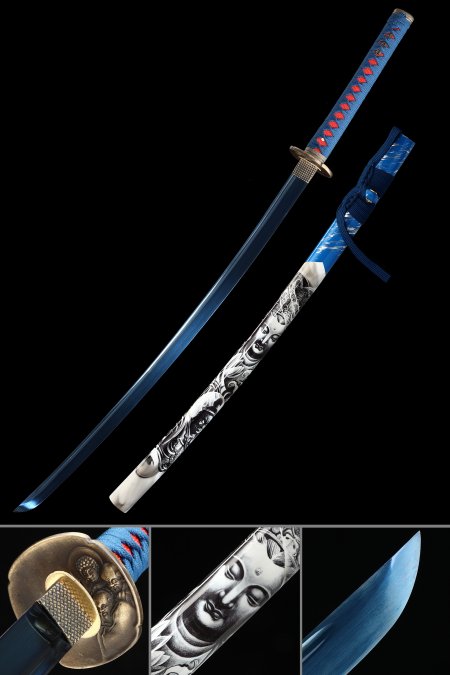
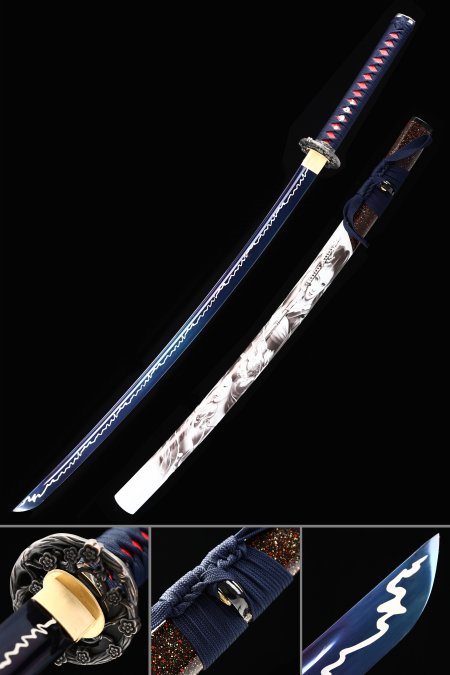
A white lacquer saya serves as a neutral visual anchor that allows the blue and red tsuka ito to function as the primary focal point of the display piece. In traditional Japanese sword aesthetics, high-contrast pairing between the saya and the handle was a deliberate compositional choice - signaling status and artistic intention rather than casual accessory matching. The white lacquer finish reflects light evenly, making it an ideal background for displaying color-heavy handle wraps and ornate tsuba designs like the plum blossom or Buddha-print fittings found in this collection. For wall or stand display, the white saya creates visual separation from darker backgrounds.
What tsuba designs are available in this collection?
This collection features two distinct tsuba styles that pair with the blue-red handle aesthetic in different ways. The plum blossom tsuba references one of the most enduring motifs in East Asian decorative arts - the ume blossom, associated with resilience and the arrival of spring in Japanese cultural symbolism. The second option is a bronze alloy tsuba with a Buddha-print motif, reflecting a more devotional aesthetic tradition and offering a warmer metallic tone that complements blue ito wrapping particularly well. Both tsuba are cast or worked in alloy materials that develop subtle patina characteristics over time, adding to their long-term collectible appeal.
How should I maintain and store a blue red handle katana?
For long-term display preservation, store the katana horizontally on a dedicated wooden stand in a room with stable, low humidity - ideally below 60% relative humidity. Apply a thin coat of choji oil or mineral oil to the blade surface every two to three months using a soft cloth, wiping from the base toward the tip to prevent oxidation. Avoid leaving the katana in direct sunlight for extended periods, as prolonged UV exposure can fade tsuka ito dye, particularly in blue and red synthetic cords. When handling, use clean cotton gloves or hold the blade with a soft cloth to prevent skin oils from accelerating surface oxidation on the manganese steel.
Customer Reviews
Arman Giovanni Hall
Arizona, United States
This sword looks and feels amazing!!! I'm so happy to add it to my collection
 |
Blue Manganese Steel Katana with Buddha-Print White Saya - Blue-Red Tsuka Ito, Bronze Alloy Tsuba |
Kolbey Jacobs
Indiana, United States
Love it. Came earlier than expected. Looking forward to my next purchase
 |
Manganese Steel Katana with Dark Blue Blade, Lightning Hamon, White Lacquer Saya - Plum Blossom Tsuba |
Rachel Martinez
New Mexico, United States
Looks exactly like the picture. Very beautiful. Picture is clear and the lightning on the blue sword is also beautiful. This is the second sword we purchased and I'm sure it's not our last.
|
Manganese Steel Katana with Dark Blue Blade, Lightning Hamon, White Lacquer Saya - Plum Blossom Tsuba |