Dragon Tsuba Naginata

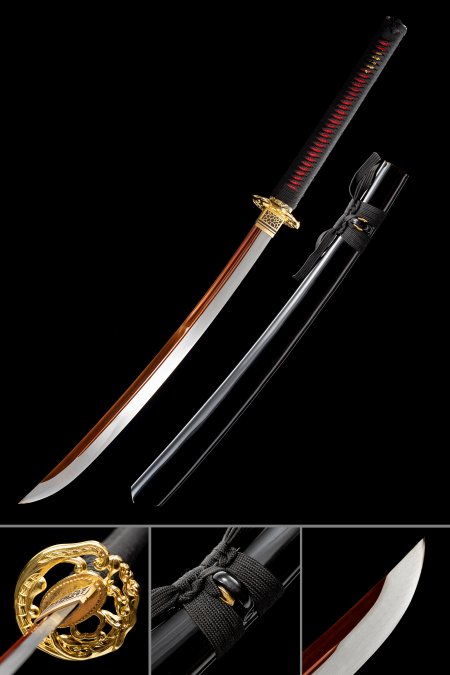
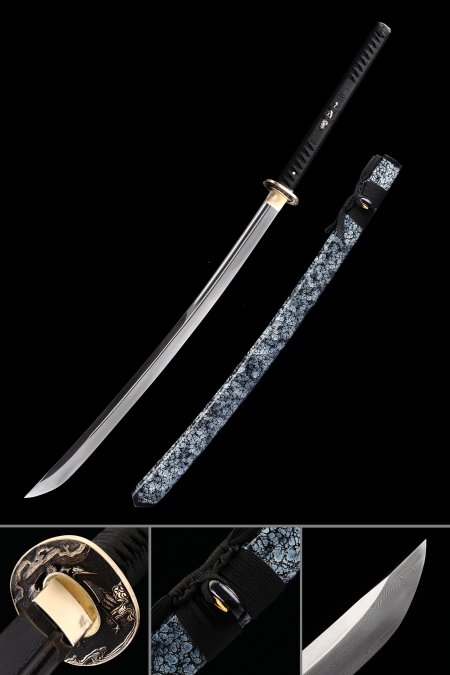
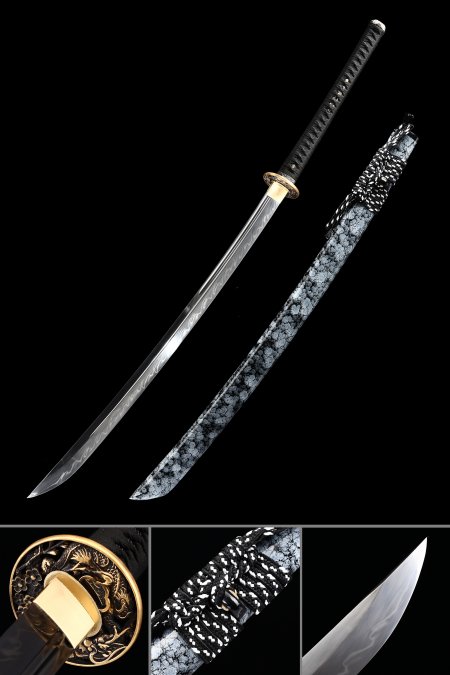
The Dragon Tsuba Naginata collection brings together handcrafted Japanese pole arms finished with intricately cast dragon-motif guards, offered in both Damascus pattern steel and T10 clay-tempered construction. Each piece features a full-tang assembly, hand-lacquered saya, and authentic hamon or folded-steel patterning — details that make every naginata a compelling display centerpiece. Enjoy free standard shipping and hassle-free returns on every order from TrueKatana.
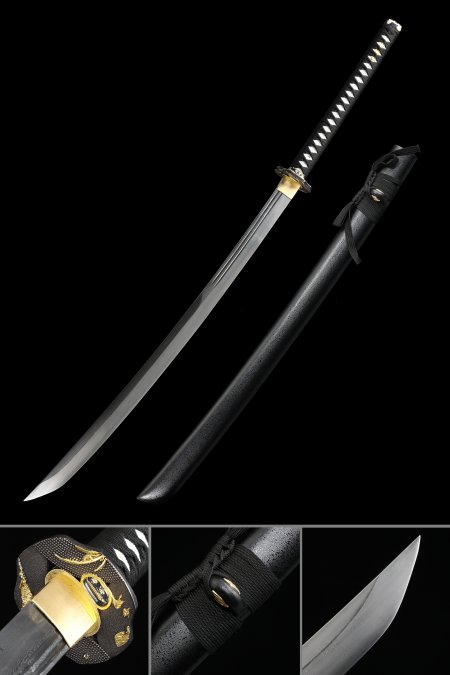
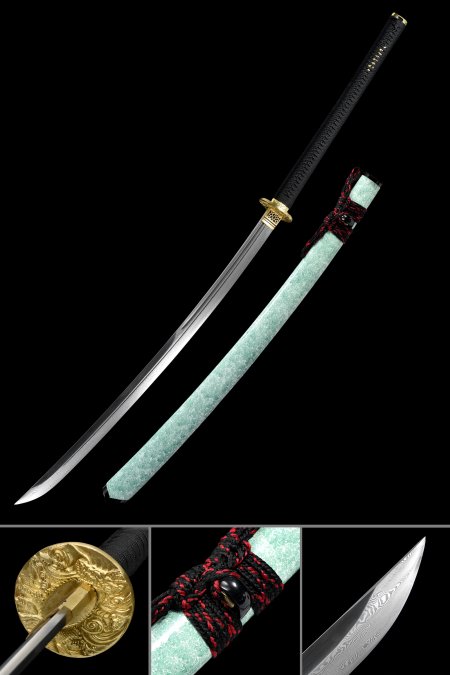
Showing 5 Products

Frequently Asked Questions

What makes a dragon tsuba different from a standard naginata guard?
A standard naginata tsuba is typically a simple round or oval disc of iron or copper with minimal decoration, serving primarily as a structural separator between the blade and handle. A dragon tsuba is a fully sculpted piece — the dragon's body, scales, claws, and often clouds or waves are cast or hand-chased in relief across the guard's surface. On the collectible naginata in this series, the dragon motif wraps around the tsuba's rim and face, making the guard itself a display element rather than a background component. The fitting material — copper, iron alloy, or antiqued brass — is chosen to complement the blade's surface finish, so a Damascus blade with warm brown grain tones is typically paired with a copper tsuba, while a darker clay-tempered blade pairs naturally with a darker iron-toned guard.
How does Damascus naginata steel differ from T10 clay-tempered steel?
Damascus pattern steel is made by forge-welding multiple layers of high- and low-carbon steel, then drawing and folding the billet repeatedly. When the finished blade is ground and acid-etched, the contrasting carbon content between layers becomes visible as a flowing grain pattern — dark and silver bands that shift with the light. The pattern is a direct expression of the blade's internal structure. T10 clay-tempered steel takes a different approach: T10 is a high-carbon tool steel known for fine grain and edge retention. Before quenching, a thick clay paste is applied to the spine, causing differential cooling. The edge hardens rapidly while the spine stays relatively soft, and the boundary between these two zones forms a hamon — the misty, undulating line visible along the blade's length. For collectors, the choice comes down to surface character: layered Damascus pattern versus the classical hamon of clay-tempered steel.
What saya finishes are available and how should I maintain them?
The Dragon Tsuba Naginata series offers four distinct saya treatments: high-gloss black lacquer, deep blue lacquer, granite-textured wrapping, and a natural green-tone finish. Each finish is applied over a fitted hardwood core that is shaped to the specific blade geometry. Maintenance is minimal but important — avoid exposing lacquered saya to prolonged direct sunlight, which can cause surface crazing over time, and never store a blade in its saya for extended periods in high-humidity environments, as moisture trapped between wood and steel accelerates oxidation. For dust, a soft dry cloth is sufficient. If a lacquer surface develops minor scuffs, a small amount of furniture paste wax applied with a cotton pad and buffed dry can restore gloss without risking damage to the underlying finish.
Is a 118 cm naginata practical to display in a standard home space?
At 118 cm overall length, a naginata requires more deliberate display planning than a standard katana. Horizontal wall mounts designed for long-form Japanese arms work well and are widely available in two- or three-tier configurations that can accommodate a naginata alongside shorter sword forms. Floor-standing display racks with angled cradles are the other common solution, placing the piece at eye level and allowing the full profile — from saya tip to dragon tsuba — to be appreciated without obstruction. Ceiling clearance is rarely an issue on horizontal mounts, but vertical or diagonal display requires at least 130 cm of unobstructed wall height. Many collectors position a 118 cm naginata as the central vertical anchor of a wall grouping, flanked by shorter mounted pieces, which naturally draws the eye and communicates the scale hierarchy of traditional Japanese arms.
How should I care for the blade long-term to preserve its finish?
Long-term care for a display naginata blade centers on controlling two variables: moisture and fingerprint acidity. Both Damascus pattern steel and T10 clay-tempered blades are high-carbon steel, which means they will develop surface rust if left unprotected in humid or fluctuating environments. Every three to four months — or after handling — wipe the blade from habaki to tip with a clean cotton cloth lightly treated with choji oil or a food-grade mineral oil. Apply only a thin coat; excess oil attracts dust and can work into the saya, softening the lacquer's interior fit over time. Store the piece horizontally on a padded rack or in its saya with the edge upward. Avoid display near kitchen areas, bathrooms, or exterior walls prone to condensation. If a small spot of surface rust appears, remove it promptly with a cotton swab and oil rather than abrasive material, which would disturb the etched Damascus pattern or polished hamon surface.

Customer Reviews

Michael E Glass Indiana, United States

The swords arrived 7-8 days after they were shipped. I had received an email confirming the order when I placed it, however I did not receive an email when it shipped, so I didn't know to look for them. They may have been outside a day before I noticed the boxes. With that said the boxes arrived in good shape with no obvious shipping damage. I'm not the biggest fan of the all styrofoam containers, due to it being a little messy when opening the packaging, but I can't deny it did an excellent job in protecting the swords as they arrived in perfect condition. I haven't had a chance to cut any water bottles yet, but all of the swords seem reasonably sharp. Everything seems well built with no obvious defects that I can tell at this time.

Fuuun Kairyuu Damascus Naginata - Pattern Steel, Green Saya, Copper Tsuba, Full Tang Fuuun Kairyuu Damascus Naginata - Pattern Steel, Green Saya, Copper Tsuba, Full Tang
Shawn P Franco New Mexico, United States

I have to say I'm impressed with the high quality and astounding prices. Here is my latest acquisition on the top tier. Extremely satisfied with this company's vast array of offerings. Very good business model ends up a win for all involved in any transaction. TRUEKATANA HAS IT NAILED!! Many thanks.
T10 Clay Tempered Naginata - Handcrafted Folded Steel, Real Hamon, Blue Saya, 118cm T10 Clay Tempered Naginata - Handcrafted Folded Steel, Real Hamon, Blue Saya, 118cm