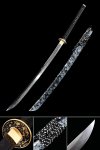
What makes a flower saya different from a standard naginata scabbard?
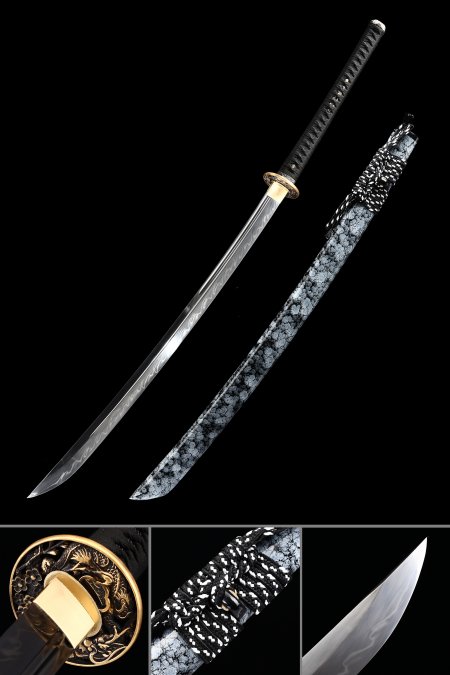
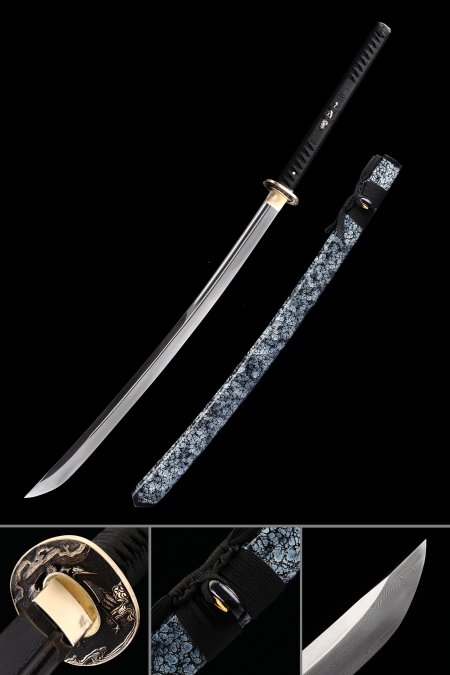
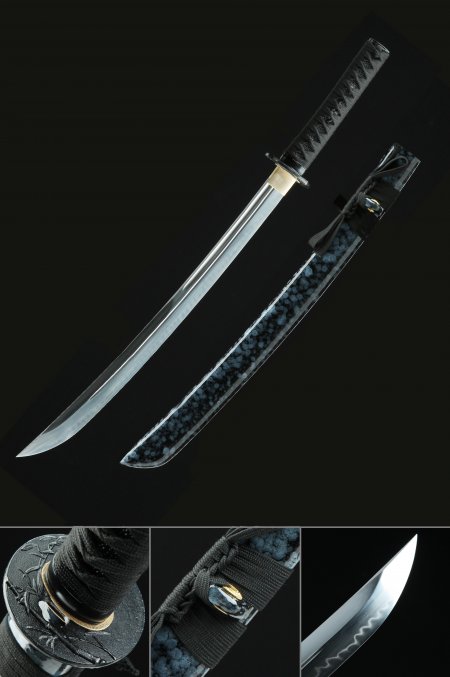
A flower saya refers to a lacquered naginata scabbard finished with decorative surface treatments — typically deep solid lacquer in colors like cobalt blue or layered granite tones — that elevate the scabbard from a purely functional cover to a display object in its own right. Standard naginata saya are often plain wood or lightly finished, prioritizing protection. Flower saya versions involve additional hand-application stages where lacquer is built up in layers, sanded between coats, and polished to a depth that plain finishes cannot achieve. For collectors focused on wall display or cabinet presentation, the saya is often the first visual element a viewer notices, making its finish quality central to the piece's overall impact.
How does clay tempering create the hamon on a naginata blade?
Clay tempering is a differential hardening technique where a clay mixture is applied along the spine of the blade before it is quenched in water or oil. The clay acts as an insulator — the coated spine cools slowly and remains relatively soft, while the exposed edge cools rapidly and hardens into a high-carbon martensitic structure. The boundary between these two zones, where crystalline activity is most visible, appears as the hamon: a wavy or irregular temper line that runs the length of the blade. On T10 steel, which has a high carbon content around 1.0%, this process produces well-defined hamon activity with visible nie and nioi — crystalline granules that collectors examine under raking light. No two clay-tempered blades produce an identical hamon, which is why each piece is considered individually unique.
Is Damascus pattern steel or T10 steel better for a display naginata?
Neither is objectively superior — they appeal to different collecting priorities. T10 clay-tempered steel is chosen for its visible hamon, which is a direct record of the forging and hardening process. It rewards close examination and appeals to collectors focused on traditional Japanese blade aesthetics. Damascus pattern steel, produced by forge-welding multiple layers of steel together and manipulating the billet through twisting or drawing, creates flowing surface patterns that are purely visual in nature and unique to each blade. Damascus pieces tend to photograph dramatically and work well in display contexts where visual impact from a distance matters. If your collection emphasizes historical process fidelity, T10 is the stronger choice. If you prioritize surface pattern uniqueness and visual variety, Damascus offers something T10 cannot.
How should I store a lacquered saya naginata for long-term preservation?
Long-term storage of a lacquered saya naginata requires controlling three main factors: humidity, contact abrasion, and light exposure. Lacquered surfaces are sensitive to rapid humidity changes, which can cause the finish to craze or chip — maintaining a stable relative humidity between 45% and 55% is ideal. The blade itself should be lightly coated with a thin film of choji oil or a mineral-based blade oil before storage to prevent oxidation, particularly on high-carbon steels like T10. Avoid storing the piece in a sealed synthetic bag, which can trap moisture. For display, keep the naginata away from direct sunlight and halogen lighting, both of which can fade lacquer pigmentation over time. A horizontal wall mount or padded cabinet rack distributes weight evenly and prevents warping of the wooden haft.
Is a full-tang naginata a meaningful feature for a display collectible?
Yes, and for reasons that go beyond structural strength. Full-tang construction means the steel of the blade extends continuously through the handle assembly rather than terminating at a short hidden stub. For a polearm of naginata proportions — typically over 100 centimeters total length — the tang's integration with the nagaé and handle fittings directly affects how the piece balances and presents in a mount. A properly fitted full-tang assembly also shows cleaner handle construction at the mekugi peg points and habaki collar, details that experienced collectors examine when assessing overall build quality. From a collectible standpoint, full-tang pieces represent the same structural philosophy as historically produced blades, which adds authenticity value that partial-tang constructions simply cannot match.