What does "gold-black tsuba" mean on a wakizashi?
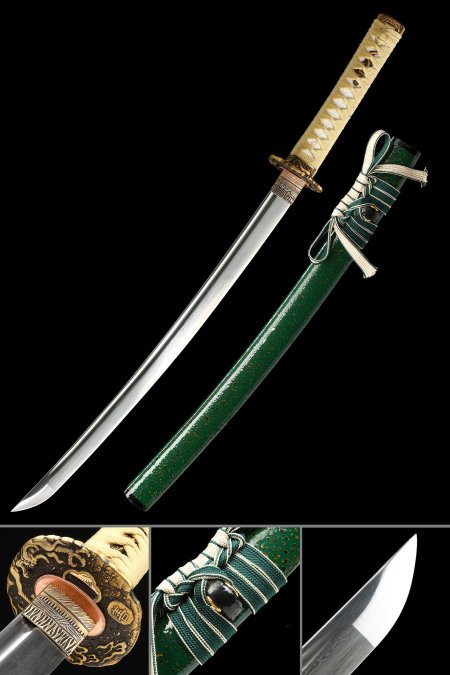
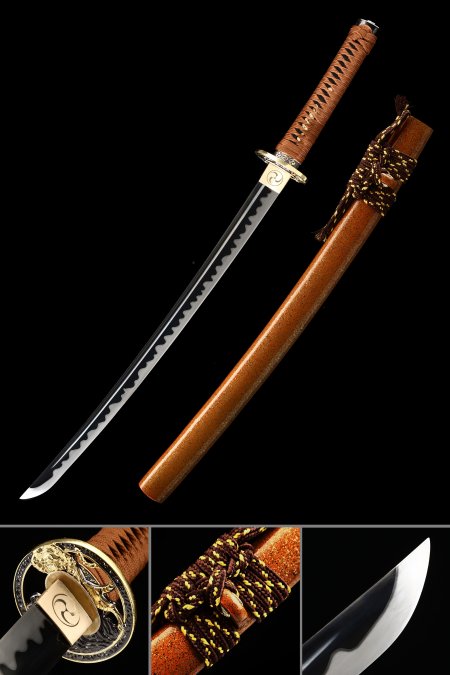
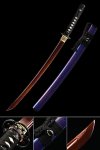
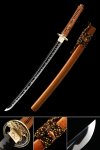
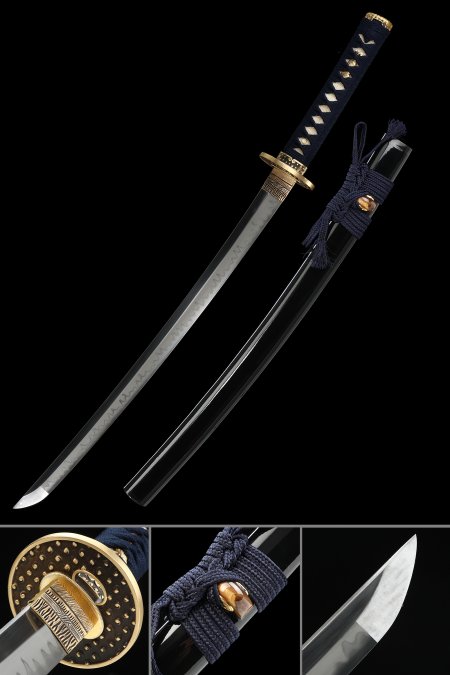
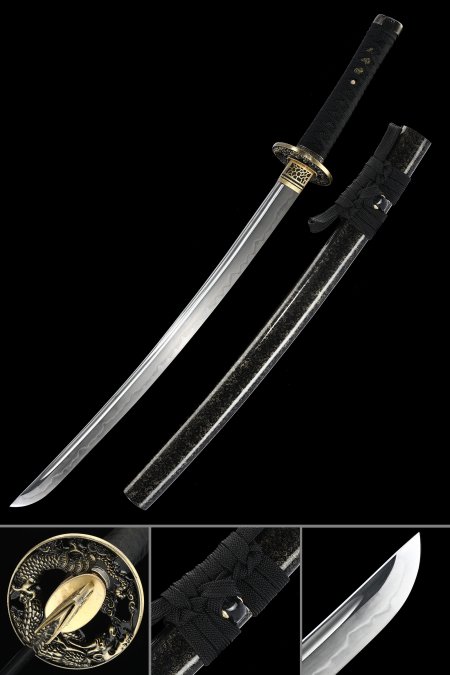
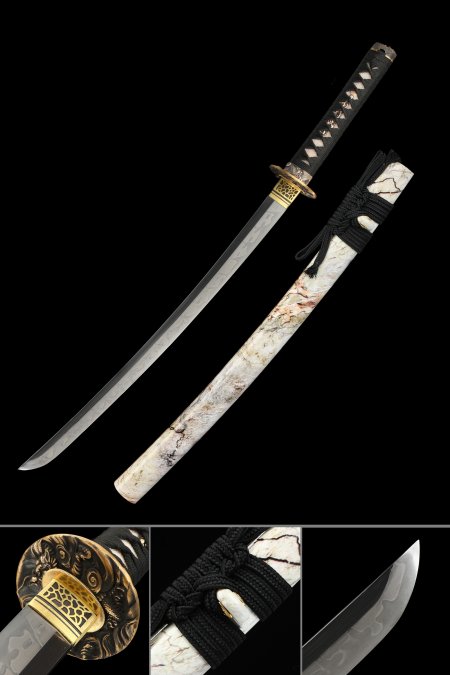
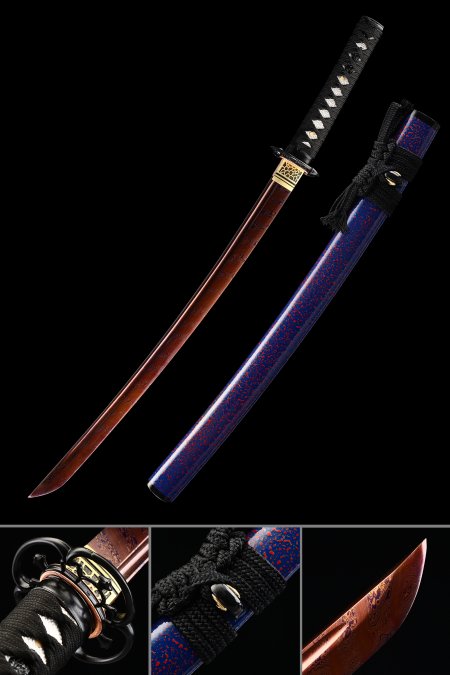
The tsuba is the guard that sits between the blade and the grip on a Japanese sword. A gold-black tsuba refers to a guard finished in a two-tone scheme combining gold-toned metalwork with blackened surfaces. This contrast is achieved through selective patination, plating, or paint treatments applied to an alloy base. On wakizashi in this collection, the effect is used to highlight engraved details — dragon motifs and scroll patterns — making the decorative work stand out clearly against the darker background. It is a purely aesthetic choice valued by collectors for its visual impact and its echoes of traditional Japanese sword furniture aesthetics.
How does Damascus steel differ from T10 steel in a wakizashi?
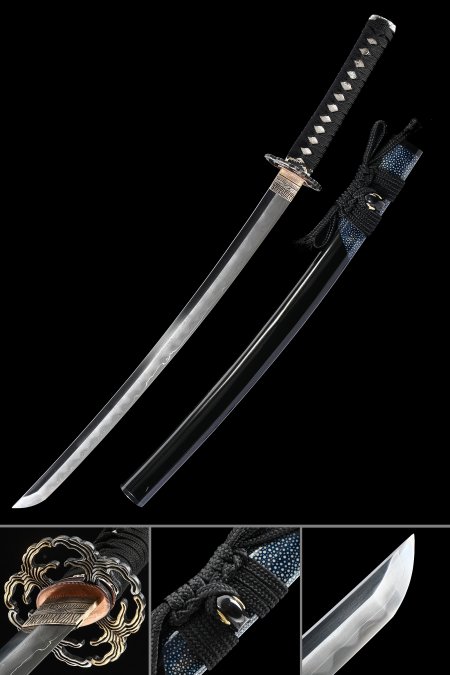
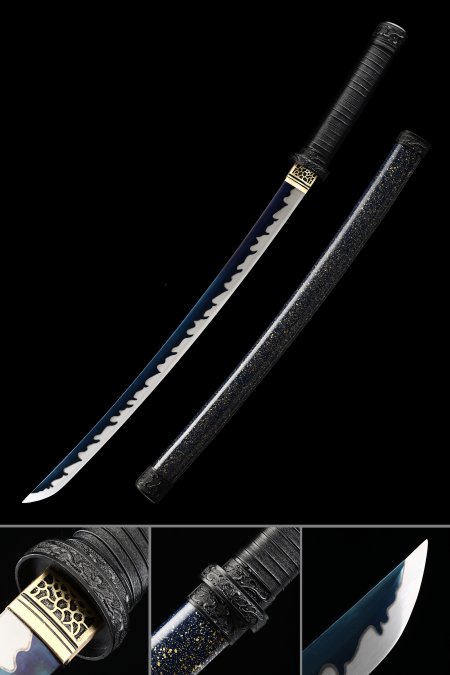
Damascus steel is produced by folding and forge-welding multiple layers of steel together, resulting in the flowing grain pattern visible on the blade surface. Each Damascus wakizashi displays a unique pattern, which is a major draw for display collectors. T10 carbon steel, by contrast, is a high-carbon tool steel prized for its ability to take and retain a clean edge and, when differentially hardened, to develop a genuine hamon — the visible temper line along the blade. The hamon on a T10 wakizashi is formed during the clay-coating and quenching process, not etched artificially. Collectors who prioritize classical Japanese sword aesthetics often prefer T10 for this reason, while those drawn to visual texture and layered surface patterns tend to gravitate toward Damascus.
What is a hamon and how can I tell if it is real?
A hamon is the temper line that appears along the edge of a blade following differential heat treatment. To create it, the smith applies a clay coating — thicker along the spine, thinner near the edge — before quenching the blade. The unprotected edge cools faster and hardens into a crystalline structure called martensite, while the spine cools more slowly and remains relatively softer. The boundary between these two zones is the hamon. A genuine hamon has subtle activity — nie (bright crystalline granules) and nioi (a misty, cloud-like boundary) — that cannot be fully replicated by acid etching. On this collection's T10 wakizashi, the hamon is formed through actual differential hardening, making it a meaningful detail for collectors who study blade metallurgy.
How should I store a wakizashi to protect it on display?
For long-term display, store the wakizashi in its saya, which protects the blade from dust and physical contact. Keep the piece away from high-humidity environments, as moisture accelerates oxidation on carbon steel blades. Apply a thin coat of blade oil — choji oil or a neutral mineral oil — every few months, or more frequently in humid climates. Avoid touching the blade surface directly; skin oils transfer moisture and salts that cause spotting. If the sword will be handled for inspection or photography, wipe the blade clean afterward with a soft, lint-free cloth before returning it to the saya. Lacquer saya require no special treatment beyond keeping them away from direct sunlight, which can cause lacquer to fade or crack over extended exposure.
Can a wakizashi be displayed as part of a daisho set?
Yes, and a daisho — the pairing of a katana and wakizashi with matched koshirae — remains one of the most recognized display formats for Japanese swords. The gold-black tsuba design shared between wakizashi and katana in coordinated sets creates a visually unified pair that reads clearly even from a distance. When building a display daisho, collectors typically match tsuba motif, ito color, and saya style across both swords. A dragon-engraved gold-black tsuba wakizashi, for example, pairs naturally with a katana carrying the same dragon tsuba and complementary fittings. Displayed on a two-tier sword stand, the daisho format communicates historical context and demonstrates a collector's attention to curatorial detail.