What makes a clay tempered ninjato different from a standard ninjato?
Updated Feb 2026
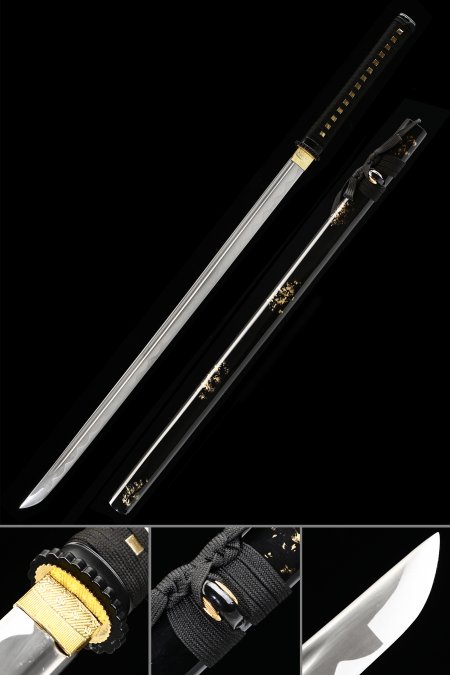
The defining difference is the differential hardening process. A standard ninjato is typically through-hardened, meaning the entire blade reaches a uniform hardness after quenching. A clay tempered ninjato, by contrast, has an insulating layer of clay applied more thickly along the spine before the blade enters the quench. This causes the edge to cool rapidly into hard martensite while the spine cools slowly into softer, more flexible pearlite. The practical outcome is a blade with a harder cutting edge and a spine that can absorb shock without cracking. The aesthetic outcome is the hamon — a visible temper line along the blade that is unique to each individual sword, since the clay application and quench dynamics are never perfectly identical. This combination of structural duality and one-of-a-kind patterning is what elevates a clay tempered ninjato above a uniformly hardened counterpart in collector value.