Green Sageo Wakizashi
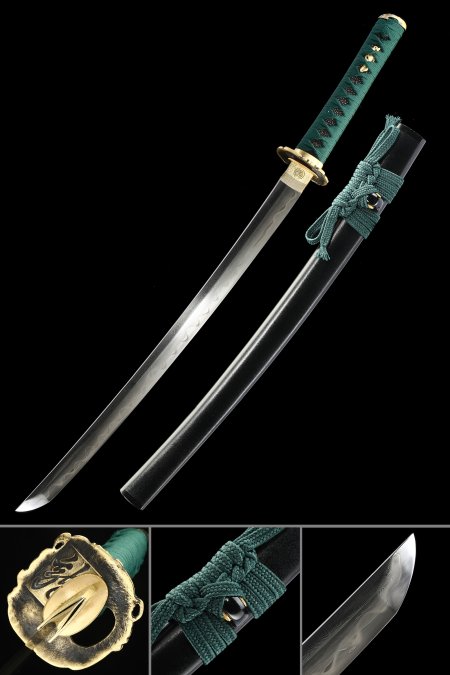
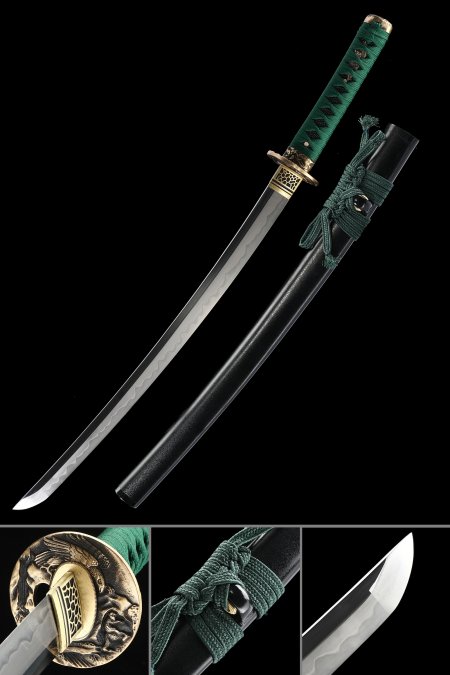
The Green Sageo Wakizashi collection brings together hand-forged short swords dressed in rich green cord wrapping and complementary lacquered saya, each piece assembled with ornamental tsuba and full-tang construction for lasting display integrity. From folded Melaleuca steel to high-carbon T10 and Manganese blades, every wakizashi is crafted to satisfy the discerning collector who values authentic materials and classical Japanese aesthetics. Enjoy free shipping on your order, plus a straightforward return policy for complete peace of mind.
Related Collections
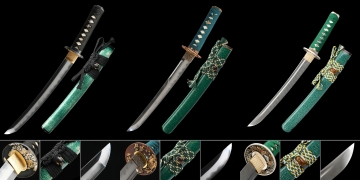
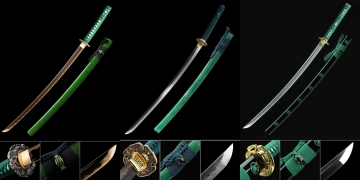
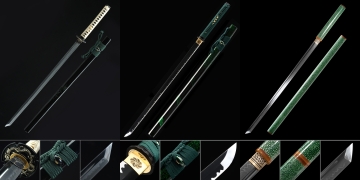
Frequently Asked Questions
What does the sageo cord actually do on a wakizashi?
The sageo is the braided cord threaded through the kurigata, the small knob on the saya's outer face. Historically, a samurai would use it to secure the saya to the obi when drawing, or tie off excess movement during travel. On a display-grade collectible wakizashi, the sageo serves no functional role but remains one of the most visually prominent fittings — its color and material directly influence the overall palette of the mounted piece. Green sageo in silk or synthetic braid pairs naturally with black lacquer saya and gold-tone fittings, producing a tonal balance that collectors and interior stylists alike recognize as distinctly classical Japanese.
How does T10 carbon steel differ from folded Melaleuca steel visually?
T10 high-carbon steel is a homogenous alloy that, when clay-tempered and polished, develops a clear hamon — the undulating temper line along the edge — visible against a relatively uniform blade surface. The visual focus is on that hamon contrast and on the polish quality itself. Folded Melaleuca steel, by comparison, has been manipulated through repeated forging folds that produce a flowing grain pattern across the entire flat of the blade. Under direct light, the layers catch at different angles and create a living, shifting texture. Neither is inherently superior for display; they appeal to different collector preferences. T10 suits collectors who prize a clean, classical Japanese aesthetic, while Melaleuca steel attracts those drawn to complex surface patterning.
Is full-tang construction important for a display wakizashi?
Yes — full-tang construction is one of the most reliable quality indicators on any collectible short sword. In full-tang assembly, the nakago (tang) extends the complete length of the tsuka rather than terminating partway through or being bonded to a separate rod. This matters for display pieces because it ensures the handle retains its alignment permanently, prevents the loosening that can affect partial-tang mounts over years on a stand, and signals that the maker applied production standards consistent with serious collectible rather than purely decorative grades. When examining a wakizashi for purchase, confirming full-tang construction alongside the steel type and fitting quality gives a clear picture of the piece's long-term display integrity.
How should I care for a lacquered saya on a displayed wakizashi?
Black lacquer saya require modest but consistent care to maintain their finish over years of display. Keep the saya away from direct sunlight, which can cause lacquer to fade or crack along the grain of the underlying wood. Relative humidity between 40 and 60 percent is ideal — environments that are very dry can cause the wood substrate to contract and stress the lacquer surface. Dust with a soft, dry cloth only; avoid cleaning products that contain solvents or alcohol. For the blade itself, a light application of camellia oil (choji oil) on the steel surface every few months prevents surface oxidation, particularly in coastal or humid climates. Store the wakizashi horizontally on a proper stand rather than standing blade-down, which can put uneven stress on the habaki fitting where blade meets saya.
Can a green sageo wakizashi be displayed as part of a daisho set?
Absolutely — the daisho pairing of a katana and wakizashi is one of the most recognized display formats in Japanese sword collecting. To assemble a coherent matched pair, look for a katana that shares the same ito color, tsuba motif family, and saya finish as the wakizashi. A green ito katana with a dragon or crane tsuba in gold-tone fittings alongside a matching wakizashi from this collection creates a visually unified daisho that reads as intentionally curated rather than incidentally paired. Mounted on a two-tier horizontal stand with the katana on the upper rail and wakizashi on the lower, the set becomes a strong focal display piece. Both pieces should share the same care routine to ensure the saya lacquer and cord color age consistently side by side.