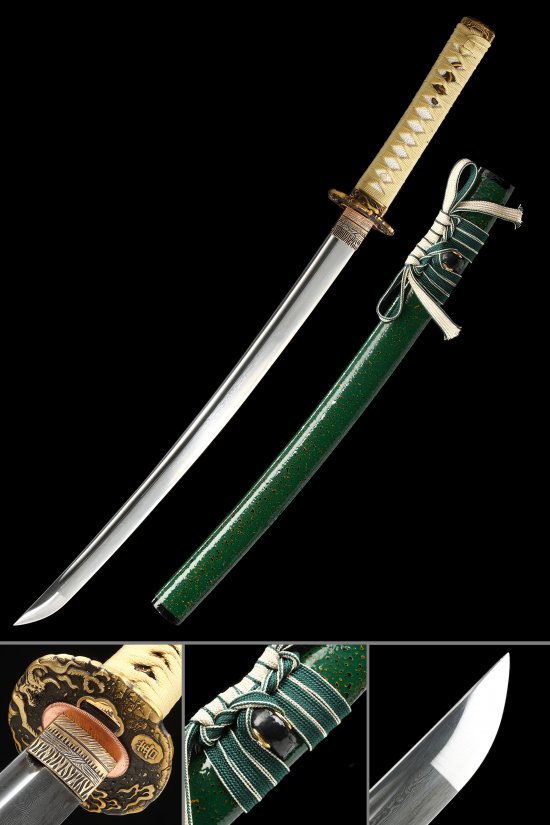
Green Wakizashi
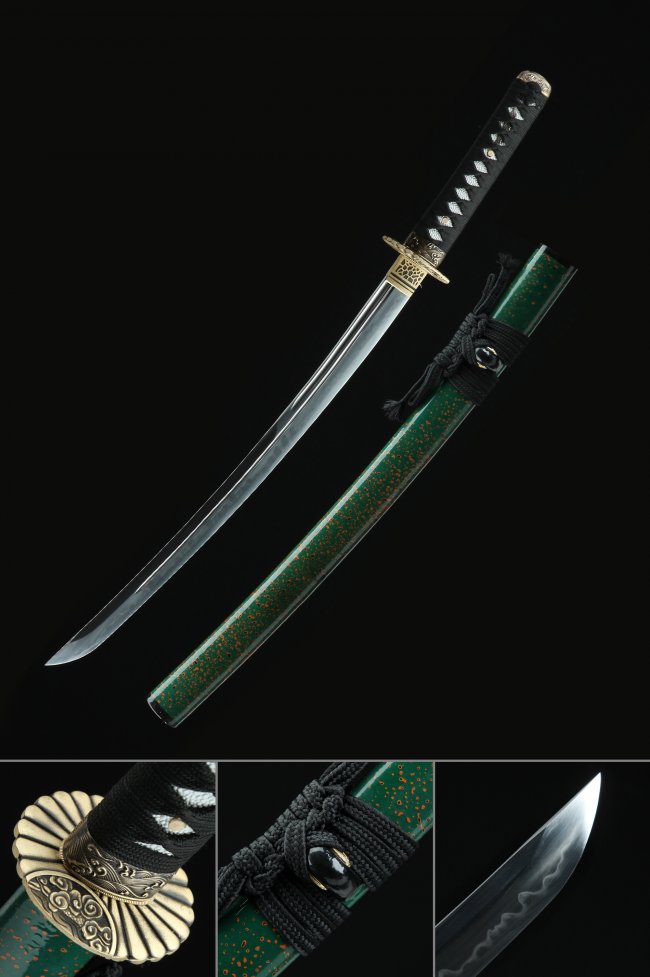
A green wakizashi has a quieter kind of presence that stands out once you see it up close. The shorter blade already gives the wakizashi a more practical, balanced feel than a full katana, and the green details add just enough character without making the design feel overdone. Our green wakizashi sword collection includes real steel blades, traditional-style fittings, and carefully wrapped handles that feel solid and comfortable in hand. Some designs lean toward classic samurai aesthetics, while others bring in subtle anime-inspired touches through the colors and mounting work. Whether you collect Japanese swords, prefer compact blades, or simply want something with a different visual tone, these green wakizashi pieces are easy to appreciate naturally.
Related Collections
Handmade Katana 110 items
Green Katana 30 items
Green Damascus Katana 3 items
Shikomizue Sword 6 items
Customer Reviews
I've bought a number of katanas and wakizashis through various sites and so far this has been my favorite. Really high quality look and feel and I definitely would recommend it to anyone in the market.
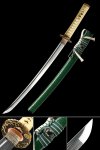 Damascus Steel Wakizashi in Green Lacquer Saya - Dragon Tsuba, Beige Ito, 28.74" Blade
Verified Purchase
Damascus Steel Wakizashi in Green Lacquer Saya - Dragon Tsuba, Beige Ito, 28.74" Blade
Verified Purchase
This is a gift so I did not do anything more than check color and and over all construction. Did not remove plastic wrap. Looks good. Gave 4 stars because you did not send me an e-mail saying it was shipped so it sat at the front door for days because I was gone.
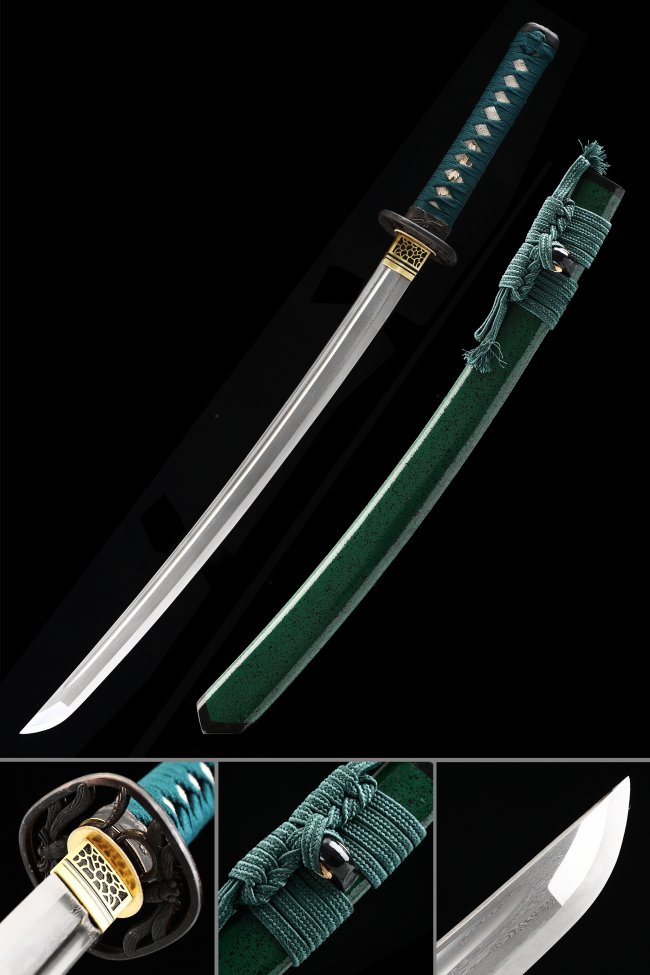
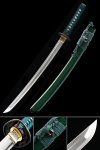 Damascus Steel Wakizashi with Green Lacquer Saya - Teal Cord Handle, Copper Tsuba, 20.47" Blade
Verified Purchase
Damascus Steel Wakizashi with Green Lacquer Saya - Teal Cord Handle, Copper Tsuba, 20.47" Blade
Verified Purchase
Well made and very sharp. Clearly a real weapon and not a fake, brittle display toy.
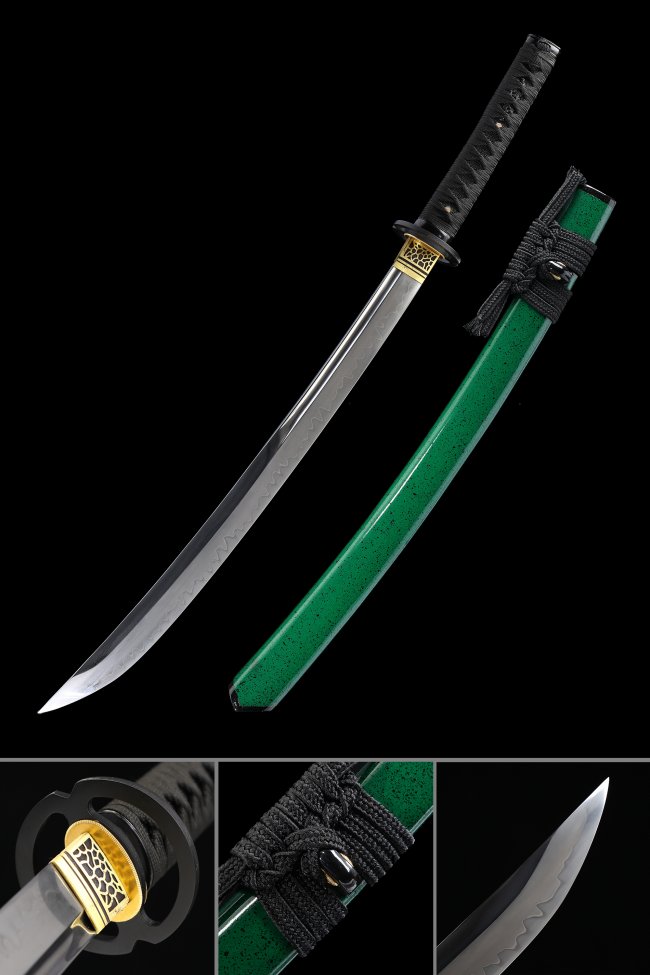
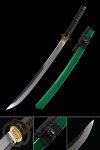 T10 Steel Wakizashi with Green Lacquer Saya - Hamon Blade, Black Cord Handle, Gold Tsuba
Verified Purchase
T10 Steel Wakizashi with Green Lacquer Saya - Hamon Blade, Black Cord Handle, Gold Tsuba
Verified Purchase
Beautiful wakizashi! Light weight, wide blade, gorgeous hamon. Interesting wide Saya. Very different from other wakizashi that I have. I love it!
T10 Steel Wakizashi with Green Lacquer Saya - Hamon Blade, Black Cord Handle, Gold Tsuba
Verified Purchase
First time buyer and I thought this wakizashi was worth every penny. Super sharp and stylish, balanced well and comfortable to hold with 2 hands or 1 hand. Will buy again from them!!
T10 Steel Wakizashi with Green Lacquer Saya - Hamon Blade, Black Cord Handle, Gold Tsuba
Verified Purchase
Everything is good and tight but the bottom of the handle is a little loose and the blade could be a little sharper, but overall I like it a lot and you get what you pay for so get something in mind for yourself if you want something better, but it's a different sword than the katana and shorter movements or easier to move. The handle is good and tight but there is a little gap on one side of the handle that looks rushed to be finished and also the bottom butt of the handle is loose. Over all I think it's great for what it's worth
Damascus Steel Wakizashi with Green Lacquer Saya - Teal Cord Handle, Copper Tsuba, 20.47" Blade
Verified Purchase
This is my second Purchase from True Katana and I am very happy. My Katana and Wakizashi are beautiful pieces of art. I will be purchasing a High Performance Katana in the near future.
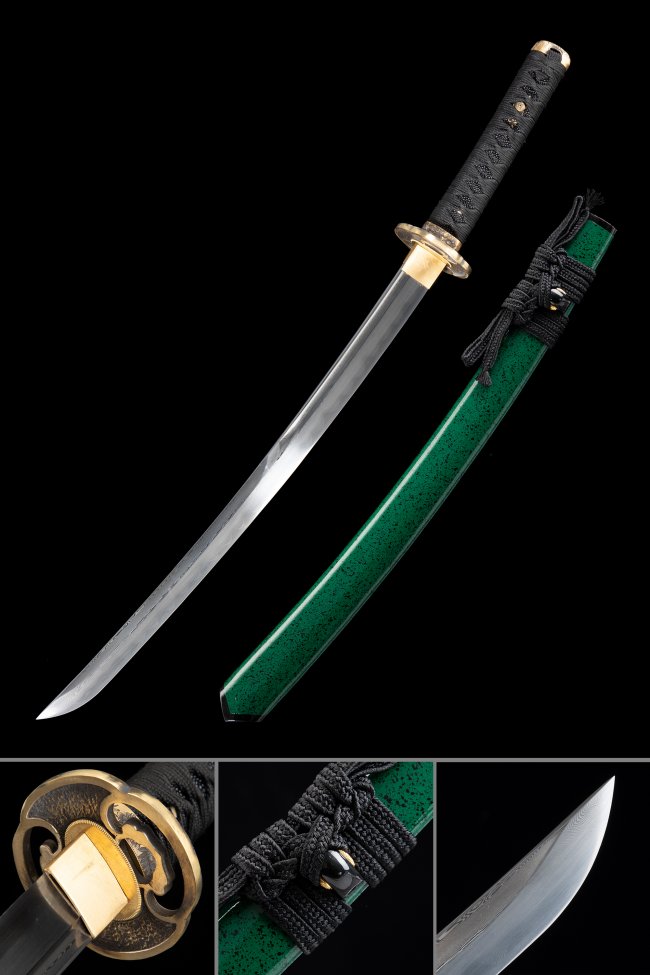
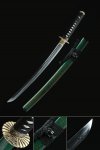 T10 Carbon Steel Wakizashi with Real Hamon in Green Lacquer Saya - Gold Chrysanthemum Tsuba
Verified Purchase
T10 Carbon Steel Wakizashi with Real Hamon in Green Lacquer Saya - Gold Chrysanthemum Tsuba
Verified Purchase
I have hand forged knives and swords from American and Canadian craftsman of the highest quality. These swords being sold on this site are as advertised. These are master smiths forging these I'm sure of it. Stunning.
T10 Steel Wakizashi with Green Lacquer Saya - Hamon Blade, Black Cord Handle, Gold Tsuba
Verified Purchase
Excellent quality and craftsmanship. All I expected and more. A very nice and sharp wakizashi; now sitting in my office, at the ready for combat.
T10 Carbon Steel Wakizashi with Real Hamon in Green Lacquer Saya - Gold Chrysanthemum Tsuba
Verified Purchase
This was a gift and the receiver was thrilled, loved the look, and quality he is already thinking about how he is going to display it. As the buyer I could not be more impressed with the price, the amazing customer service response that I was given with a address mix-up on my part, They were on it right away. The quick shipment, the item was shipped the day after I ordered it and the item arrived 3 days earlier than projected. They also provided shipping and tacking number immediately upon shipment. I would not hesitate to order again from this company. Thanks!
T10 Carbon Steel Wakizashi with Real Hamon in Green Lacquer Saya - Gold Chrysanthemum Tsuba
Verified Purchase
Great sword, delivery was very slow it took one month.
Overall they responded to my email by the next day so I would buy from them again .
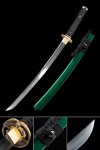 T10 Carbon Steel Wakizashi with Green Lacquer Saya - Copper Tsuba, Black Ito, Hamon Blade
Verified Purchase
T10 Carbon Steel Wakizashi with Green Lacquer Saya - Copper Tsuba, Black Ito, Hamon Blade
Verified Purchase
Honestly not sure what I expected but I am very pleased with the product received.
The service was great, the price was right...; the problem, what do I get next.
Many thanks . . .
Damascus Steel Wakizashi with Green Lacquer Saya - Teal Cord Handle, Copper Tsuba, 20.47" Blade
Verified Purchase
Another great sword, keep up the great workmanship.
T10 Steel Wakizashi with Green Lacquer Saya - Hamon Blade, Black Cord Handle, Gold Tsuba
Verified Purchase
I have bought a few swords from you, and they all have proven to be really nice swords, good quality.
Great service, quick shipping, good packaging.
Keep up good work!
T10 Carbon Steel Wakizashi with Green Lacquer Saya - Copper Tsuba, Black Ito, Hamon Blade
Verified Purchase