
Green Ninjato
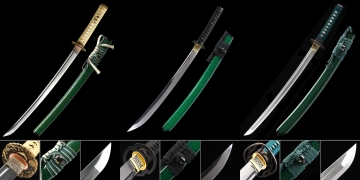
Explore our Green Ninjato collection — straight-bladed collectible swords finished in distinctive green tones, from deep emerald cord wraps to vivid lacquered scabbards. Each piece is hand-assembled with traditional fittings and carefully forged carbon steel, offering collectors a bold visual accent grounded in authentic Japanese sword-making heritage. Every order ships with free shipping and hassle-free returns.
Related Collections
Frequently Asked Questions
What steel types are used in your Green Ninjato swords?
Our Green Ninjato collection primarily features two carbon steels: 1045 and T10. The 1045 grade contains roughly 0.45 percent carbon, which produces a tough, resilient blade with a clean dark finish that pairs well with green fittings. T10 steel adds a small percentage of tungsten to a high-carbon base, increasing wear resistance and — more importantly for collectors — enabling differential clay hardening. That process creates a visible hamon temper line along the blade, meaning each T10 ninjato carries a unique wave pattern that no two pieces share. Both steels are well suited to display pieces because they hold an attractive surface finish over time when properly oiled.
How does a ninjato differ from a katana in shape and design?
The most immediate difference is the blade geometry. A katana features a curved, single-edged blade typically between 60 and 73 centimeters, designed around a sweeping draw-cut motion. A ninjato, by contrast, carries a straight or nearly straight blade that is usually shorter — often around 55 to 60 centimeters — with a square tsuba rather than the katana’s round or ornate guard. The straight profile gives the ninjato its distinctive angular silhouette on a display wall. Handle construction is broadly similar, using ray skin and cord wrapping over a full-tang core, but the overall proportions feel more compact and utilitarian, reflecting the sword’s association with covert operatives in Japanese lore.
How should I maintain a Green Ninjato on display?
Carbon steel develops surface oxidation quickly if left unprotected, so a light coat of choji oil — or any refined mineral oil — should be applied to the blade every four to six weeks. Use a soft, lint-free cloth and wipe in one direction from spine to edge to avoid leaving streaks. If your display area is humid, consider placing silica gel packets inside the saya and nearby on the shelf. The green cord wrap can be kept dust-free with a dry microfiber cloth; avoid wet cleaning, which may loosen the ito over time. Alloy tsuba and fuchi-kashira fittings occasionally benefit from a gentle wipe with a brass-safe polish to maintain their luster.
What makes the Zatoichi-style piece different from the other ninjato?
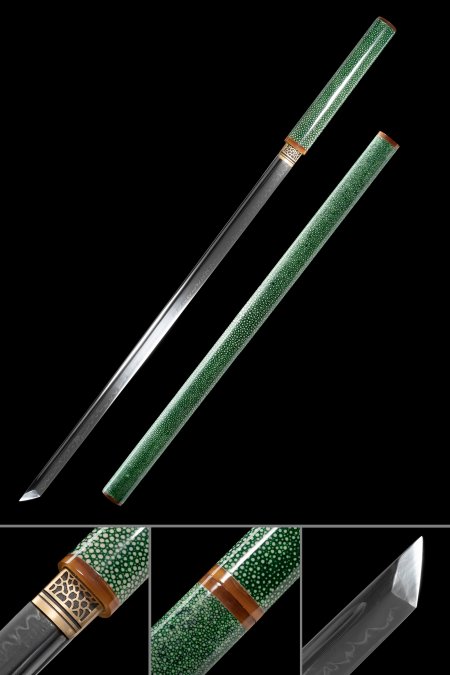
The Zatoichi-style sword, also called a shikomizue, disguises its blade inside a cane-like scabbard. It has no tsuba or visible guard, and the handle is a smooth, continuous cylinder that blends seamlessly with the saya when sheathed. In our green collection this piece features a lacquered green scabbard and a T10 blade with a genuine hamon produced through differential hardening. The minimalist design appeals to collectors who appreciate understated aesthetics. Displayed alongside a more traditionally mounted ninjato with its square guard and cord-wrapped handle, the Zatoichi creates a compelling visual contrast that highlights two very different Japanese sword-concealment traditions.
Is a Green Ninjato a good gift for a sword collector?
It makes an excellent gift precisely because of its specificity. Most collectors already own a standard katana or two, so a ninjato in an unusual color scheme fills a gap rather than duplicating what they have. The straight blade and square guard give it a distinct wall profile, and the green accents — whether in cord, lacquer, or fittings — add a visual theme that stands apart from traditional black or red pieces. Each sword ships with a matching saya, a cloth storage bag, and mounting hardware, so the recipient can display it immediately without sourcing additional accessories.



