Melaleuca Steel Tanto
Melaleuca steel tantos bring centuries of Japanese blade-folding tradition into a compact, display-ready form. Each piece features a hand-forged laminated blade with visible folding layers, paired with carefully matched fittings — from lacquered saya to wrapped ito handles — that reflect authentic kogusoku aesthetics. Free standard shipping on all orders, with hassle-free returns for your peace of mind.
Related Collections
Frequently Asked Questions
What makes melaleuca steel different from regular high-carbon steel?
Melaleuca steel is produced by repeatedly folding and forge-welding alternating layers of high-carbon steel and softer iron. This process can generate dozens to hundreds of individual layers depending on how many folds are performed. The folding creates a surface hada — a flowing, wood-grain-like pattern — that is unique to every single blade. Beyond aesthetics, the lamination produces a blade with a harder edge zone supported by a tougher, more resilient core, a structural characteristic that traditional Japanese swordsmiths developed over centuries. Regular monosteel blades, while structurally consistent, lack this visible layer pattern and the differential hardness profile it produces.
How do I read the grain pattern on a folded tanto blade?
The visible surface pattern on a melaleuca blade is called hada in Japanese, and it develops naturally from the folding and forge-welding process. The most common pattern types are masame (straight grain running parallel to the edge), itame (a tight interlocking burl pattern), and mokume (a larger, rounder wood-grain figure). On a tanto-length blade, the compact geometry makes these patterns especially easy to examine — the hada is typically most vivid near the shinogi (ridgeline) and transitions subtly toward the hamon line along the edge. Viewing the blade under a single directed light source, held at a low angle, brings out the full depth of the layering.
What is the best way to store a display tanto long-term?
For long-term display storage, the blade should rest in its saya (scabbard) to protect the surface from airborne moisture and dust. Apply a thin, even coat of blade oil — traditional choji oil or a modern mineral-based equivalent — before returning the tanto to its saya. Avoid storing the piece in a sealed plastic case without desiccant, as trapped humidity accelerates oxidation. A wooden display stand in a stable, low-humidity environment away from direct sunlight is ideal. Inspect the blade surface every three to four months; if light surface discoloration appears, a light re-oiling with a soft cloth is usually sufficient to restore the finish.
What does shirasaya mean, and why do some collectors prefer it?
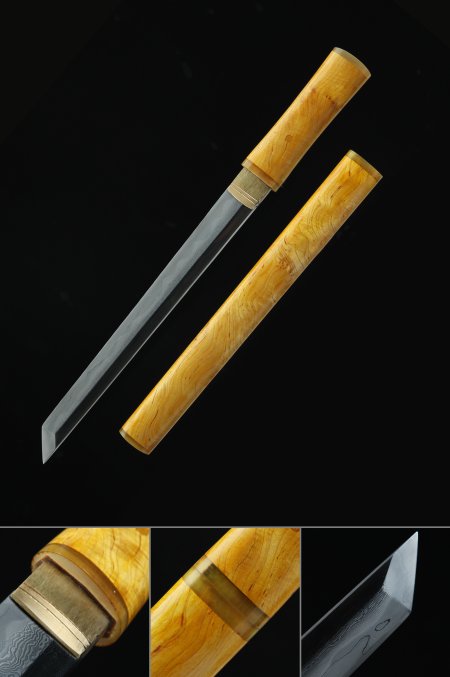
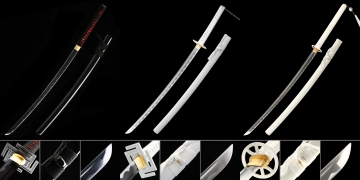
Shirasaya translates roughly as 'white scabbard' and refers to a plain, unadorned wooden housing — typically hon-oki (magnolia wood) — designed purely for blade storage and preservation rather than presentation with full koshirae fittings. In Japanese tradition, prized blades were kept in shirasaya when not being formally displayed, as the plain wood allows the steel to breathe while protecting it from contact. For modern collectors, a shirasaya tanto is visually striking in its simplicity: the absence of tsuba, ito, and lacquer directs all attention to the blade itself. It also signals familiarity with authentic Japanese storage custom, which is a mark of collecting knowledge.
Can a melaleuca tanto be displayed as part of a daisho set?
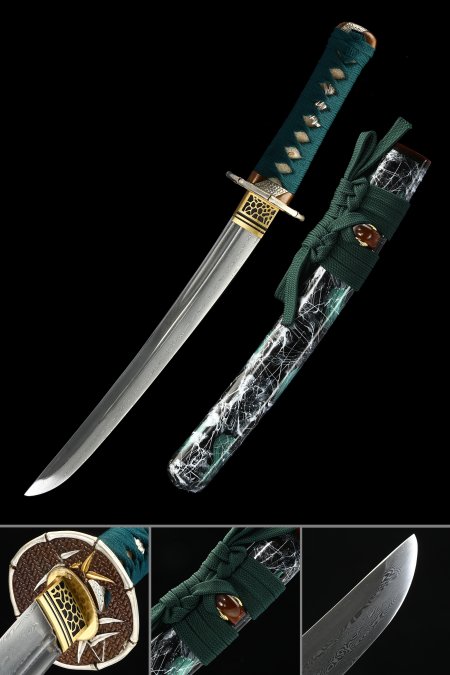
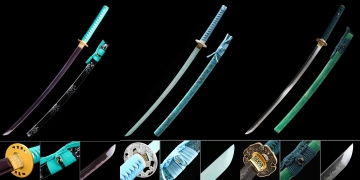
Traditionally, a daisho is a matched pair of a katana (long sword) and wakizashi (short sword), but in collector display practice it is common to arrange a tanto alongside a katana or wakizashi on a three-tier stand as a kogusoku grouping. When assembling a display trio, matching the handle cord color, tsuba finish, and saya style across pieces creates visual cohesion. A melaleuca tanto with a teal ito handle, for example, pairs well with a folded-steel katana featuring complementary cord wrapping and a similarly finished tsuba. The layered blade surface on both pieces will share the same family of hada character, giving the display a unified, purposefully curated appearance.