Blue 1090 Carbon Steel Katana
Blue 1090 carbon steel katanas occupy a distinctive niche in serious sword collecting - defined by a controlled bluing process that saturates the blade in deep, oxidized color while the high-carbon steel beneath retains its structural integrity. Each piece is hand-forged from 1090 high-carbon steel, fitted with full-tang construction, and assembled with matched hardwood saya and ornate tsuba for a cohesive display presence. Free standard shipping on all orders, with hassle-free returns to keep your collecting experience confident.
Related Collections

Frequently Asked Questions
What gives a blued katana blade its deep blue color?
The blue color on these katanas comes from a controlled oxidation process applied directly to the high-carbon steel surface. Unlike paint or powder coating, bluing creates an iron oxide layer that bonds chemically with the steel itself. When done correctly on 1090 carbon steel, the result is a deep, cool-toned finish that shifts between blue-black and charcoal depending on ambient lighting. Because the process is applied to bare steel rather than over a polished or lacquered surface, the underlying grain structure of the blade remains visible through the finish - giving it a visual complexity that a standard silver polish cannot achieve.
How does 1090 carbon steel compare to 1045 or 1060 for collectible katanas?
Carbon content is the key differentiator. 1045 steel sits at roughly 0.45% carbon - serviceable for decorative pieces but limited in its ability to hold a refined heat treatment. 1060 steel, at 0.60% carbon, is a middle ground popular for its balance of toughness and hardening potential. 1090 steel, with approximately 0.90% carbon, allows for more pronounced differential hardening, which produces a more defined hamon (temper line) along the blade. For collectors focused on authentic construction details rather than purely decorative finish, 1090 is a meaningful step up in terms of visible craftsmanship output - the hamon on a properly heat-treated 1090 blade is noticeably more articulate than on lower-carbon counterparts.
How should I maintain a blued blade to preserve the finish?
A blued finish is more maintenance-sensitive than a standard polished steel blade. The oxide layer that creates the blue color is thinner than lacquer and can be compromised by humidity, fingerprints, or prolonged exposure to moisture. To preserve it: apply a thin coat of choji oil or food-grade mineral oil every two to three months using a soft cloth. Always handle the blade with clean cotton gloves to prevent skin oils from transferring to the surface. Store the piece horizontally in its saya in a climate-controlled space, ideally below 60% relative humidity. Avoid extended display in direct sunlight, as UV exposure can shift the blue tones toward a duller brownish hue over time.
Is a full-tang construction important for display katanas?
Yes - full-tang construction is a meaningful quality indicator even for pieces intended purely for display. A full-tang blade means the steel extends as a single unbroken piece from the tip all the way through the length of the handle, secured within the tsuka rather than glued or pinned at a short stub. For a collector, this matters for two reasons: structural integrity during handling and inspection, and authenticity of construction method. Katanas assembled with a full tang more closely reflect traditional forging standards, and the added weight distribution through the handle gives the piece a balanced, substantial feel that partial-tang or rat-tail assemblies cannot replicate.
Do the tsuba and saya designs vary across this collection?
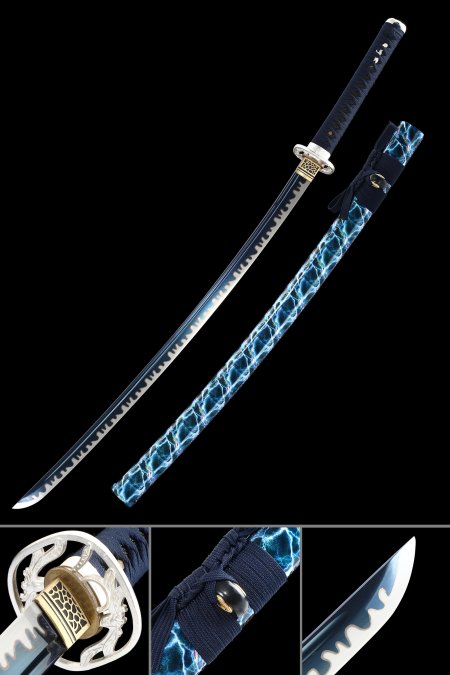
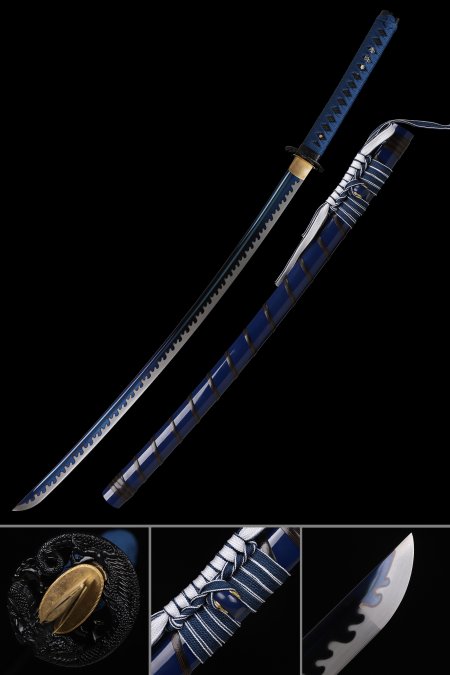
Yes - the fittings across this collection are intentionally matched to complement the blued blade aesthetic rather than serve as generic hardware. Dragon-motif tsuba in dark iron tones reinforce the dramatic quality of the blue finish, while ornate silver-gold scroll tsuba introduce contrast and visual complexity. Saya (scabbards) follow the same design logic: deep blue hardwood saya echo the blade's color family for a monochromatic, refined look, while lightning-pattern saya offer a more graphic, high-contrast alternative. Each assembled piece is designed to read as a coordinated collectible object rather than a blade fitted with whatever hardware was available.