What makes dark red katana fittings historically significant?
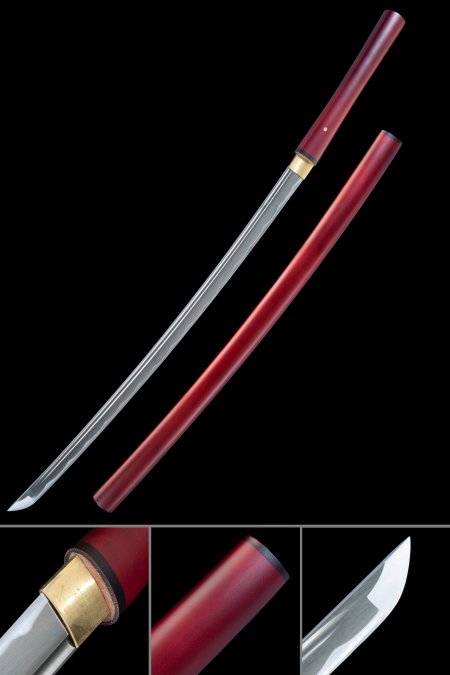
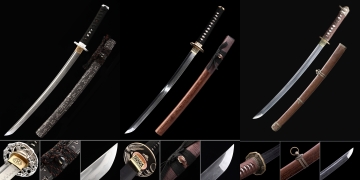
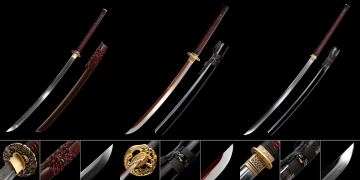
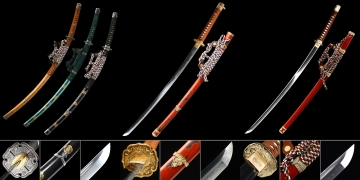
Deep red lacquerwork on katana saya and tsuka has roots in Japanese court and ceremonial culture, where color carried explicit symbolic meaning. Red — particularly the dark, muted crimson seen on lacquered hardwood mounts — was associated with rank, protection, and ritual significance during the Heian through Edo periods. Collectors today appreciate these pieces not just for visual impact, but as a continuation of a deliberate aesthetic tradition. Authentic lacquered hardwood saya in this color typically involve multiple layered coats over a shaped wooden core, producing a surface depth that painted or dipped finishes cannot replicate. When evaluating a dark red saya, look for evenness of finish, surface luster, and how well the kojiri (end cap) and koiguchi (mouth fitting) are fitted to the lacquered body — these details reveal construction quality at a glance.
How does folded steel differ from standard 1045 or 1090 carbon steel in a display katana?
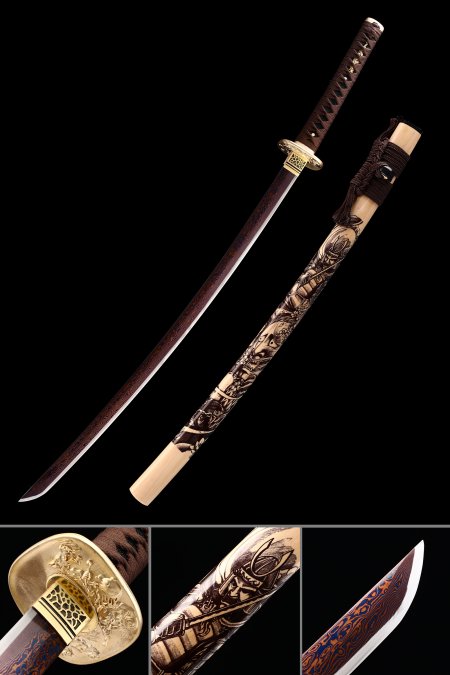
Standard 1045 and 1090 carbon steel blades are forged from a single billet, which produces a clean, consistent grain structure suited for display and handling. Folded melaleuca steel — sometimes called Damascus-pattern folded steel — is created by repeatedly folding and forge-welding multiple layers of steel together. This process creates the flowing grain patterns visible on the polished surface, known as hada, that experienced collectors specifically seek. The visual complexity of a folded steel blade is fundamentally different from a mono-steel blade: light catches the layered surface differently at every angle. For display-focused collectors, folded steel pieces command attention precisely because the blade itself becomes a visual artifact, not merely a shaped piece of metal. Note that fold count and layer count are not direct indicators of performance — they are indicators of the smith's labor investment and the resulting surface aesthetics.
Does a shirasaya-style dark red katana need a tsuba to be display-ready?
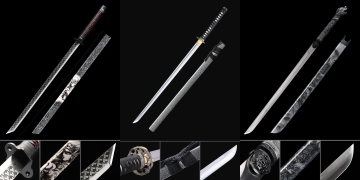
No — and in fact, the absence of a tsuba is the defining characteristic of a shirasaya mount. Shirasaya translates literally to 'white scabbard,' referring to the plain wooden mount traditionally used to store a blade when not in formal use. In the context of dark red matte hardwood versions, the shirasaya aesthetic is adapted to combine minimalist construction with a richer tonal choice. The result is a highly refined display piece: no metalwork to distract the eye, just the continuous line of handle, blade collar, and saya in harmonious form. Collectors who favor this configuration often display the blade partially drawn — blade and saya together — to emphasize the elegant transition between the two surfaces. It's a presentation style well suited to modern interior settings where visual restraint is valued alongside craftsmanship.
How should I maintain and store a carbon steel katana with a lacquered saya?
Carbon steel blades — whether 1045, 1090, or folded steel — require periodic light oiling to prevent surface oxidation. A thin, even application of choji oil (clove-infused mineral oil) or a modern equivalent, applied with a soft cloth and wiped to a near-dry finish, is the standard collector's practice. Avoid storing the blade inside the saya for extended periods without occasional inspection, as trapped moisture between blade and saya can cause localized rust. For lacquered hardwood saya, keep the piece away from direct sunlight and extreme humidity fluctuations — both cause lacquer to crack or lift over time. Store horizontally on a katana stand in a climate-stable environment, ideally with blade edge facing upward in the traditional katana orientation. Avoid contact with fingerprints on the blade surface; the oils in skin accelerate oxidation on bare carbon steel.
Is a dark red handle katana a good choice as a collector's gift?
A dark red handle katana makes a particularly memorable gift for collectors who appreciate Japanese aesthetics and handcraft, precisely because the color choice demonstrates deliberate curatorial intent — it's not the default black or brown, and that specificity signals thoughtful selection. For first-time recipients, a 1045 carbon steel piece with a lacquered hardwood saya and coordinated tsuka offers strong visual presence at an accessible level of material investment. For established collectors, a folded steel blade with gold tsuba and dark red saya provides the kind of display centerpiece that earns a permanent place on a dedicated sword stand. Consider pairing with a basic maintenance kit — uchiko ball, oil, and soft cloth — which both enhances the gift's practicality and communicates that the piece is intended to be cared for and appreciated as a genuine collectible.