What makes purple and white saya katana stand out as collectibles?
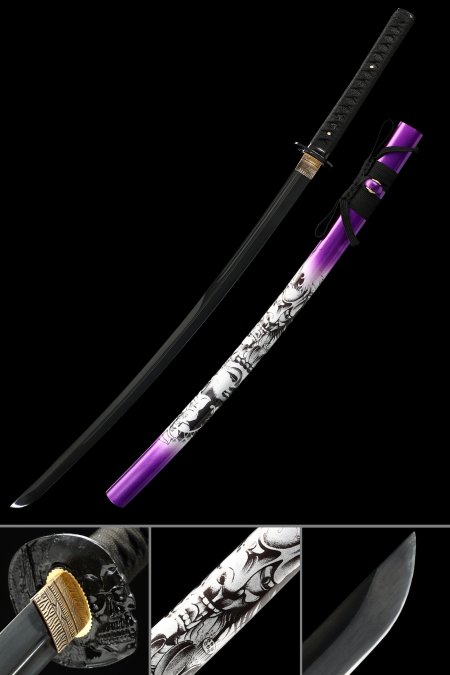
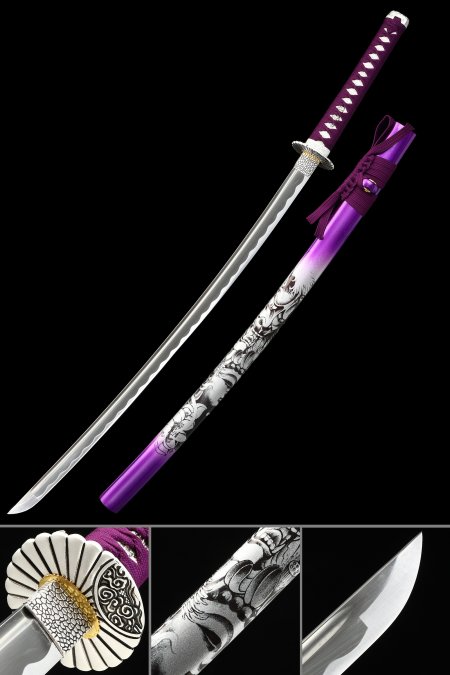
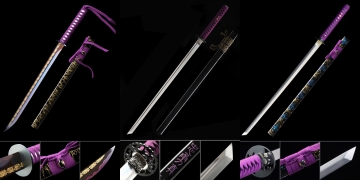
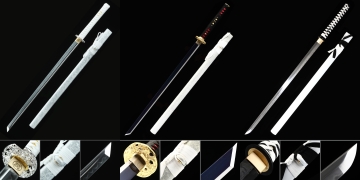
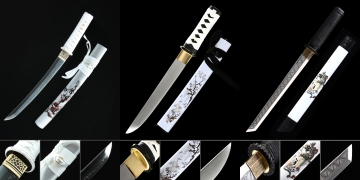
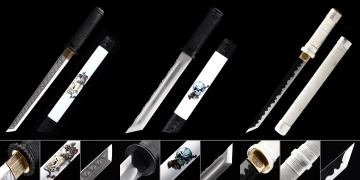
The visual contrast between deep violet or lilac lacquerwork and white accent detailing is what immediately separates these pieces from standard black or natural wood saya katana. Beyond color, the distinguishing factor is the surface composition - illustrated motifs such as dragons, chrysanthemums, and skull panels are applied with layered finishing techniques that create depth rather than a flat printed appearance. Combined with decorative tsuba in matching or complementary styles, these katana function as complete aesthetic objects rather than individual components. For collectors focused on display impact, a purple-and-white saya piece draws the eye in a way that monochrome scabbards rarely achieve.
How does 1065 carbon steel differ from Damascus steel in these katana?
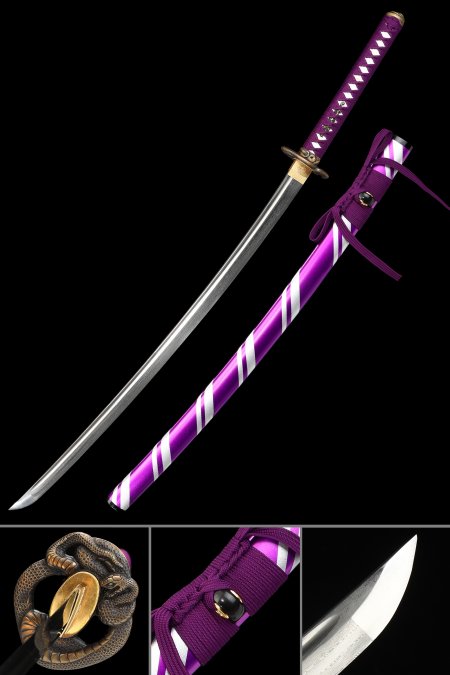
1065 high-carbon steel is a single-composition alloy valued for its consistency and clean surface, making it an excellent candidate for traditional polish work and specialized treatments like black blade finishing. It has a straightforward grain structure and responds predictably to heat treatment, which is why it remains a reliable choice for display-quality collectibles. Damascus steel, by contrast, is produced by forge-welding multiple layers of steel together and manipulating the billet to produce the characteristic flowing surface pattern visible after etching. That patterning makes the blade itself a decorative element - no two Damascus blades carry identical surface designs. The trade-off is that Damascus requires slightly more attentive care, as the layered structure can be more sensitive to moisture exposure over time.
How should I store a lacquered saya katana to protect the finish?
Purple lacquer finishes are more photosensitive than natural wood saya - extended exposure to direct sunlight will gradually shift the pigment toward a duller, brownish tone. Store display pieces away from south- or west-facing windows, or use UV-filtering display cases if the mounting location receives regular light. Humidity is the second factor: lacquer applied over a wood saya core can develop hairline checks if the environment drops below approximately 40% relative humidity for extended periods. A small humidity pack inside an enclosed cabinet provides inexpensive protection. For the blade, apply a thin coat of camellia or mineral oil every two to three months using a soft cloth, removing any previous residue before reapplying.
Is a full-tang construction important for a display katana?
Full-tang construction means the steel of the blade extends continuously through the handle rather than terminating at a short stub or rat-tail connector. For a display collectible, this matters primarily for structural integrity during handling and for long-term durability. A full-tang katana withstands the repeated handling involved in repositioning, cleaning, and showing a piece without placing stress on a joint between blade and handle. It also signals manufacturing quality - full-tang construction requires more material and more precise fitting of the handle components around the complete steel profile, which is reflected in the overall fit and finish of the mounted piece.
Can these katana be displayed alongside other Japanese sword styles?
Purple and white saya katana pair naturally with several adjacent collecting categories. The high-contrast color scheme complements black-blade or Damascus katana well, creating a display arrangement where each piece reads distinctly rather than blending together. Thematically, pieces featuring dragon saya motifs connect logically to dedicated dragon-themed katana collections, allowing a collector to build a cohesive narrative across multiple display pieces. For wall mounting, alternating purple-saya and dark-saya pieces at measured intervals produces a visually balanced arrangement. Collectors who favor matched sets may also consider pairing a katana with a tanto or wakizashi in coordinating finish as a daisho-inspired display composition.