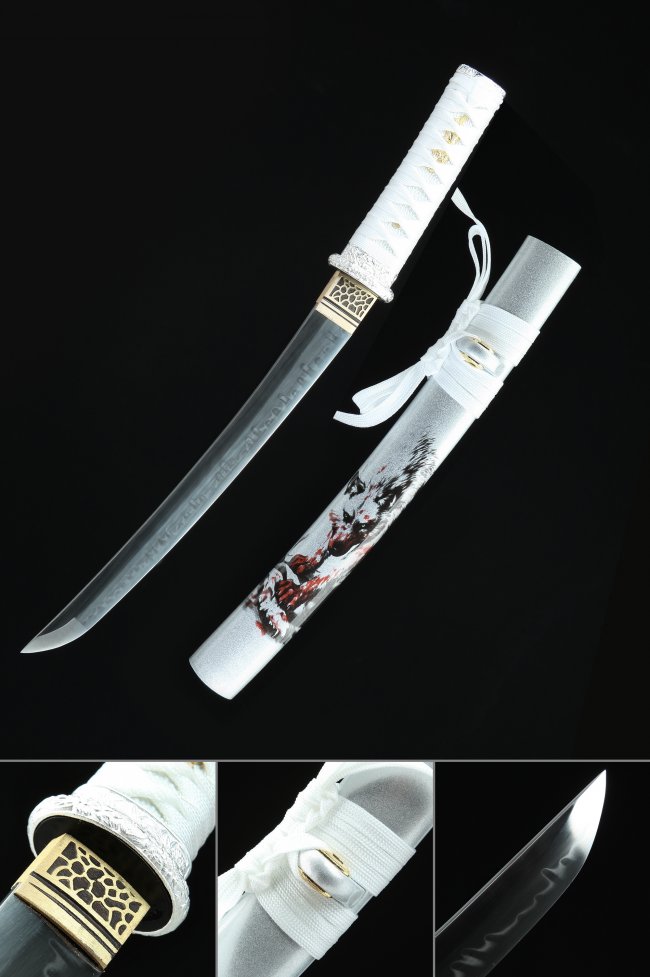
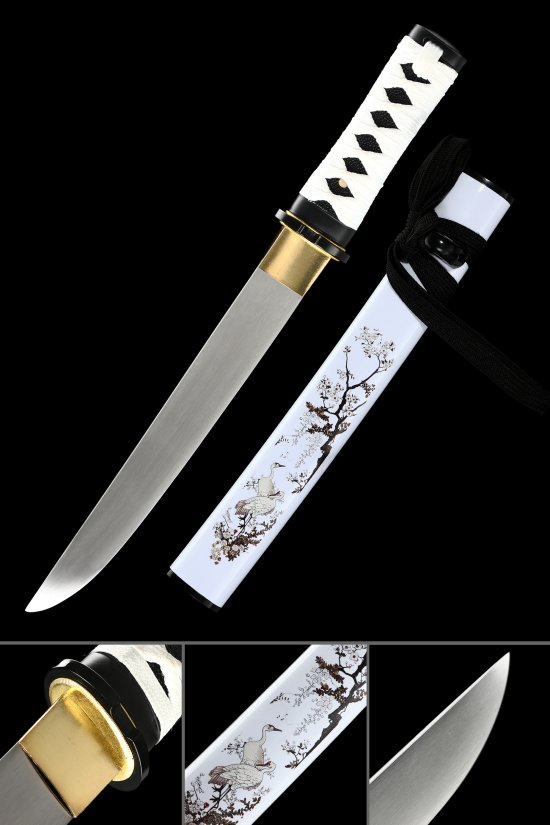
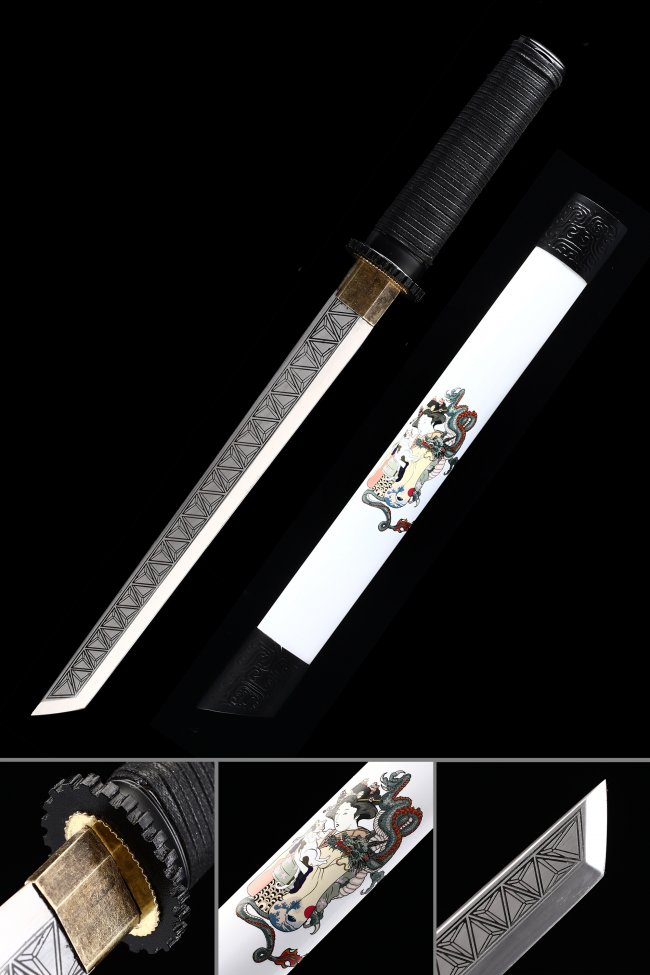
White Tanto
White on a tanto is a demanding finish — at the compact scale, any gap in the wrap, any misaligned fitting, any inconsistency in the saya lacquer is immediately visible. That's why a white tanto that's put together properly is worth noticing. Every white tanto in this collection is forged and finished with the kind of attention the color demands: the wrap is tight, the fittings seat correctly, and the lacquer holds. Clean lines, real construction, nothing hiding underneath. Whether you're drawn to the aesthetic, building a display around a minimal palette, or want a tanto that earns its finish — take a look at what we have below.
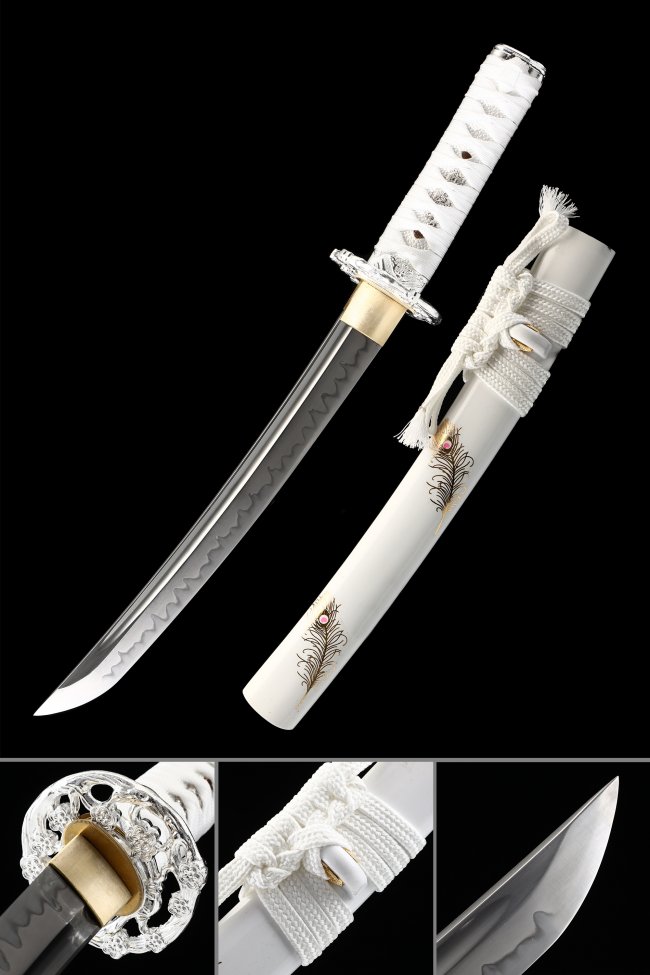
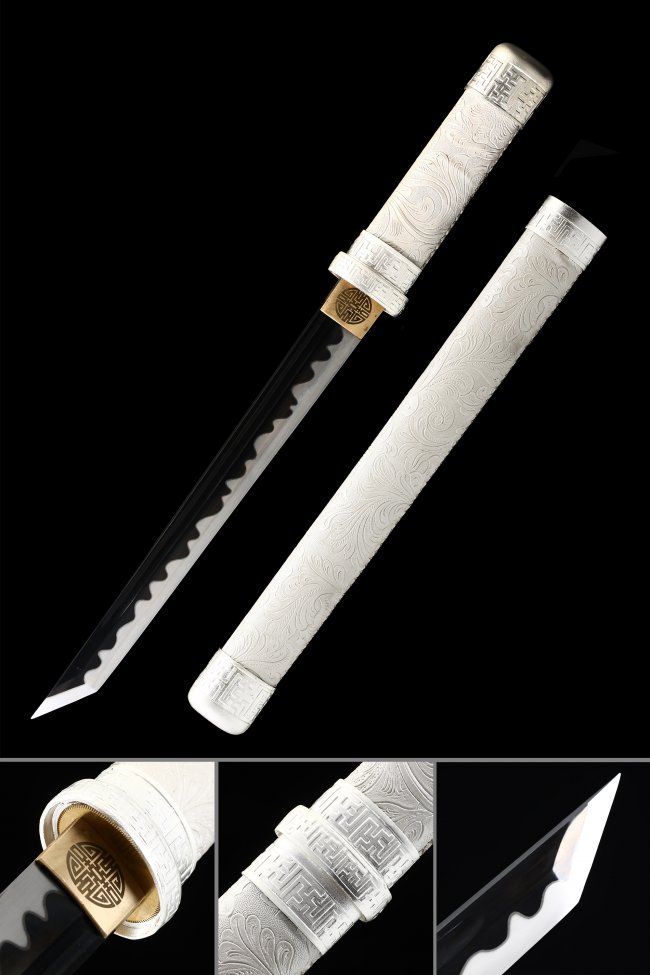
T10 Carbon Steel Tanto With Real Hamon - White Piano Lacquer Saya With Peacock Feather Design And Silver Dragon Tsuba
2 Reviews
ON SALE 15% OFF
$239.00
$279.00
Related Collections
Customer Reviews
Was able to find a white scabbard wolf themed Tanto sword. Very pleased with my purchase.
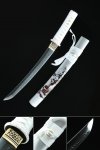 T10 Carbon Steel Tanto Sword with Real Hamon in White Saya - Hand-Painted Wolf Scabbard Collectible
Verified Purchase
T10 Carbon Steel Tanto Sword with Real Hamon in White Saya - Hand-Painted Wolf Scabbard Collectible
Verified Purchase
Exactly how it looks in photos. Fast shipping. Great overall value. Got it for my wife and she is very happy.
T10 Carbon Steel Tanto Sword with Real Hamon in White Saya - Hand-Painted Wolf Scabbard Collectible
Verified Purchase
Tanto looked great, no visible flaws. Cuts regular paper well, has trouble cutting thin magazine pages.
T10 Carbon Steel Tanto Sword with Real Hamon in White Saya - Hand-Painted Wolf Scabbard Collectible
Verified Purchase
I was mistaken with this order. I thought I had ordered the Kodachi and I plan on dual wielding both this Taranto and the Kodachi as a shinigami wearing an oni mask. Thank you very much it is great it holds the essence of a GREAT soul in it. 𖤐
T10 Carbon Steel Tanto Sword with Real Hamon in White Saya - Hand-Painted Wolf Scabbard Collectible
Verified Purchase
Amazing tanto!!! The look is great, the balance is incredible! The edge is perfect!!! 10 out of 10!!! This is now my go company for hand forged weapons!
T10 Carbon Steel Tanto Sword with Real Hamon in White Saya - Hand-Painted Wolf Scabbard Collectible
Verified Purchase
I absolutely love my new tanto!!! It's beautiful and well made and I can't stop staring at the real hamon!!! Definitely buying another, not the same one but another tanto with the real hamon!!!! It's wonderfully sharp, though it's only for display but it is razor sharp and battle ready!!!!
T10 Carbon Steel Tanto Sword with Real Hamon in White Saya - Hand-Painted Wolf Scabbard Collectible
Verified Purchase
Just got this sward looks great on time beautifully made will order more, thanks
T10 Carbon Steel Tanto Sword with Real Hamon in White Saya - Hand-Painted Wolf Scabbard Collectible
Verified Purchase
I can't believe how beautiful this sword is. Excellent work. I'm very happy I chose this one. But will be buying the others I was deciding on after the holidays. Excellent swords and service.
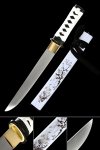 Manganese Steel Japanese Tanto with Crane and Plum Blossom Hand-Painted White Saya in Full Tang Design
Verified Purchase
Manganese Steel Japanese Tanto with Crane and Plum Blossom Hand-Painted White Saya in Full Tang Design
Verified Purchase
The sword has a silver scabbard and hand guard. That's not what I ordered, I wanted the white one. Also the last 3 inches of the blade at the hilt was dull. Beyond that the blade is fairly sharp. For what I paid I guess this is what I get. Retuning it won't work as I'm disabled. Just know that I'll be going elsewhere to make future purchases. Thanks.
T10 Carbon Steel Tanto Sword with Real Hamon in White Saya - Hand-Painted Wolf Scabbard Collectible
Verified Purchase
Love the design, looks great. Edge was very dull though and I had to sharpen it myself.
T10 Carbon Steel Tanto Sword with Real Hamon in White Saya - Hand-Painted Wolf Scabbard Collectible
Verified Purchase
As long as I'm not a real samurai, I can only to appreciate the craft. Probably in a skillful hand will become a deadly weapon. Thank you!
T10 Carbon Steel Tanto Sword with Real Hamon in White Saya - Hand-Painted Wolf Scabbard Collectible
Verified Purchase
My order came out beautifully. Very pleased with it. My only question is whether the swords are really battle-ready or not because the website says they are but the pamplet that comes with the swords says not to use them to cut, slice and that they are for display over. I bought these as backup weapons to my guns so if they aren't battle ready that would defeat the point. But they are beautiful indeed!!!
T10 Carbon Steel Tanto Sword with Real Hamon in White Saya - Hand-Painted Wolf Scabbard Collectible
Verified Purchase
Very pleased with the Tanto; the Fitment and workmanship is excellent!
There are only minor 2 niggles...
There several small black spots on the silver tsuba (possibly paint , as
I could not feel an edge to the dots, which I would have felt if the plating was failing).
the second niggle...it is kinda sharp, but should have been sharper...
Minor, in my opinion...The Hamon is beautiful, The blade is well polished, and
the overall feel and balance is very good...
Will purchase from TrueKatana again.
Tom
T10 Carbon Steel Tanto Sword with Real Hamon in White Saya - Hand-Painted Wolf Scabbard Collectible
Verified Purchase
Delivered perfectly on time with a beautiful perfect blade. All put together with care and will definitely keep buying
T10 Carbon Steel Tanto Sword with Real Hamon in White Saya - Hand-Painted Wolf Scabbard Collectible
Verified Purchase
Excellent service and delivery. Sword in perfect condition. I’m a repeat customer.
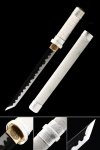 Manganese Steel Tanto with Black Blade, White Engraved Saya and Cord Handle
Verified Purchase
Manganese Steel Tanto with Black Blade, White Engraved Saya and Cord Handle
Verified Purchase
Loading more reviews...