What makes T10 steel a good choice for a display wakizashi?
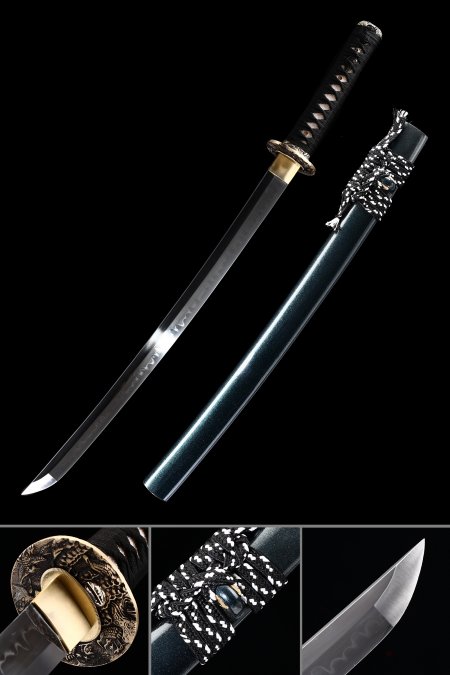
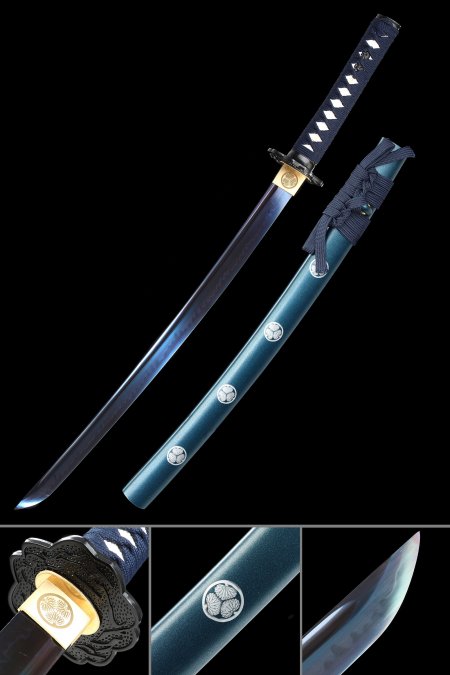
T10 is a high-carbon tool steel with a carbon content of approximately 1.0%, which gives it a fine, dense grain structure. For display collectors, the most important consequence of this grain structure is visual: T10 responds exceptionally well to clay tempering, producing a hamon - the temper line along the blade edge - with rich nie and nioi activity. These are microscopic crystalline formations that catch and scatter light, giving the hamon a living, textured appearance rather than the flat etched line seen on lower-grade steels. Each T10 clay-tempered blade has a genuinely unique hamon because the clay application and quenching process cannot be perfectly repeated. Collectors value this individuality as one of the key markers of authentic hand-forged work.
How does teal lacquer differ from standard black saya finishes?
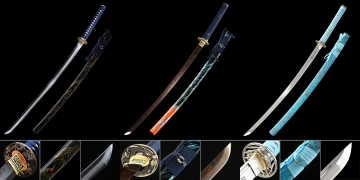
Black lacquer has been the dominant saya finish in Japanese sword tradition for centuries, valued for its formal austerity and its ability to visually recede, keeping attention on the blade and fittings. Teal lacquer takes a fundamentally different approach: it asserts itself as part of the compositional design, creating a color relationship with the ito wrapping, the tsuba metal, and the blade finish. The layered application of teal lacquer over hardwood also produces a surface depth - a sense of color existing below the surface plane - that flat-painted finishes cannot replicate. This depth makes the saya visually interesting from multiple viewing angles, which matters considerably when a piece is displayed on a stand rather than stored in a rack.
What is the correct way to oil and maintain a displayed wakizashi?
For a wakizashi kept on display, the primary maintenance task is protecting the high-carbon steel blade from humidity-driven oxidation. Apply a small amount of choji oil - a traditional Japanese mineral oil blend - to a soft, lint-free cloth and run it along the blade surface in a single direction, following the edge geometry. The goal is an extremely thin, almost imperceptible film, not a visible coating. Excess oil can attract dust and, over time, become sticky on the surface. Perform this process every four to six weeks in normal indoor conditions, or more frequently if you live in a coastal or high-humidity environment. Never use silicone-based products, as they can penetrate the wood components and interfere with the fit between blade and saya over time.
How does a wakizashi compare to a tanto for display collecting?
The tanto and the wakizashi occupy adjacent but distinct positions in Japanese blade tradition. A tanto typically measures under one shaku (approximately 30 cm), making it a compact piece whose fittings and blade geometry are studied at close range. The wakizashi, ranging roughly between 30 and 60 cm, occupies a middle scale where both the sweep of the blade and the quality of the saya finish can be appreciated from a normal viewing distance. For display purposes, this means a wakizashi reads well on an open stand in a room, while a tanto rewards close handling. Collectors who want a piece that contributes visual presence to a display shelf while still being manageable in size often find the wakizashi format the more satisfying choice.
Can a teal saya wakizashi be paired with other pieces for a cohesive display?
Yes, and the teal saya format lends itself to several strong pairing strategies. The most traditional approach is a daisho display, pairing the wakizashi with a katana that shares the same fitting aesthetic - matching ito color, tsuba style, or metal finish creates a visually unified set even when the two pieces are purchased separately. A black ito wakizashi with a copper dragon tsuba pairs naturally with katana pieces featuring similar copper or bronze hardware. Alternatively, collectors who favor a color-forward display can group the teal saya wakizashi alongside other lacquered pieces in complementary tones - deep navy or forest green saya work particularly well - creating a curated arrangement that demonstrates range without visual discord.