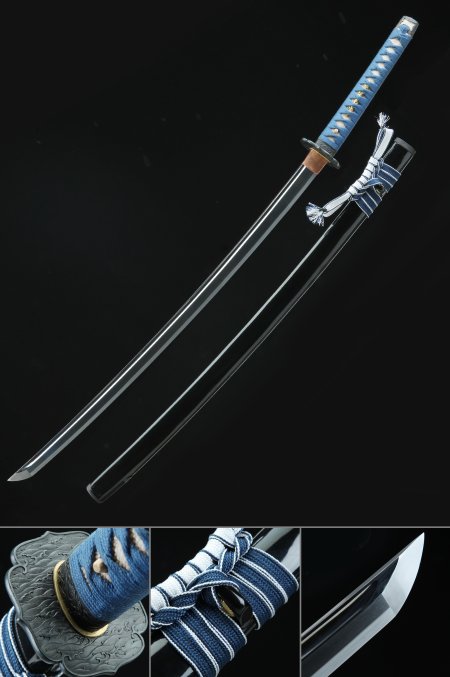
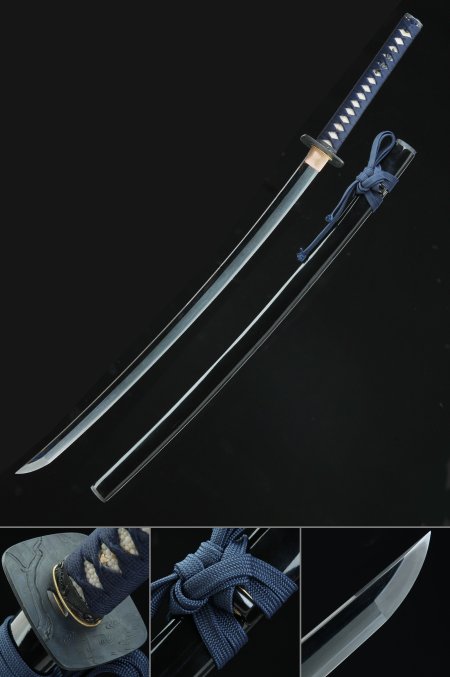
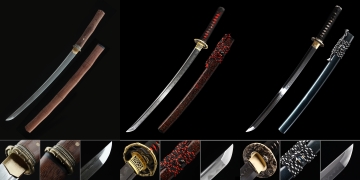
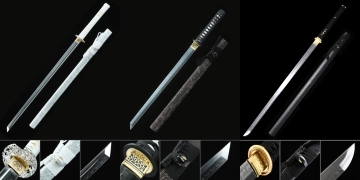
What makes tamahagane steel different from modern high-carbon steel?
Tamahagane is produced through the traditional tatara smelting process, in which iron sand (satetsu) and charcoal are layered inside a clay furnace and fired for up to 72 hours. The resulting steel bloom contains varying carbon concentrations throughout - some sections high-carbon for hardness, others low-carbon for flexibility. A skilled swordsmith physically selects fragments based on their fracture surfaces and carbon content before folding and forging them together. This process creates a blade with a non-uniform grain structure that modern homogeneous steels like 1095 or T10 simply cannot replicate. The visual result is a surface with subtle depth and a hamon with complex internal activity, prized by collectors precisely because it reflects a direct link to centuries-old metallurgical tradition.
How can I tell if a katana has a real hamon or a fake one?
A genuine hamon forms during differential clay tempering: the smith coats the spine with a thick clay layer and leaves the edge exposed before quenching, causing the edge to harden into martensite while the spine remains relatively soft. Under good lighting - especially natural or incandescent light held at an angle - an authentic hamon shows internal activity: small bright specks called nie (individual martensite crystals), misty transition zones called nioi, and irregular undulations that vary along the blade's length. A false hamon, typically produced by acid etching or abrasive polishing on non-differentially-tempered blades, appears flat and uniform, with no internal crystalline texture. The contrast between a genuine and a cosmetic hamon is immediately apparent to an experienced collector examining the blade under proper light.
Why is blue chosen for the handle wrap on these katanas?
Blue koshirae has a documented presence in Japanese sword culture since the Edo period, where it was favored by scholars, high-ranking retainers, and collectors for its association with intellectual refinement and visual restraint. The specific shade used in deep indigo or navy wrapping creates a strong chromatic contrast against the silver or iron tones of the tsuba and fittings, drawing the eye along the full length of the handle. From a collector's display standpoint, blue ito also photographs exceptionally well against both light and dark backgrounds, making it one of the more versatile color choices for a centerpiece display piece. The association between the color and quality craftsmanship is not accidental - it reflects a historical aesthetic tradition rather than a modern decorative trend.
How should I store and maintain a tamahagane katana at home?
The blade should be lightly coated with choji oil - traditionally a clove-infused mineral oil - every two to three months, or more frequently in humid climates. Apply the oil with a soft cloth or nuguigami (Japanese polishing paper) in smooth strokes along the blade length, working from the habaki toward the tip. Avoid touching the polished surface directly with bare hands, as skin oils accelerate oxidation. For storage, a horizontal katana stand with the edge facing upward follows the traditional Japanese display orientation and minimizes stress on the saya and blade. Keep the piece away from direct sunlight to protect the lacquerwork on the saya, and store in a stable humidity environment - between 40% and 60% relative humidity - to prevent the handle components from swelling or contracting.
Is a blue tamahagane katana a good choice as a collector's gift?
For someone who appreciates Japanese history, craftsmanship, or decorative arts, a tamahagane katana represents a meaningful and substantive gift that stands apart from mass-produced decorative items. The combination of authentic steel, genuine hamon, and a visually distinctive blue koshirae gives the piece immediate display appeal while also carrying genuine material and historical depth. It is particularly well-suited as a gift for collectors who already own modern steel katanas and are ready to add a piece with traditional metallurgical provenance to their collection. Pairing the katana with a quality horizontal display stand makes for a complete and presentation-ready gift set that requires no additional purchases.