Darkred Tanto
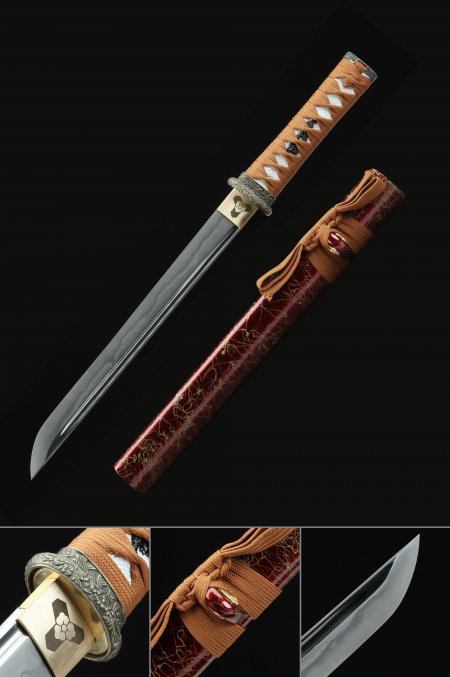
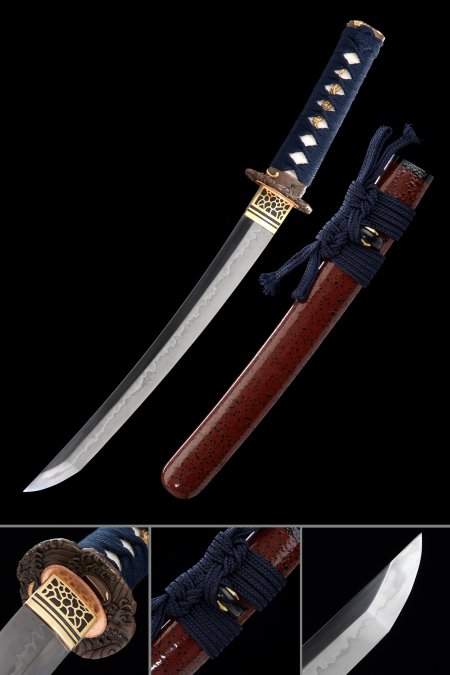
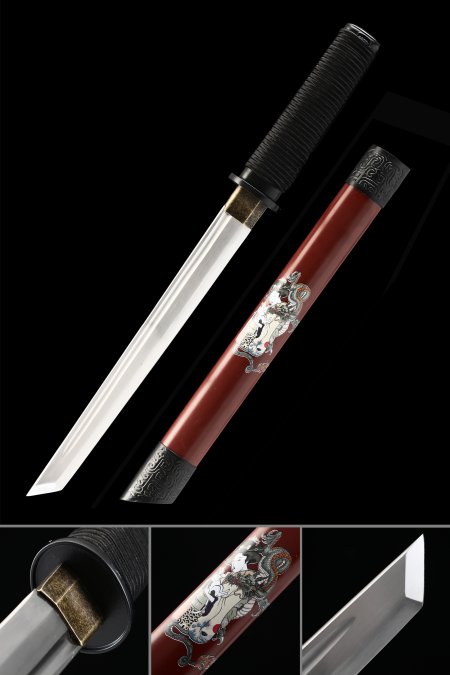
The Darkred Tanto collection brings together hand-forged tanto blades paired with rich crimson lacquered hardwood saya, offering collectors a striking visual contrast between traditional craftsmanship and bold aesthetic design. Each piece features authentic high-carbon or high-manganese steel construction, carefully selected fittings, and cord-wrapped handles that reflect classical Japanese mounting conventions. Enjoy free standard shipping on your order, and shop with confidence knowing returns are always straightforward.
Related Collections
Frequently Asked Questions
What steel types are used in the Darkred Tanto collection?
The collection primarily features two distinct steels. T10 carbon steel is a high-carbon tool steel with a fine grain structure that responds exceptionally well to differential hardening, producing a visible hamon line along the edge — a hallmark of traditional Japanese blade craftsmanship. High-manganese steel, used in other pieces, offers strong toughness and a smooth surface finish that is well-suited to detailed engraving such as dragon artwork. Each steel type brings a different character to the finished blade, and knowing which material a piece uses helps collectors understand both its aesthetic qualities and its long-term care requirements.
What exactly is a hamon and why does it matter to collectors?
A hamon is the temper line that appears along a blade's edge as a result of differential clay-coating before the quenching process. The smith applies clay in a specific pattern across the blade — thicker along the spine, thinner near the edge — so that the edge cools faster and hardens more deeply than the body. This thermal difference produces the visible boundary line known as the hamon. For collectors, the hamon is significant for two reasons: it is direct physical evidence of traditional hand-forging technique rather than machine production, and because the exact pattern is influenced by countless variables during the smith's process, no two hamon are perfectly alike. A tanto displaying a natural hamon is therefore a genuinely individual piece.
How does a tanto differ from other Japanese blade formats?
A tanto is the shortest of the traditional Japanese blade categories, typically measuring under 30 cm in blade length. Where a katana or wakizashi relies on curvature and extended reach as part of its design logic, the tanto is built around compactness and a precisely executed point geometry called the kissaki. This shorter format allowed smiths to put extraordinary focus into point construction and blade thickness, resulting in a distinctive profile. For collectors, the tanto's smaller scale makes it an ideal display piece in limited spaces and allows for more detailed appreciation of fitting work — the tsuba, habaki, and handle wrapping are all proportionally more prominent than on a longer blade.
How should I store and maintain a tanto with a lacquered hardwood saya?
For the blade, apply a very light coat of choji oil — traditional camellia oil — every two to three months using a soft cotton cloth. Avoid touching the polished steel directly with bare hands, as skin oils accelerate surface oxidation. For the saya, the lacquered hardwood finish is durable but should be kept away from prolonged direct sunlight, which can fade the deep crimson color over time. Store the mounted tanto horizontally in a low-humidity environment, ideally in a display case that allows air circulation without dust accumulation. Do not store in sealed plastic, which traps moisture. If condensation has contacted either the blade or the saya, dry both thoroughly before resheathing.
Is the Darkred Tanto a good choice as a display gift for collectors?
Yes — the visual contrast between the crimson lacquered hardwood saya and the wrapped tsuka makes these pieces immediately striking as display items, even to someone unfamiliar with the specifics of Japanese blade collecting. For a recipient who is knowledgeable, the presence of a real hamon on T10 steel pieces or the detailed dragon engraving on the high-manganese variant gives genuine talking points. The tanto's compact format also makes it practical to display on a standard tanto stand on a desk or shelf without requiring dedicated wall space. When gifting, pairing the tanto with a quality display stand and a basic care kit — choji oil and a soft cloth — completes the presentation thoughtfully.
Customer Reviews
Ernie J Jimenez
California, United States
Quality Hamidashi Tanto. Shipped from China received in 7 days.
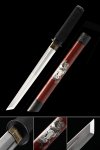 |
High Manganese Steel Tanto with Red Lacquer Saya - Dragon Artwork, Black Cord Handle |