Gold Saya Tachi
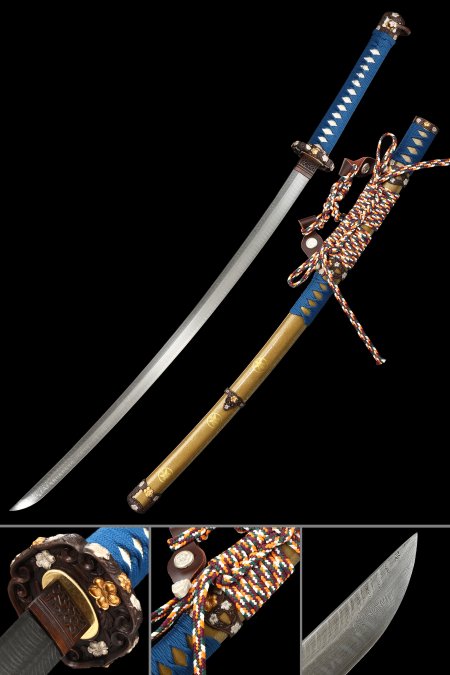
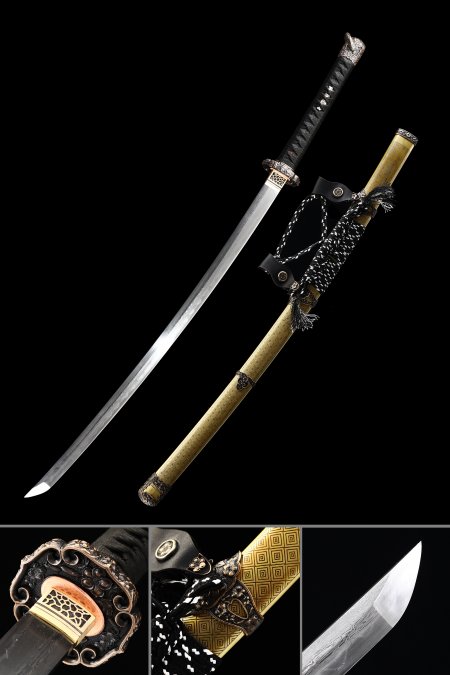
Gold Saya Tachi brings together the grandeur of ancient Japanese court swords and the refined artistry of gold lacquer finishing. Each piece in this collection features hand-forged Damascus steel, full-tang construction, and meticulously lacquered hardwood saya - crafted for serious collectors who value both visual splendor and authentic sword-making tradition. Enjoy free standard shipping on every order, plus a hassle-free return policy for your peace of mind.
Related Collections
Frequently Asked Questions
What makes a tachi different from a katana?
The tachi predates the katana by several centuries and was designed primarily for use on horseback. Its most defining characteristic is how it was worn: suspended from the belt with the cutting edge facing downward, rather than thrust through the belt edge-up as with a katana. This wearing method influenced the blade's geometry - tachi tend to have a more pronounced curvature (sori) and greater overall length to accommodate the mounted posture. Historically, tachi were associated with court nobility and mounted samurai of the Heian and Kamakura periods, giving them a ceremonial prestige that katana, as later infantry swords, did not carry in the same way. For collectors, this distinction matters when evaluating proportions, curvature, and how the piece should be displayed - traditionally with the edge facing downward on a stand to honor the original wearing orientation.
How is Damascus steel different from mono-steel in a display sword?
Damascus steel - also called pattern-welded steel in the modern context - is produced by forge-welding multiple layers of steel together, then drawing, folding, and manipulating the billet to create a visible grain pattern across the blade surface. This layered structure produces the flowing, water-like visual texture that immediately distinguishes Damascus pieces from mono-steel blades. In a collectible context, the pattern becomes one of the primary aesthetic features, making each blade visually unique since no two folded billets produce exactly the same surface pattern. Mono-steel blades, by contrast, are uniform in appearance and typically favored for functional clarity. For display collectors, Damascus steel offers a richer visual story - the grain pattern, when combined with a real hamon temper line, creates a blade surface with considerable depth and detail that rewards close examination.
What is a real hamon and how can I identify one?
A hamon is the visible boundary line between the hardened edge and the softer body of a blade, produced through differential heat treatment - a process where clay is applied to the spine before quenching, causing the edge to cool rapidly and harden while the spine remains more flexible. A real hamon has an organic, three-dimensional quality: it is not a sharp painted line but rather a misty, textured transition zone with subtle activity such as nie (crystalline grain) or nioi (a soft, clouded glow). Etched or simulated hamon, by contrast, appear flat, uniform, and lack this inner texture. When evaluating a collectible blade, examining the hamon under directional light - held at an angle to a lamp or window - reveals whether the transition has depth. The pieces in the Gold Saya Tachi collection feature naturally formed hamon, one of the details most valued by knowledgeable collectors.
How should I care for a gold lacquer saya long-term?
Gold lacquer saya require moderate care to maintain their finish over time. The primary concerns are humidity fluctuation, direct sunlight, and physical contact. Lacquer - whether traditional urushi or modern synthetic - can develop fine hairline crazing if exposed to extreme dryness, so storing the piece in an environment with stable, moderate humidity (around 45-55% RH) is ideal. Avoid prolonged direct sunlight, as UV exposure will gradually shift the gold tone and dull the surface gloss. When handling, use clean cotton gloves or hold the saya by its body rather than the lacquered panels, since skin oils can leave marks that are difficult to remove without professional refinishing. Dust the surface with a soft, dry microfiber cloth rather than any solvent-based cleaner. The blade inside should be lightly oiled with choji oil every few months and removed using a soft cloth before re-sheathing to prevent moisture transfer to the interior wood.
Is a gold saya tachi a good centerpiece for a Japanese sword display?
Gold saya tachi are particularly effective as display centerpieces because the gold lacquer finish creates strong visual contrast against most wall tones and display surfaces, drawing the eye immediately. The elongated profile of a tachi - longer than a standard katana - also adds a sense of scale and ceremony that shorter swords cannot achieve in the same space. For thematic displays, a gold saya tachi pairs well with a dark or black-finished companion piece, such as a black-tsuka odachi, to create tonal contrast. Display orientation matters for authenticity: tachi are traditionally mounted with the edge facing downward, opposite to how katana are shown. Horizontal wall mounts or tiered sword stands both work well depending on the wall space available. As a gift, a gold saya tachi is well suited to collectors who already have standard katana pieces and are looking to expand into classical Japanese court sword forms.