What makes manganese steel different from high-carbon steel in collectible swords?
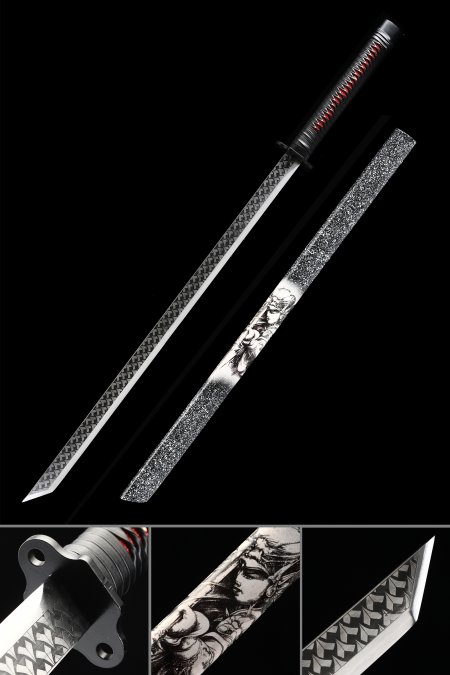
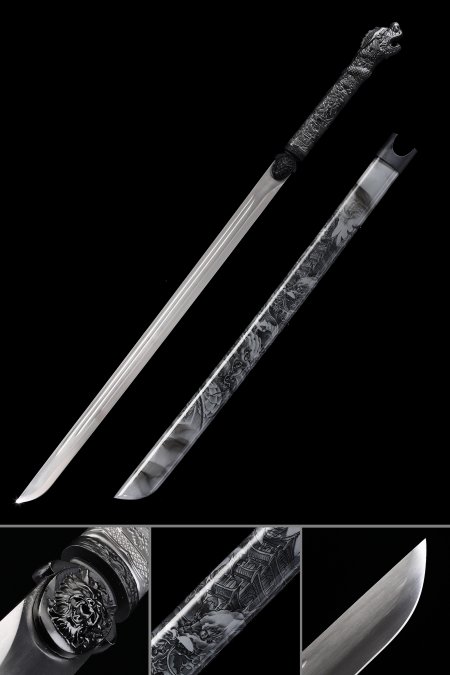
Manganese steel achieves its toughness through a different alloying process than standard high-carbon steels like 1060 or 1095. The addition of manganese increases the steel's impact resistance and promotes a work-hardening characteristic — meaning the grain structure densifies under stress rather than fracturing. For display and collectible purposes, this translates to a blade that holds its geometry reliably over time and develops a naturally matte gray surface tone without heavy polishing. High-carbon steels, by contrast, are more commonly mirror-polished to showcase hamon (temper lines), but manganese steel's appeal lies in its raw, industrial-aesthetic finish that suits the ninjato's understated design language particularly well.
Is the gray finish on these ninjato blades a coating or the steel itself?
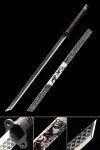
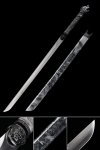
The gray surface you see on these blades is not a paint, powder coat, or spray-on finish — it is the natural appearance of the manganese steel, lightly stabilized to slow surface oxidation. This is an important distinction for collectors, because coatings can chip, peel, or wear unevenly over time, whereas the steel's own surface character remains consistent. Light surface conditioning with a neutral oil like choji or mineral oil will help maintain the finish during long-term display. Avoid storing the blade in humid environments or in contact with leather for extended periods, as both can accelerate uneven surface changes on unpolished steel.
What does full-tang construction mean, and why does it matter for display pieces?
Full-tang construction means the steel of the blade extends as a single continuous piece all the way through the handle, rather than terminating at the guard (partial tang) or being attached separately. For collectible swords, this matters for two reasons: structural integrity and authenticity. A full-tang blade distributes weight more evenly across the entire length of the sword, which affects how it balances in a display mount or when held for examination. It also reflects the construction standard used in historically authentic Japanese swordsmithing, making the piece more meaningful to collectors who value structural fidelity alongside visual design. In the ninjato pieces in this collection, the full-tang build is a core construction feature, not an afterthought.
How should I store and maintain a manganese steel ninjato long-term?
For long-term display and storage, the most important factors are controlling humidity and preventing contact with corrosive materials. Keep the sword in an environment with relative humidity below 60% — a dehumidifier or silica gel packets near the display area can help in damp climates. Apply a light coat of neutral mineral oil or choji oil to the blade surface every few months using a soft cotton cloth, wiping in the direction of the grain. When sheathed in the saya (scabbard), avoid leaving the blade stored for months without occasional inspection, as any trapped moisture can cause uneven surface changes. For the handle wrapping and lacquered saya, occasional dusting with a dry microfiber cloth is sufficient — avoid water or chemical cleaners on lacquered surfaces.
How does the ninjato's straight blade affect its look on a display stand compared to a katana?
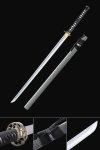
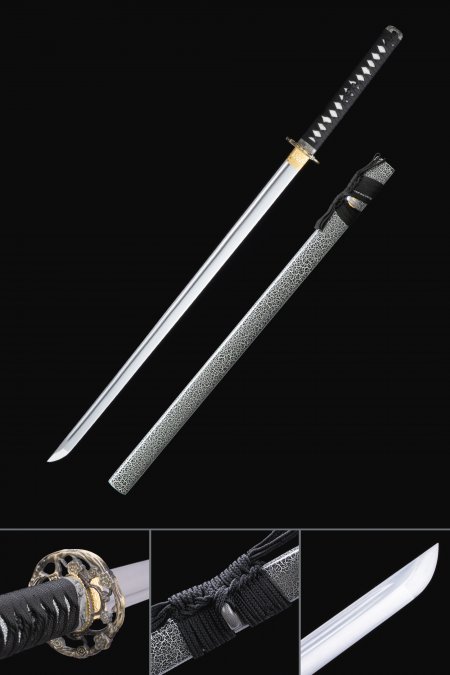
The ninjato's straight or near-straight blade profile creates a distinctly different visual rhythm on a display stand compared to the katana's elegant curve. Where a katana's curvature draws the eye along a flowing arc, the ninjato presents a clean, geometric horizontal or vertical line that reads as deliberate and architectural. Collectors who display multiple Japanese swords often find that pairing a straight-bladed ninjato with a curved katana creates a visually balanced contrast — the two silhouettes complement rather than compete with each other. The gray manganese finish also tends to read differently under display lighting than a polished blade, absorbing light rather than reflecting it, which gives the ninjato a quieter, more subdued presence that can anchor a multi-piece display without overwhelming it.