What makes 1060 carbon steel a good choice for a ninjato collectible?
1060 carbon steel contains roughly 0.60% carbon, placing it in a range that responds well to hand-forging and differential heat treatment. During the hardening process, the edge is brought to critical temperature and quenched while the spine cools more slowly, producing a visible hamon - the natural temper line that distinguishes a hand-forged piece from a production casting. For display collectors, 1060 offers the authentic appearance of a properly made blade without the brittleness associated with higher-carbon alloys like 1095. The steel is dense, takes a clean polish, and develops character over time, making it a solid foundation for a collectible ninjato meant for long-term display.
How does a ninjato differ from a katana in design and display appeal?
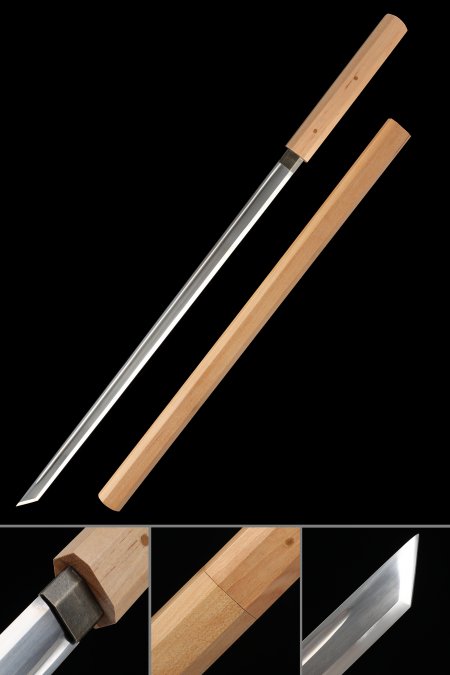
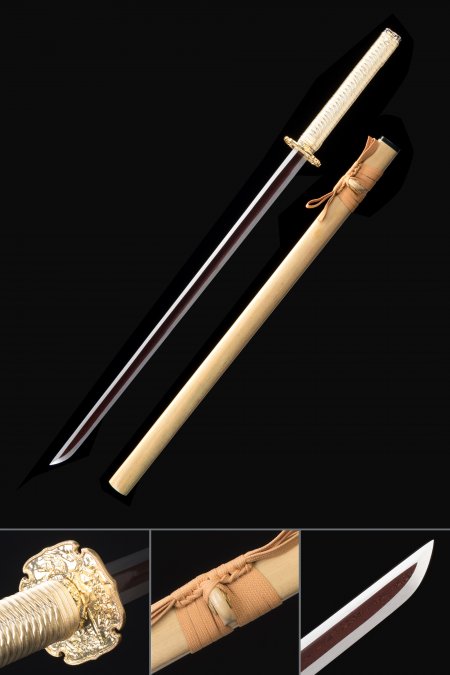
The most immediate difference is blade geometry. A katana features a pronounced curve along its length, a design element tied to drawing technique and the aesthetics of classical Japanese sword-making. A ninjato, by contrast, has a straight or nearly straight blade, which gives it a more angular, architectural silhouette when displayed. The ninjato also typically has a shorter blade with a squared tsuba, contributing to a compact, unornamented profile. For collectors who prefer a bold, linear display piece over the flowing line of a curved blade, the ninjato presents a compelling alternative. Its visual restraint pairs particularly well with natural hardwood saya, which let the blade geometry take center stage.
What is a shirasaya, and how does it affect the look of the sword?
A shirasaya is a plain, undecorated mounting consisting of a bare wooden handle (tsuka) and matching wooden scabbard (saya), with no ray-skin wrap, no cord binding, and minimal fittings. Originally used in Japan as a storage mounting to let a blade rest undisturbed between uses, the shirasaya style has become popular among collectors for its extreme minimalism. On a ninjato, the shirasaya format amplifies the already-stark straight-blade aesthetic - the entire assembly reads as a single clean line of wood and steel. Display-grade shirasaya pieces are often mounted horizontally on a stand or laid flat in a display case, where the grain of the natural hardwood becomes part of the visual composition.
How should I maintain a carbon steel ninjato kept on display?
Carbon steel requires periodic attention to prevent surface oxidation, especially in humid environments. Every two to three months, remove the blade from its saya and apply a very thin coat of choji oil or a neutral mineral oil using a soft, lint-free cloth. Wipe away any excess - a heavy oil coat can attract dust and degrade the wood interior of the saya over time. Avoid touching the blade surface with bare hands during handling, as the acids in skin oils are enough to initiate spotting on polished high-carbon steel. Store the piece in its saya in a stable, low-humidity space away from direct sunlight, which can fade the wood finish. With these simple habits, a 1060 carbon steel display piece will hold its appearance for years.
Is a full-tang ninjato a better display piece than a partial-tang one?
For serious collectors, full-tang construction is the preferred standard. A full-tang blade extends the steel the entire length of the handle, meaning the piece is built as a single continuous unit rather than a blade inserted into a separate handle component. This has no practical impact on display use, but it matters for structural integrity and collectible value. A full-tang piece feels more substantial in hand, sits more solidly on a display stand, and signals a higher level of manufacturing commitment. When comparing pieces side by side, full-tang construction is one of the first checkpoints experienced collectors use to assess quality, alongside the presence of a natural hamon and the fit and finish of the saya and fittings.