Orange Handle Tachi
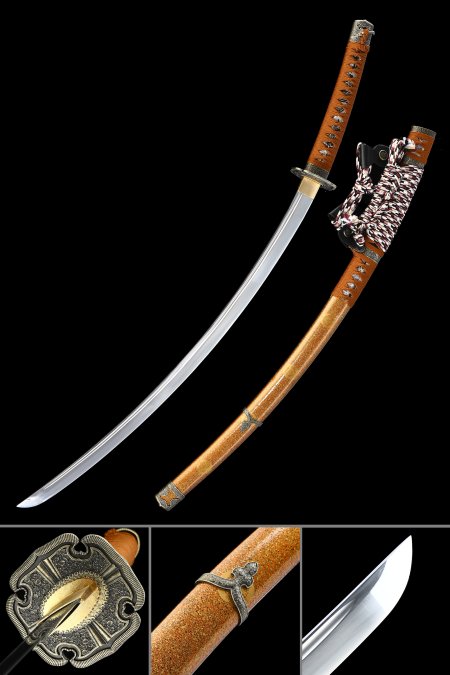
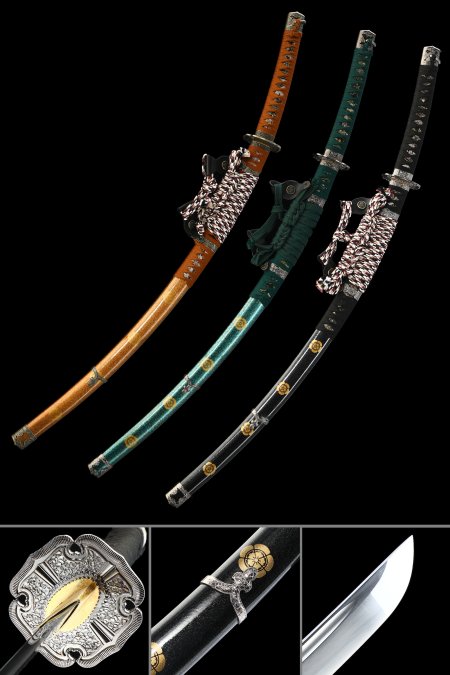
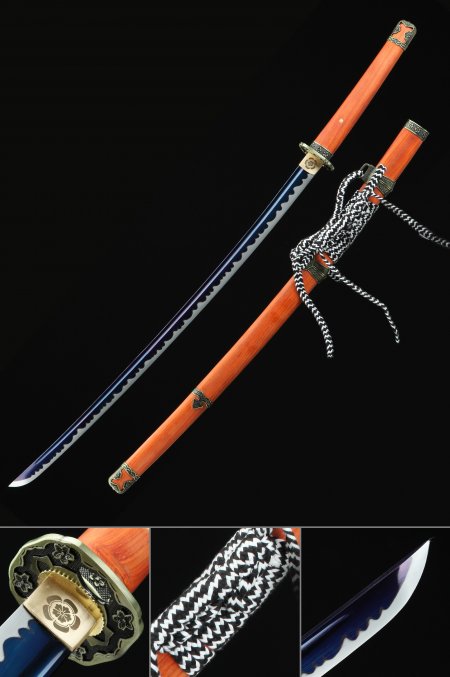
Orange Handle Tachi brings a vivid collector's aesthetic to the classic tachi form — long blades paired with richly toned orange hardwood or rosewood handles that command attention on any display stand or wall mount. Each piece is hand-forged from high-carbon steel, fitted with full-tang construction and ornate bronze tsuba, and finished with lacquered saya in coordinating hues. Free standard shipping is included on every order, backed by our hassle-free return policy.
Related Collections
Frequently Asked Questions
What makes tachi different from a katana in terms of design?
The tachi predates the katana and differs in several measurable ways. Tachi blades are generally longer, often exceeding 70 cm, and carry a more pronounced curvature along the entire length rather than concentrated near the base. Historically, tachi were suspended edge-down from the belt, which influenced how the curvature was shaped and how the fittings were oriented. The nagasa (blade length) combined with that deeper sori (curve) gives the tachi a sweeping, elegant silhouette that collectors find distinctly different from the katana's more compact, utilitarian profile. For display purposes, the tachi's longer form creates a stronger visual presence on a wall mount or horizontal stand, particularly when paired with a richly colored saya like the orange hardwood or rosewood finishes in this collection.
What is the difference between 1045 and 1095 carbon steel for display blades?
Both are high-carbon steel grades well suited for collectible blades, but they have distinct visual and structural characteristics worth understanding. 1045 carbon steel contains approximately 0.45% carbon, producing a tough, resilient blade with a clean, consistent hamon line — the temper line along the edge created during the hardening process. This makes 1045 blades visually appealing and straightforward to appreciate. 1095 carbon steel, at roughly 0.95% carbon, has a finer grain structure and produces a more complex, active hamon with greater visual texture and depth. Collectors who study blade metallurgy closely often prefer 1095 for the additional detail visible along the temper line. For a display collection, 1095 blades reward close inspection, while 1045 blades offer strong overall presence from a distance.
Why do the tsuba on these tachi use bronze instead of iron?
Bronze was historically used for tsuba in certain court and ceremonial contexts, prized for its capacity to hold fine decorative detail and its distinctive aging characteristics. Unlike iron, which can develop rust without careful maintenance, bronze oxidizes into a warm, stable patina that collectors find aesthetically desirable. Over time, a bronze tsuba deepens in tone — shifting from bright gold toward rich amber and brown — which creates an increasingly harmonious relationship with orange hardwood or rosewood handle components. The chrysanthemum and scroll motifs cast in bronze also hold their relief detail more cleanly than many iron equivalents, making them rewarding to examine up close. For display-focused collectors, bronze fittings generally require less intervention to maintain their appearance compared to raw iron guards.
How should I store and maintain an orange lacquered saya long-term?
Lacquered wood saya requires stable environmental conditions to maintain its finish. The primary concern is humidity fluctuation: excessive dryness causes the wood to contract and can produce fine cracks in the lacquer surface, while prolonged high humidity promotes mold growth inside the saya. Aim to store the piece in a space with relative humidity between 45% and 60%. Avoid placing lacquered saya in direct sunlight, which fades pigment and dries the wood over time. For the blade itself, apply a light coat of choji oil or camellia oil every few months using a soft cloth — this prevents surface oxidation and keeps the blade's finish in stable condition. Store the assembled sword horizontally on a padded rack rather than vertically to reduce stress on the habaki and saya mouth over time.
Is the three-piece saya set a good choice as a collector gift?
A matched three-piece set is one of the more thoughtful options for a collector gift precisely because it removes the guesswork of sourcing complementary pieces separately. The orange, teal, and black lacquered saya in this set are designed to work together visually — the color range is broad enough to create contrast on a display rack while the consistent lacquer quality and blade construction tie the set together as a unified group. For someone new to collecting Japanese long-blade forms, receiving a complete display-ready set removes the barrier of building a cohesive arrangement incrementally. For an established collector, a set with this level of color intentionality functions more like a curated art object than a single piece acquisition. Including a display stand or wall mount alongside the set completes the presentation.