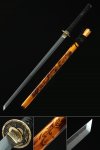
Orange Ninjato

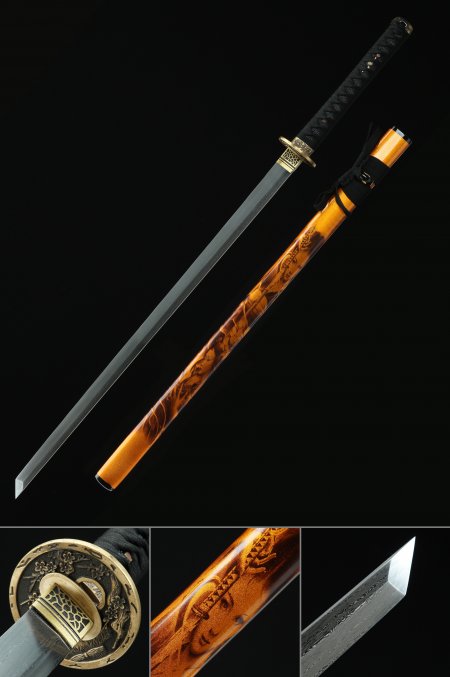
Explore our Orange Ninjato collection — straight-bladed collectible swords finished with vivid orange accents across the tsuka-ito, saya, or fittings. Each piece is hand-assembled with traditional construction methods, offering the clean geometric lines that define the ninjato profile. Free shipping and free returns on every order.
Showing 1 Products

Related Collections

Black Katana407 items


2447 Reviews

Orange Katana27 items


119 Reviews

Orange Wakizashi3 items


2 Reviews

Orange Tanto5 items


12 Reviews

Frequently Asked Questions

What makes a ninjato different from a katana in blade shape?
The most visible distinction is the blade geometry. A katana features a pronounced curvature, called sori, that typically measures between 1 and 2 centimeters along the spine. A ninjato has a straight or nearly straight blade with minimal to zero sori, giving it a distinctly angular profile. This straight design also means the kissaki (tip) is shaped differently — often a simpler, more acute point rather than the curved yokote line seen on katana. For collectors, the straight silhouette offers a striking contrast when displayed alongside curved Japanese swords, making the ninjato a strong visual complement in a mixed collection.
What steel types are used in this Orange Ninjato collection?
The pieces in this collection feature several steel options. Melaleuca steel, also known as folded Damascus steel, is created by layering and forge-welding multiple sheets of steel together, producing visible wavy grain patterns on the blade surface after polishing. Other pieces use mono-steel construction with a differential hardening process that produces a real hamon — the wavy temper line along the edge where harder martensite meets softer pearlite. Both approaches yield a full-tang blade where the steel extends through the handle and is secured with mekugi bamboo pins for structural integrity.
How should I maintain an Orange Ninjato for display?
Start by handling the blade with a soft cloth or gloves to avoid leaving fingerprints, since skin oils accelerate oxidation on carbon steel. Apply a thin layer of choji oil (clove oil) along the flat and spine of the blade every two to three weeks, or more frequently in humid climates. Wipe excess oil away so the surface has a light sheen without dripping. Store the sword in its saya when not on display and keep it in a room with stable humidity — ideally between 40 and 55 percent relative humidity. The orange tsuka-ito can be kept clean with a dry soft brush to remove dust without fraying the cord fibers.
Can I display an Orange Ninjato alongside a katana and tanto?
Absolutely, and this is one of the most popular ways collectors build a cohesive display. A traditional Japanese sword set, called a daisho, pairs a long sword with a short sword, but many modern collectors expand to three pieces for visual balance. Pairing this Orange Ninjato with an orange-accented katana and tanto creates a triptych of contrasting blade profiles — straight, curved, and compact — unified by a shared color theme. A tiered horizontal rack or a three-slot vertical wall mount works well for showcasing the differing lengths and geometries side by side.
Is the orange finish on the saya durable over time?
The orange finish on the scabbard is typically achieved through a lacquer coating applied over the wooden saya body. Traditional urushi-style lacquer is quite resilient against light scratches and UV fading, though prolonged direct sunlight will gradually dull any lacquer finish over years. To preserve vibrancy, display the sword away from windows or use UV-filtered lighting. If minor scuffs appear, a very light buffing with a microfiber cloth restores the sheen. Avoid chemical cleaners or solvents, as these can strip the lacquer layer. With basic care, the finish retains its bold appearance for decades of display enjoyment.

Customer Reviews

Daniel Webb Oklahoma, United States

The blade pattern is beautiful! The fittings are nice and tight. I have not done any cutting with it so I don't know if it will stay that way. The Saya, or scabbard, is a little loose and the blade rattles around. But it does hold the sword in place, even upside down the sword stays in place. Overall, it's a great looking sword for the price.

Melaleuca Folded Steel Chokuto Ninjato with Orange Dragon-Carved Saya - Straight Katana Replica Melaleuca Folded Steel Chokuto Ninjato with Orange Dragon-Carved Saya - Straight Katana Replica
Jesse James Edward Stevenson , Canada

Totally amazing. Very good quality. I used an amazing traditional stone with three surfaces including a crystal to sharpen the swords properly and break away any brittle impurities on the edge and tip to strength and sharpen a true edge any samurai or ninja would respect. Now I have a wonderfully legit sword that will make anyone happy who did not go full bore to West Okinawa to spend the big money. 1000 fold NINJATO AND 1000 FOLD KATANA.

Melaleuca Folded Steel Chokuto Ninjato with Orange Dragon-Carved Saya - Straight Katana Replica Melaleuca Folded Steel Chokuto Ninjato with Orange Dragon-Carved Saya - Straight Katana Replica