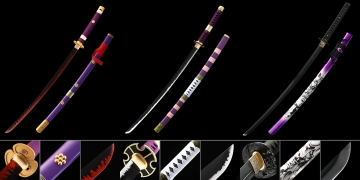
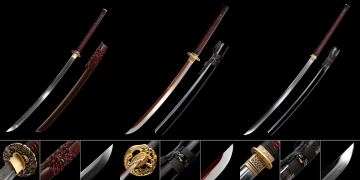
What makes T10 steel a good choice for a tachi collectible?
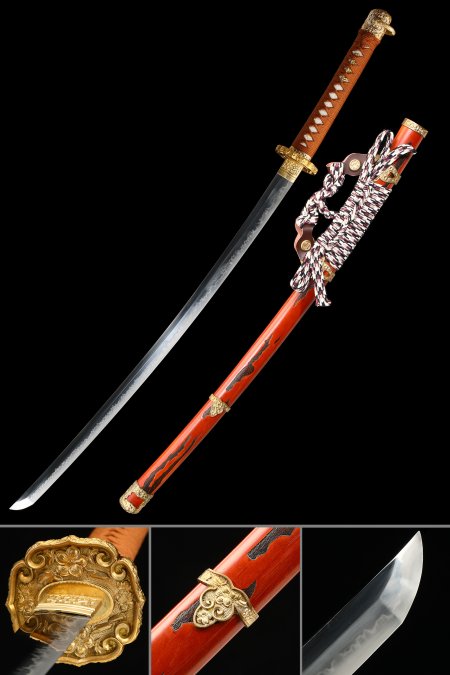
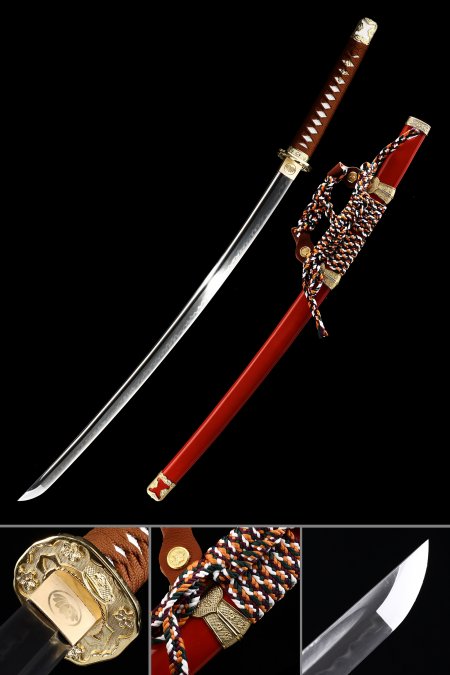
T10 is a high-carbon tool steel with a carbon content around 1.0%, combined with trace silicon and minimal impurities. That composition produces a tight, fine grain structure in the finished blade, which serves two purposes important to collectors. First, it allows the smith to develop a sharply defined hamon through clay-differential hardening—the temper line appears crisp and expressive rather than blurry or faint. Second, the polished surface of T10 takes on a mirror-quality finish that shows fold lines and hamon activity with excellent visual clarity. For display purposes, this translates directly into a blade that photographs beautifully and rewards close inspection under light—qualities that distinguish a genuinely craft-forward collectible from a decorative reproduction.
Is the hamon on these red tachi blades real or decorative?
The hamon on each blade in this collection is produced through authentic clay-tempering, not acid etching or mechanical engraving. The process involves coating the spine of the blade with a clay mixture before the final quench, which slows the cooling rate on the spine while allowing the edge to harden rapidly. The boundary between these two crystalline zones—hard martensite at the edge, tougher pearlite at the spine—appears as the hamon when the blade is polished. Because the clay is applied by hand and quench conditions vary slightly with each individual blade, no two hamon are exactly alike. Collectors who are familiar with authentic nihonto will recognize this variability as a hallmark of genuine heat-treatment craft rather than a mass-production finish.
How should I store a red lacquer saya to keep it in good condition?
Red lacquer over a wooden saya core is sensitive to two environmental factors: humidity extremes and prolonged direct sunlight. Low humidity can cause the wooden core to contract and eventually crack the lacquer surface, while high humidity promotes moisture retention that may affect both the lacquer and any metal fittings over time. Ideal storage is at a stable indoor humidity between 40–60%, away from windows or heating vents. For long-term display, a horizontal sword stand in a room with consistent climate control is preferred. If storing in a bag or case, use a breathable fabric sleeve rather than airtight plastic, which traps moisture. Periodically inspect the fittings and blade for any condensation, and apply a light coat of choji oil or mineral oil to the blade surface every few months to prevent oxidation.
How does a tachi differ from a katana in terms of design?
The primary structural differences come down to curvature, length, and the intended mounting orientation. Tachi were historically worn edge-down suspended from the belt by cords attached to the saya, which required a deeper and more pronounced curve (sori) to ensure the edge faced the correct direction when drawing. Katana, by contrast, are thrust through the belt edge-up, and their curvature is generally shallower and positioned closer to the handle. Tachi also tend to be longer overall, often exceeding 70 cm in blade length, giving them a sweeping visual profile that collectors find architecturally striking on a wall display. For display purposes, these differences make the tachi format distinctly imposing—the deeper curve and longer blade create a silhouette that reads clearly even from across a room.
Are red tachi swords a good gift for a Japanese sword enthusiast?
A red tachi makes an exceptionally thoughtful gift for someone who already collects Japanese swords or studies Japanese art history, precisely because it goes beyond the standard katana format most casual buyers default to. The red lacquer saya and gold tsuba fittings give it immediate visual impact that works well even outside a dedicated sword collection—displayed in a study, library, or office with Japanese aesthetic interests, it reads as a considered, culturally informed choice. For collectors specifically, the T10 steel construction and authentic hamon communicate that the giver understood the difference between decorative novelty and genuine craft. Pairing the tachi with a double or triple sword stand elevates the presentation further and gives the recipient a display-ready setup from the moment they open it.