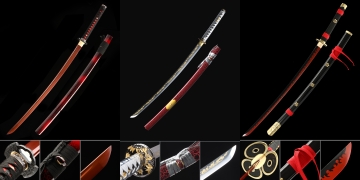
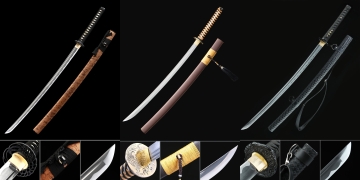
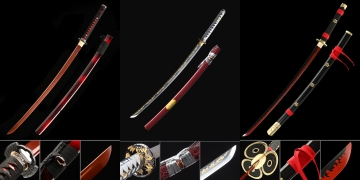
What makes 1060 carbon steel a good choice for tachi replicas?
1060 carbon steel sits at approximately 0.60% carbon content, placing it in the medium-high range of the plain carbon steel spectrum. For collectible tachi, this composition offers two practical advantages: it is hard enough to hold a well-defined hamon line when heat-treated, and it retains enough ductility to maintain structural integrity in a full-tang construction over years of display use. Higher-carbon steels like 1095 can achieve a sharper edge geometry, but they carry increased brittleness risk. For display and collection purposes - where visual fidelity and long-term dimensional stability matter most - 1060 strikes a balance that experienced collectors appreciate. The steel also responds well to hand-polishing, producing the reflective ji surface characteristic of authentic Japanese blade aesthetics.
How does a tachi differ from a katana in terms of design?
The tachi predates the katana and differs in several measurable ways. Blade length on a tachi typically exceeds 70 cm (roughly 27.5 inches), often reaching 80 cm or more, compared to the katana's standard 60-73 cm range. The curvature (sori) of a tachi tends to be more pronounced and positioned toward the base of the blade (koshi-zori), while katana curvature is generally centered mid-blade (tori-zori). Most significantly, the tachi was worn suspended edge-down from the obi by its saya cords, suspended from the belt, as opposed to the katana's edge-up thrust-through carry. This orientation difference is why authentic tachi replicas feature signature cord loops (ashi) on the saya and distinctive suspension fittings - details that differentiate a proper tachi display piece from a re-labeled katana.
Who is Tsurumaru Kuninaga, and why is it a popular replica subject?
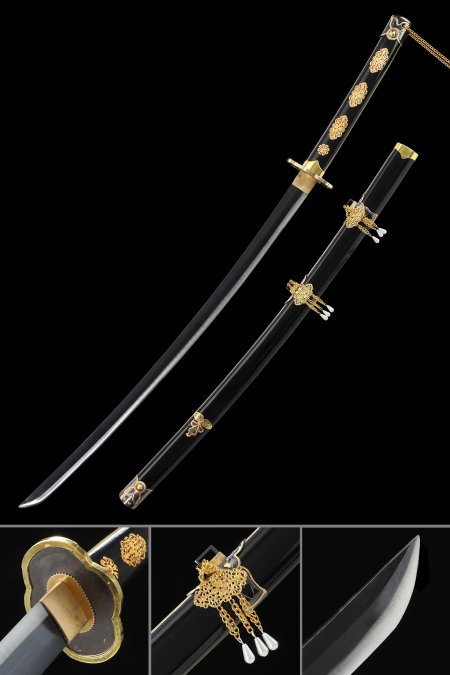
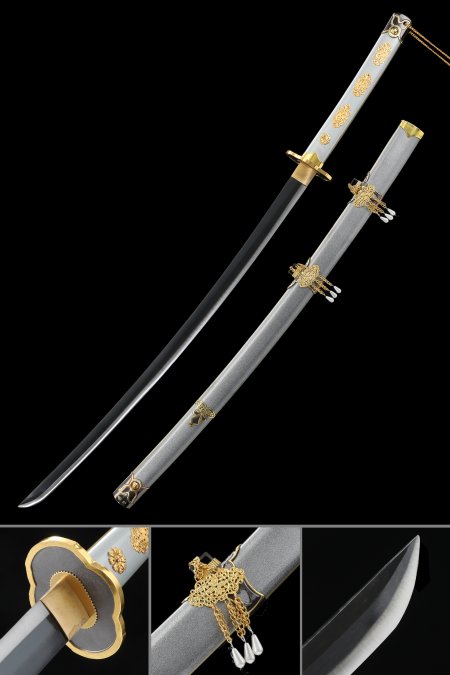
Tsurumaru Kuninaga is a historically documented Japanese tachi attributed to a swordsmith of the Yamashiro school, believed to date to the late Heian or early Kamakura period (roughly the 12th century). It is designated a Japanese national treasure and is renowned for its exceptionally white, mirror-polished surface - an unusual characteristic that sets it apart visually from the more common dark-polished blades of the era. The Touken Ranbu franchise, a Japanese media property that anthropomorphizes famous historical swords, brought widespread international attention to Tsurumaru Kuninaga through its distinctive white-and-gold visual identity. For collectors, replica versions of this blade offer a rare combination: documented historical pedigree, a distinctive aesthetic that photographs beautifully in a display setting, and connection to a beloved popular-culture interpretation.
How should I maintain a 1060 carbon steel tachi on display?
Carbon steel requires more active care than stainless alternatives, but the routine is straightforward. Every two to three months - or whenever you handle the blade directly - apply a thin, even coat of choji oil (traditional camellia oil blend) along the entire blade surface using a soft cotton cloth or dedicated nuguigami paper. This creates a micro-thin barrier against oxidation. Store the tachi in a stable environment: target indoor humidity between 40-60% RH and keep the piece away from exterior walls, air conditioning vents, or direct sunlight, all of which cause temperature and humidity fluctuations that accelerate surface oxidation. If the saya is lacquered wood, avoid sealing it in an airtight case - wood needs to breathe. Periodically inspect the blade for any rust spots; early-stage surface rust can typically be addressed with a light application of oil and gentle removal with a clean cloth.
Is a tachi a good display centerpiece alongside katana and wakizashi?
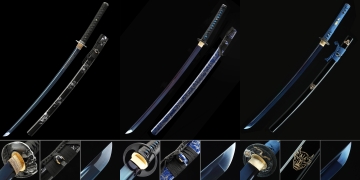
A tachi pairs exceptionally well with katana and wakizashi in a multi-piece Japanese sword display, but it works best as a compositional anchor rather than a direct set companion. Historically, samurai carried a katana-wakizashi daisho as a matched pair - tachi were not part of that pairing. Displaying a tachi alongside katana and wakizashi therefore works as a chronological or stylistic narrative: the tachi representing the earlier Heian-Kamakura mounted warrior tradition, the daisho representing the later Edo-period samurai culture. Collector displays organized around this historical arc tend to be visually compelling and educational. For mounting, a dedicated tachi-kake (stand designed for edge-down orientation) ensures the piece is presented correctly and maintains the blade's relationship to its historical context.