Blue Black Handle Ninjato

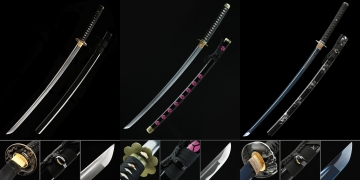
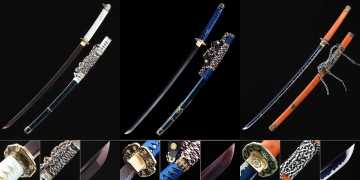
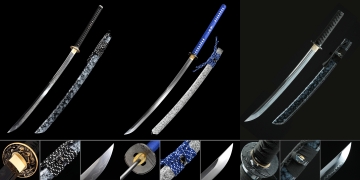
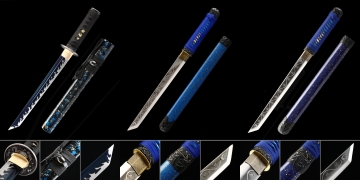
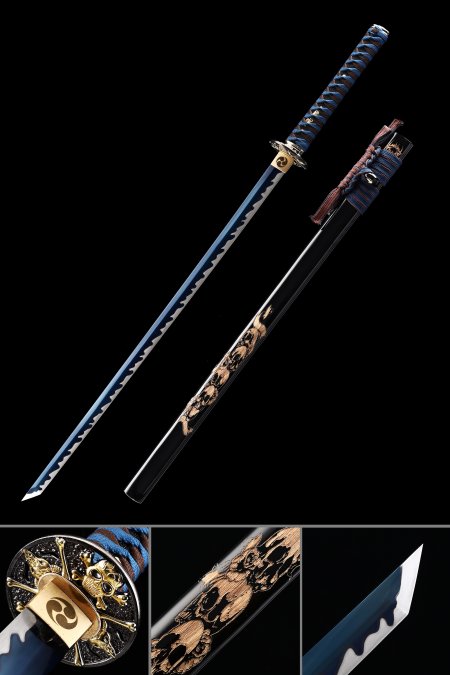
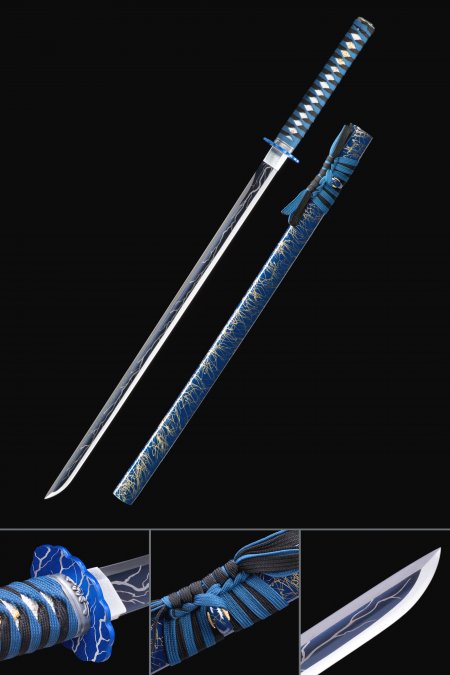
The Blue Black Handle Ninjato collection brings together straight-bladed ninja swords finished in a striking combination of deep blue and black - from the wrapped ito and lacquered saya to the blade itself. Each piece is full-tang constructed and crafted from manganese steel, offering the structural integrity and visual drama that serious collectors seek. Enjoy free standard shipping on your order, backed by our hassle-free return policy.
Showing 2 Products

Frequently Asked Questions

What steel is used in these ninjato collectibles?
Each ninjato in this collection is forged from manganese steel, a carbon-alloy steel valued for its toughness and resistance to deformation under stress. For display collectibles, manganese steel is particularly practical because it holds a consistent surface finish over time and responds well to standard oiling maintenance. It is distinct from high-carbon steels like 1060 or 1095, which are more commonly associated with differentially heat-treated blades. Manganese steel's durability makes it an excellent choice for full-tang collectibles intended for long-term display and occasional handling, providing the structural integrity collectors expect without requiring specialized upkeep.
What does full-tang mean for a display sword?
Full-tang refers to the construction method in which the steel blade extends as a single, uninterrupted piece through the entire length of the handle. In a display collectible, this is significant because it eliminates the weakest point found in partial-tang or rat-tail designs - the joint where blade meets handle. A full-tang ninjato holds its components together as one integrated unit, meaning the handle will not loosen or separate from the blade over years of display and handling. For collectors, full-tang construction is also a reliable indicator of overall build quality, suggesting that care was applied throughout the piece rather than only to the visible blade.
What is the hamon line visible on some of these blades?
The hamon is a visible boundary line along the blade surface created during differential heat treatment, where the edge and spine of the sword are cooled at different rates. On the blades in this collection that feature a hamon, the effect appears as a flowing, wave-like contrast between the hardened edge zone and the softer spine. Collectors prize the hamon as one of the most distinctive markers of craftsmanship in Japanese-style sword making. Each hamon pattern is slightly unique depending on the clay coating applied before quenching, which means no two blades produce exactly the same line - adding a subtle element of individuality to each collectible piece.
How should I care for the ito wrap and lacquer saya?
The blue ito cord wrapping requires minimal maintenance but benefits from occasional inspection for loosening at the knot points. If the wrap loosens over time due to humidity changes, a collector can carefully re-tension the cord without removing it entirely. Avoid exposing the handle to prolonged moisture, which causes the underlying rayskin or synthetic base to swell and distort the wrap geometry. The black lacquer saya should be wiped with a soft, dry cloth to remove dust and fingerprints - avoid water-based cleaners, which can dull or streak the lacquer surface. Storing the sword with the blade inside the saya, but removing it briefly every few months to air the interior, prevents moisture from becoming trapped against the blade finish.
How does a ninjato differ from a katana for collectors?
The most immediate difference a collector notices is blade geometry. The katana features a pronounced curved blade optimized for drawing cuts, while the ninjato presents a straight or near-straight single-edged blade with a more compact profile. This straight geometry gives the ninjato a distinctly modern, graphic silhouette that reads differently on a display wall - sharper in its visual lines and more angular in overall form. The tsuba on ninjato designs is also frequently square or unconventional in shape, contrasting with the round or oval guards typical of katana. For collectors building a varied Japanese sword display, the ninjato introduces a visual counterpoint to curved-blade pieces without requiring a completely different aesthetic direction.

Customer Reviews

Denis Gysbergh Belgium

Première commande sur TrueKatana.com , motivée par l'envoi à 0,00 :-D
Le colis a été envoyé de Malaisie, direction Belgique par FEDEX :
dédouanement : TVA 6% et juste 5euro de frais de traitement : agréablement surpris je m'attendais à beaucoup plus... Délai de livraison total, du paiement à la livraison : 14 jours calendrier.

le sabre est exactement comme sur les images de présentation du site, magnifique.
Je ne m'y connais pas dans les différents métaux et aciers pour y apporter une appréciation constructive. Je peux juste dire que c'est lourd et robuste : tout est bien fini, bien fixé, aucune pièce ne "gigote"...
La qualité des finitions bonne, sans quelques rares imperfections, à ce prix il ne faut pas s'attendre à des finitions au millimètre près.
l'illustration du Saya (crânes) sont gravés dans le bois, ce n'est pas une vulgaire impression sur la peinture!

Agréablement surpris donc pour cette première commande, le choix est difficile pour le(s) prochain(s) car, oui, aux prix raisonnables et frais d'importation minimes, je commande à nouveau, ça donne envie de refaire la déco !

Par contre, certains articles sont à 0,00 frais d'envoi , et d'autres 19,99USD :-/
sans savoir pourquoi ça ne donne pas envie d'acheter ceux-là...
Manganese Steel Blue Blade Straight Sword with Skull Tsuba - Full Tang, Blue-Black Ito, Black Lacquer Saya Manganese Steel Blue Blade Straight Sword with Skull Tsuba - Full Tang, Blue-Black Ito, Black Lacquer Saya