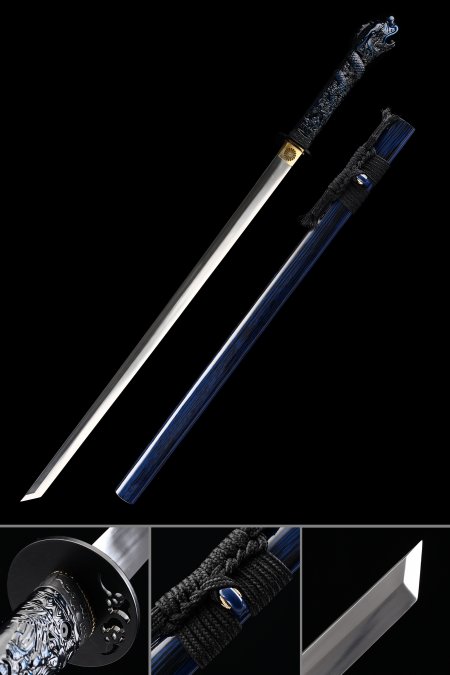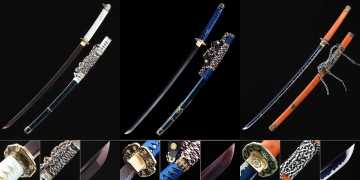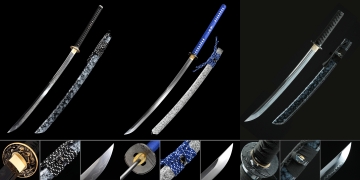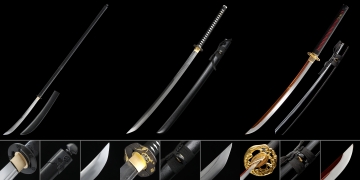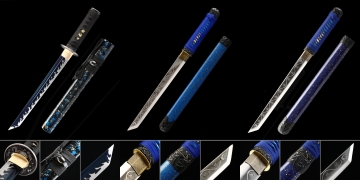
Black Blue Handle Ninjato

Each ninjato in this collection pairs a black or blue handle wrap with a straight-profile blade, offering a visually striking combination that appeals to dedicated sword collectors and Japanese martial history enthusiasts alike. From lacquered hardwood saya to lightning-patterned shirasaya, the finishing details on every piece reflect genuine craftsmanship rather than mass production shortcuts. Enjoy free standard shipping on your order, plus a straightforward return policy so you can collect with complete confidence.
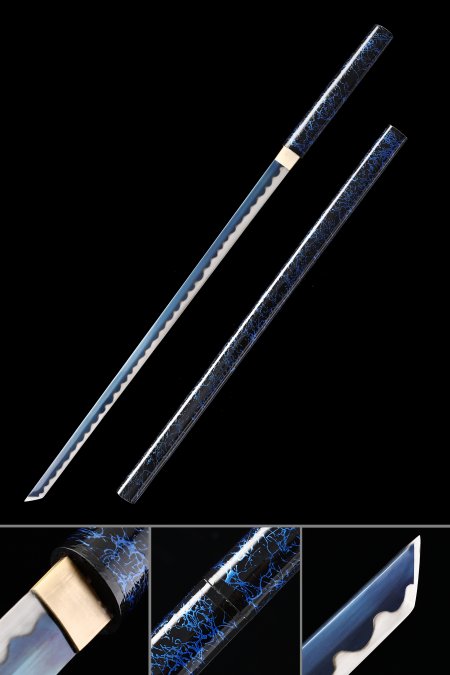
Showing 4 Products

Frequently Asked Questions

What makes a ninjato different from a katana?
The most immediately visible difference is blade geometry. A katana features a pronounced curve (sori) along its length, a product of differential hardening during the traditional forging process. A ninjato, by contrast, has a straight or near-straight blade profile - closer in form to the older chokuto swords that predate the curved Japanese blade tradition. This straight profile is often paired with a square or rectangular tsuba rather than the rounded guard typical of katana mounts. For collectors, this distinction matters because it affects both the visual presentation on a display stand and the historical narrative the piece represents. Ninjato are associated with the covert culture of feudal Japan's shinobi, lending them a different kind of historical resonance than the aristocratic symbolism tied to the katana.
What is the difference between 1095 carbon steel and manganese steel blades?
Both steels appear frequently in quality collectible swords, but they behave and look quite differently. 1095 carbon steel contains roughly 0.95% carbon, giving it a fine, consistent grain structure that polishes to a bright, mirror-like surface and holds a clean edge well over time - ideal for display pieces where visual clarity is a priority. Manganese steel, sometimes called high-manganese or Hadfield-type steel, incorporates manganese as a primary alloying element, which produces a harder, more impact-resistant structure with a distinct crystalline surface quality. This natural patterning is often highlighted in lightning-style blade finishes. From a collector's standpoint, 1095 is the more traditional choice, while manganese steel offers a bolder, more visually textured aesthetic.
How should I store a lacquered saya to prevent damage?
Lacquered saya - whether in blue hardwood or a patterned black finish - require a bit more attention than plain wood or synthetic scabbards. Avoid exposing them to rapid temperature changes, which can cause the lacquer layer to crack or separate from the wood substrate underneath. Store the piece horizontally on a sword stand rather than standing vertically for extended periods, which can stress the koiguchi (the saya mouth) over time. Keep the storage area at moderate humidity - ideally between 40% and 60% RH. Extremely dry conditions will cause the wood core to contract, while excess moisture risks softening the lacquer. A light dusting with a soft, dry cloth is all the regular maintenance needed for the saya exterior.
Are dragon handle designs historically accurate on ninjato?
Dragon motifs have deep roots in Japanese decorative arts, appearing on armor, tsuba, and sword fittings throughout the Muromachi and Edo periods. While documentary evidence for the specific hardware configurations of shinobi swords is limited - historical accounts of ninjato are sparse compared to samurai swords - dragon imagery was widely used across all social strata in feudal Japan as a symbol of strength and protection. For modern collectible pieces, dragon handle designs represent a culturally grounded aesthetic choice that connects to authentic Japanese iconographic traditions. Collectors who value thematic coherence in their display often pair dragon-handled ninjato with other pieces featuring mythological motifs for a unified presentation.
Does a full-tang construction matter for a display collectible?
Yes - even for pieces intended purely for display rather than handling, full-tang construction is a meaningful quality indicator. A full-tang blade extends the steel continuously from tip through the entire length of the handle, meaning the handle scales or wrap are fitted around the steel core rather than attached to a separate wooden or synthetic rod. This construction method results in better long-term structural integrity: the handle will not loosen or shift with changes in humidity and temperature the way a partial-tang assembly sometimes can. For collectors planning to mount pieces on wall brackets or frequently move them between display locations, full-tang construction ensures the sword remains a stable, cohesive object over years of ownership.

Customer Reviews

Ross Nichols Oregon, United States

The Saya has flawless paint and components, fits snug and flush, the katana seemed to have the slightest of a bend about 8 inches from the tip but this is spring steel so I'm not to concerned. It is easily wielded with one hand with great balance and because it's not my t10 work of art I plan on using it for practice cuting and dismantling eventually. The grip is tight with excellent finger grip. The hand guard is solid and tight.Just toothy sharp but I can remedy that. For the money it's an excellent sword.
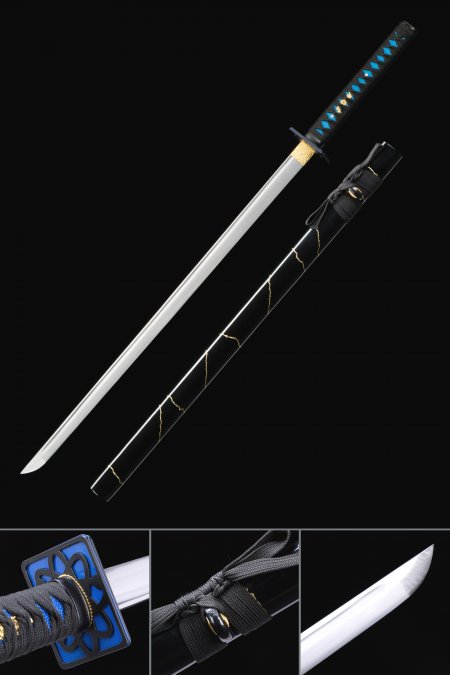
1095 Carbon Steel Ninjato with Black-Gold Lightning Saya & Blue Geometric Tsuba - Real Ninja Sword 1095 Carbon Steel Ninjato with Black-Gold Lightning Saya & Blue Geometric Tsuba - Real Ninja Sword
Alex Cousins North Carolina, United States

I love this sword;the fact it came early on the Sabbath, I actually prayed over it and had it blessed. I love the color, the lightning, the sheath,the character of the blade overall regarding design, even the leather grip ,feels amazing.

It feels like a full tang in the blade, great weight for me and working on my forearms. Haven't done a cutting test quite yet but I felt the edge slide against my finger and I know for sure it's sharp, yet it didn't cut me to cause bleeding.

Awesome blade, I recommend.

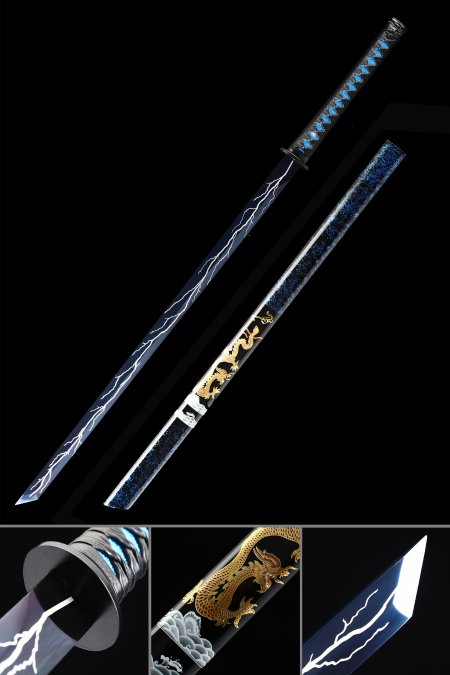
Chokuto Ninjato Straight Sword in Manganese Steel with Blue Lightning Blade and Dragon Saya Chokuto Ninjato Straight Sword in Manganese Steel with Blue Lightning Blade and Dragon Saya
Elio Lopez Florida, United States

The order arrived quickly. The weapon was beautiful. The scabbard holds the sword without slipping and the weight is just right. There was no rattle between the blade and the handle. I'm new to katana training, but even with my poor skill, I easily sliced through a water bottle. I'm very pleased with my purchase.
Zatoichi Stick Sword in Blue 1095 Carbon Steel with Lightning-Pattern Black-Blue Shirasaya Zatoichi Stick Sword in Blue 1095 Carbon Steel with Lightning-Pattern Black-Blue Shirasaya