Brown Gold Saya Katana
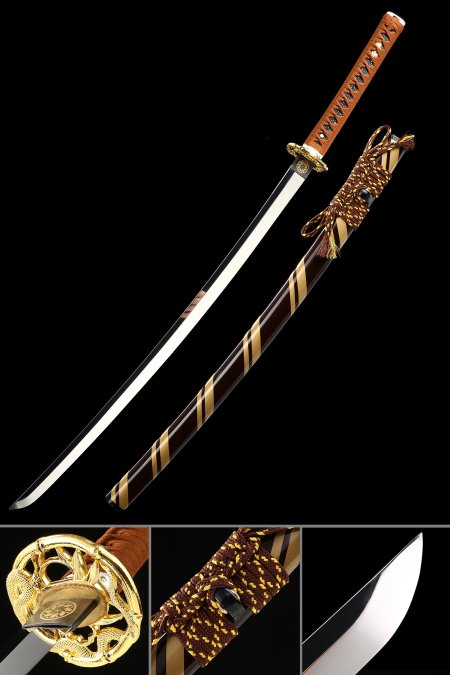
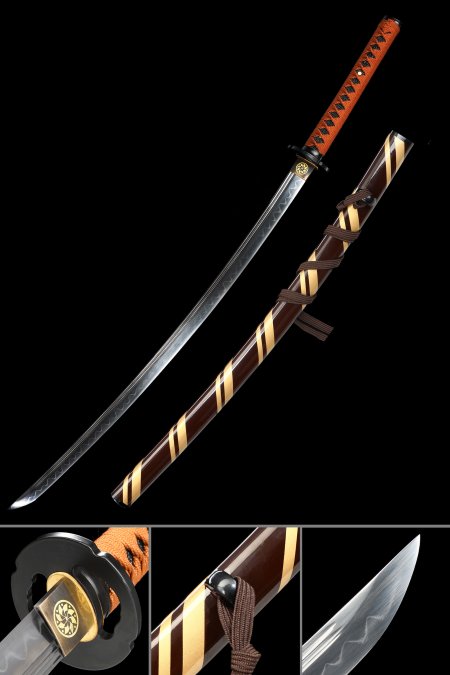
The Brown Gold Saya Katana collection brings together blades housed in richly lacquered sayas that pair warm brown tones with gilded gold accents - a finish that elevates any display case or collector's shelf. Each katana in this selection is hand-forged from high-carbon steel, fitted with period-inspired fittings, and assembled with the kind of detail that serious collectors recognize immediately. Enjoy free standard shipping on your order, backed by our hassle-free return policy.
Related Collections
Frequently Asked Questions
What makes a brown-gold saya finish different from standard black lacquer?
Standard black lacquer sayas achieve their finish through uniform application of urushi or synthetic lacquer over a wood core, producing a monochrome surface with minimal visual variation. A brown-gold saya introduces layered tonal work - a warm brown ground coat is applied first, then gold striping or accenting is added as a secondary element. This creates a surface with actual depth and visual movement, catching light at different angles in ways a flat black saya cannot. For collectors, the layered finish signals a higher level of attention to the mounting as a designed object, not just a functional sheath. It also pairs more naturally with brass or gold-toned fittings, allowing the entire koshirae (mounting set) to read as a unified composition rather than a collection of independent parts.
How does T10 steel differ from 1095 in a display katana?
Both T10 and 1095 are high-carbon steels capable of genuine clay-tempering, but they differ in alloy composition in one meaningful way: T10 contains a small amount of tungsten, typically around 0.25 percent, which refines the carbide structure during heat treatment. The practical result for collectors is a hamon that tends to show tighter, more complex activity along the temper line - the nie and nioi patterns that connoisseurs examine closely appear denser and more defined. The 1095 steel produces a clearly visible hamon as well, but with a slightly broader, more open transition zone. Neither steel is superior for display purposes - the choice comes down to whether you prefer the intricate detail of T10's temper line or the bold, readable contrast that 1095 delivers.
Does ito color actually affect collectible value or is it purely aesthetic?
Ito color carries both aesthetic and contextual significance in collector circles. Historically, certain color combinations were associated with specific periods, ranks, or schools of sword mounting, so a knowledgeable collector reading a katana will interpret the ito choice as part of the piece's design language rather than a neutral decision. Brown ito on a brown-gold saya creates tonal continuity - the entire mounting reads as a single designed object. Orange ito, by contrast, introduces deliberate contrast and is often chosen to make individual elements stand out in display photography or in a multi-piece cabinet arrangement. For resale or gift purposes, earth-tone wrappings tend to read as more formally traditional, while vivid accent colors appeal to collectors who prioritize visual impact in a display context.
How should I store a lacquered saya to prevent cracking over time?
Lacquered wood is sensitive to humidity fluctuations more than to temperature alone. The wood core of a saya expands and contracts with changes in ambient moisture, and if that movement is rapid or extreme, the lacquer surface - which is less flexible than the wood beneath it - can develop hairline cracks. The practical target for long-term storage is a relative humidity level between 40 and 60 percent, maintained as consistently as possible. Avoid placing the saya near heating vents, air conditioners, or exterior windows where seasonal swings are amplified. Horizontal storage on a proper katana stand reduces stress on the koiguchi (mouth of the saya). If you live in a very dry climate, a small in-cabinet humidity control pack is an inexpensive safeguard that most serious collectors use without thinking twice.
Is a full-tang handle important for a collectible katana display piece?
Full-tang construction means the steel of the blade extends as a single continuous piece through the entire length of the tsuka (handle), secured by one or more mekugi (bamboo retention pins). For a display-only piece that will never be subjected to dynamic stress, a rat-tail tang could theoretically hold together indefinitely under static display conditions. However, full-tang construction remains important to collectors for two reasons: first, it reflects authentic construction methodology consistent with how historical Japanese swords were actually assembled, which matters to those who value period accuracy. Second, it provides a tactile quality difference - the handle has proper weight distribution and feels solid rather than hollow when handled during inspection or photography. Both models in this collection use full-tang construction, which is a meaningful detail that separates collector-grade pieces from purely decorative wall hangers.