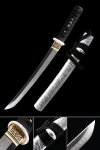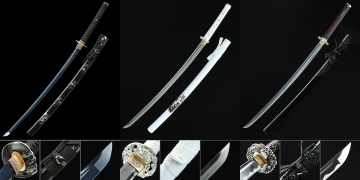
Lightning Saya Tanto

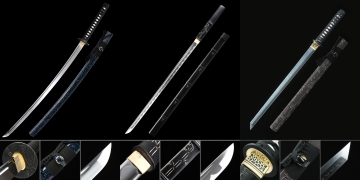
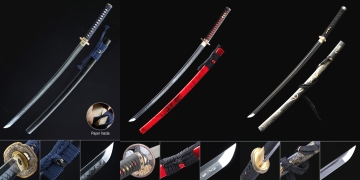
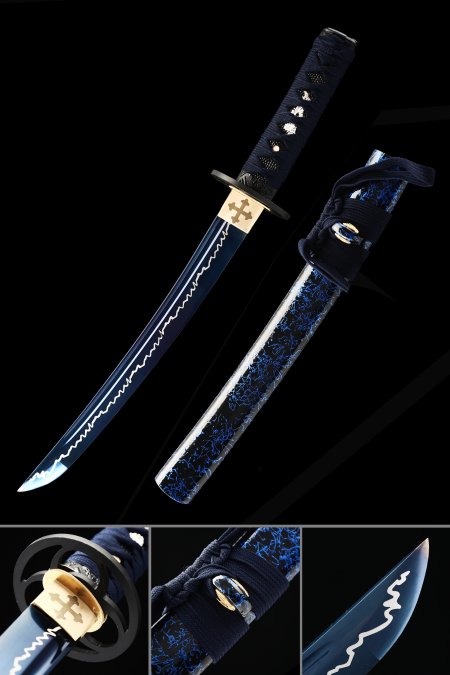
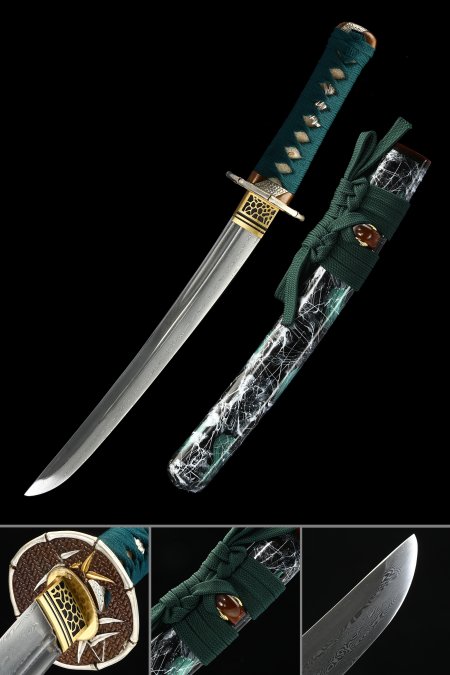
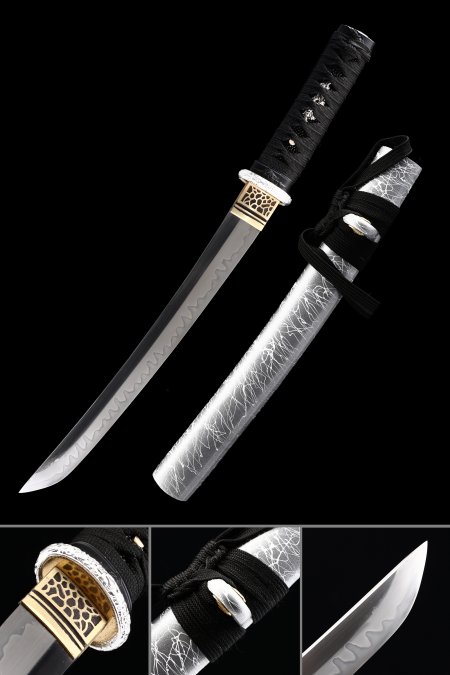
The Lightning Saya Tanto collection brings together short-blade collectibles defined by their dramatic saya finish — bold lightning-pattern lacquerwork that turns every scabbard into a visual centerpiece. Each tanto is crafted with careful attention to traditional blade geometry, quality steel, and coordinated fittings that speak to the serious collector. Free standard shipping is included on all orders, backed by our hassle-free return policy.
Showing 3 Products

Related Collections

Japanese Sword124 items


895 Reviews

Battle Ready Katana128 items


405 Reviews

Cheap Katana96 items


2940 Reviews

Decorative Katana109 items


1376 Reviews

Frequently Asked Questions

What makes the lightning pattern on the saya a collectible feature?
The saya's lightning pattern is applied through a layered lacquerwork process in which contrasting colors — typically black against white or deep blue — are built up and carved or masked to produce sharp, branching lines across the scabbard surface. Unlike a simple painted finish, properly applied lacquer is hard, moisture-resistant, and dimensionally stable over time, meaning the visual pattern holds without cracking or fading under normal display conditions. For a collector, this kind of decorative work signals craft investment: the saya is not an afterthought but a designed object in its own right, coordinated intentionally with the blade's furniture and handle wrap. Pieces where the scabbard finish is thematically matched to the tsuba material and cord color are generally considered stronger display compositions and tend to hold collector interest longer than mismatched assemblies.
How does T10 clay-tempered steel differ from manganese steel in a tanto?
T10 is a high-carbon tool steel with trace tungsten content that improves wear resistance and edge retention. When clay is applied to the blade before quenching — covering the spine while leaving the edge exposed — the differential cooling rate produces a genuine hamon: a visible transition line between the hardened edge zone and the softer, more flexible spine. This hamon is a direct artifact of the heat-treatment process and is unique to each blade. Manganese steel, by contrast, derives its toughness from manganese alloying rather than differential tempering, and typically does not produce a natural hamon. It offers good resilience and a consistent hardness profile suited to the tanto's angular tip geometry. The choice between them is a matter of collector priority — T10 clay-tempered work rewards close visual inspection and carries more traditional craft significance, while manganese steel offers reliable uniformity and a bold surface finish.
What is Melaleuca (folded) steel and how do I recognize it on a blade?
Melaleuca steel — sometimes called folded layered steel — is produced by repeatedly folding and forge-welding a steel billet, which distributes carbon more evenly and creates a fine laminated grain structure throughout the material. After polishing, this structure becomes visible as a subtle wood-grain or flowing-line pattern on the blade surface, often described as "hada" in traditional terminology. No two folded blades show identical hada because the pattern emerges from the specific sequence of folds and the smith's technique. On a display piece, recognizing hada requires examining the blade under angled, raking light — direct overhead light tends to wash out the surface detail. The pattern is most visible in the flat (ji) of the blade between the edge and the shinogi ridge. This visual complexity is a primary reason collectors seek folded-steel tantos over simpler monosteel alternatives.
How should I store and maintain a tanto with a lacquered saya?
Lacquered sayas should be kept away from prolonged direct sunlight, which can cause color shift in pigmented lacquer over time. For storage, a horizontal rack in a climate-controlled room — ideally between 40–60% relative humidity — prevents both the lacquer from drying and cracking and the wood substrate from warping. The blade inside should be lightly coated with a neutral mineral oil or traditional choji oil before sheathing, applied with a soft cloth and wiped to a thin, even film. Avoid silicone-based products, which can migrate into the wood and interfere with the lacquer adhesion at the koiguchi (saya mouth). Periodically remove the blade and inspect the interior of the saya for any moisture accumulation, which appears as discoloration on the blade surface near the habaki. A soft, lint-free cloth for handling the saya exterior will prevent fingerprint oils from dulling the lacquer finish over repeated handling.
Does a tanto display well alongside a full-length katana?
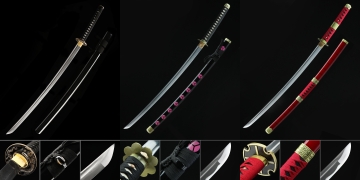
A tanto pairs naturally with a katana on a tiered horizontal display stand, and the combination references the historical practice of carrying matched short and long blades as a coordinated set. For visual balance, collectors typically position the tanto on the lower or foreground tier, with the katana above or behind it, allowing both saya finishes to be read simultaneously. When the tanto's lightning lacquer saya shares a color story with the katana's fittings — similar cord colors, complementary tsuba materials — the grouping reads as intentional rather than coincidental. Even without an exact match, the contrast between a bold patterned tanto saya and a more reserved katana scabbard can create a deliberate focal-point dynamic. If you're building a themed display, browsing the Katana collection alongside these tantos is a practical starting point for finding pieces whose furniture and finish coordinate well.

Customer Reviews

Cart 0 Items

Your cart is empty