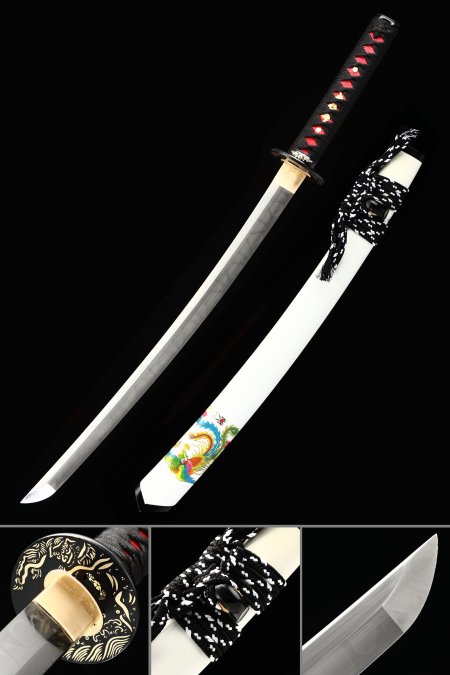
What makes a tiger tsuba significant on a wakizashi?
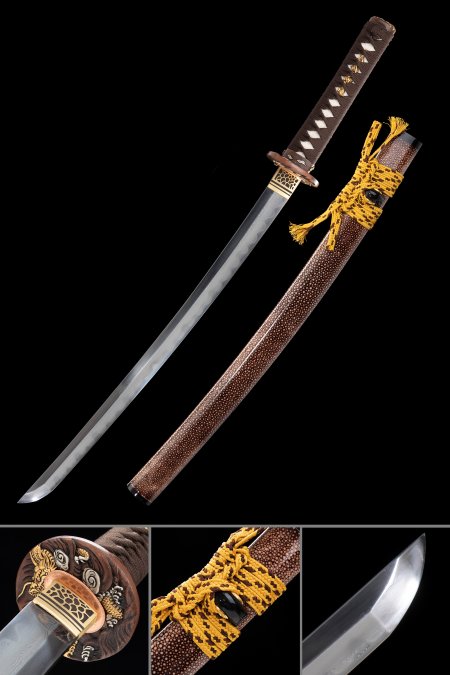
The tsuba - the guard fitting between blade and handle - is often the most expressive element of a Japanese sword's overall design. A tiger motif carries specific iconographic meaning rooted in East Asian artistic tradition: the tiger symbolizes strength, protection, and the warding off of negative forces, making it a favored subject in both Japanese and Chinese decorative arts for centuries. On a wakizashi, where the shorter blade length actually draws the eye closer to the fittings, a well-executed tiger tsuba elevates the piece from a simple blade assembly into a cohesive artistic statement. Collectors value these guards not just for their visual drama but for the cultural narrative they embed into the overall composition.
How does T10 carbon steel differ from folded Melaleuca steel?
T10 is a high-carbon tool steel containing roughly 1.0% carbon along with a small amount of silicon, which improves edge retention and allows a pronounced natural hamon to emerge through clay tempering. Each blade's temper line is genuinely unique because it forms during the quenching process rather than being applied artificially. Folded Melaleuca steel - sometimes called thousand-layer steel - is produced by repeatedly folding and welding the billet, which distributes carbon more evenly and creates the visible grain pattern known as hada on the blade surface. This layered visual texture gives the steel a depth and character that monosteel cannot replicate. Neither is strictly superior; T10 tends to offer a sharper hamon contrast, while folded steel prioritizes surface aesthetics and the visual record of the smith's process.
Can a tiger tsuba wakizashi be paired with a matching katana?
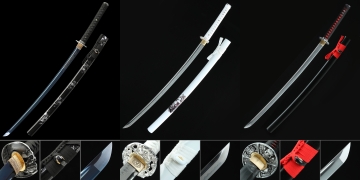
Yes - and this pairing is the essence of the traditional daisho concept, where a katana and wakizashi are displayed or worn together as a unified set. When both swords share the same tsuba motif, saya finish, and tsuka wrapping style, the visual coherence of the pair is considerably stronger than two mismatched pieces displayed side by side. For collectors building a themed display, selecting a tiger tsuba katana with a saya color and sageo material that mirrors your wakizashi creates a daisho that reads as intentional rather than assembled by chance. This kind of coordinated display carries significantly more visual impact in a dedicated sword cabinet or wall-mounted rack.
How should I store and maintain a lacquered saya long-term?
Lacquered sayas are more sensitive to environmental conditions than their natural wood counterparts. Direct sunlight is the primary threat - UV exposure causes the lacquer to yellow, crack, or peel over time, so displaying your wakizashi away from windows or under UV-filtering display lighting is strongly recommended. High humidity can cause the wood core beneath the lacquer to swell, which may eventually affect how the blade seats in the saya. Aim to store the piece in a stable environment between 40-60% relative humidity. Wipe the saya gently with a soft, dry cloth rather than any solvent-based cleaner. The blade itself should receive a light application of non-acidic sword oil every three to four months to prevent oxidation, and always ensure the blade is fully dry before returning it to the saya.
Is a wakizashi a good choice as a display collectible for beginners?
A wakizashi is an excellent entry point into Japanese sword collecting for several practical reasons. Its shorter overall length - typically between 30 and 60 centimeters - makes it easier to display in a standard home setting where a full-length katana might feel oversized. It requires the same care regimen as a larger sword, so it builds good preservation habits without being overwhelming. The wakizashi also has a rich historical context as an independent collector's piece, not merely a companion to the katana, which gives new collectors meaningful background material to study. Starting with a visually distinctive example - such as one featuring a tiger tsuba and a contrasting lacquered saya - provides an immediate focal point for a growing display and a clear aesthetic direction to build around.