What makes the white and black tsuka wrapping distinctive?
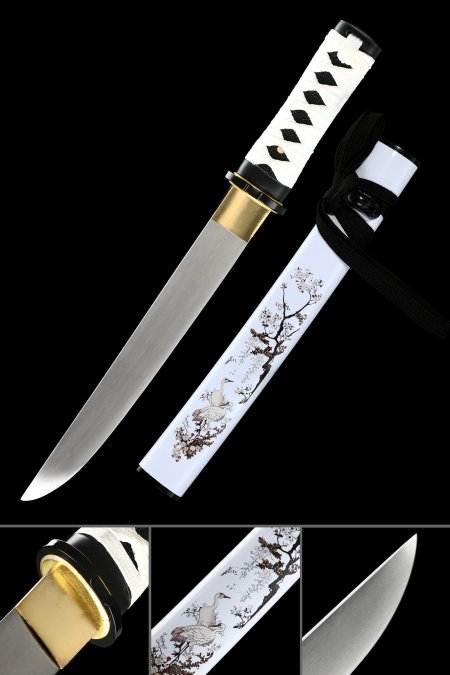
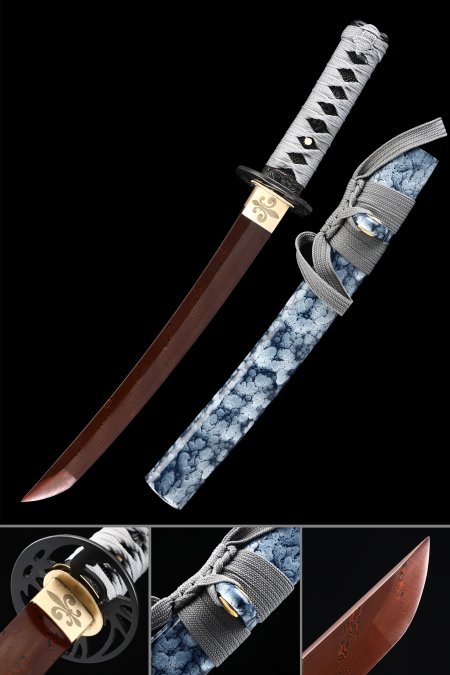
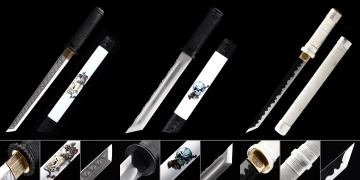
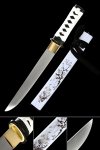
The white and black color pairing on a tanto handle — known as the tsuka — comes from alternating ito (braid) wound over samē, the textured ray skin underlayer that provides grip surface and structural padding. Unlike single-color wrappings that blend into the overall finish of a piece, the high-contrast white-black combination creates a strong visual rhythm along the handle, emphasizing the diamond-shaped gaps in the binding where the samē shows through. Historically, this contrast palette was associated with formal presentation pieces where visual clarity and aesthetic deliberateness mattered. For collectors, it also functions as a reliable indicator of how carefully the rest of the mounting was considered — a maker willing to invest in precise two-tone wrapping is typically attentive to fittings alignment and overall finish quality as well.
How does Damascus tanto differ from manganese steel tanto?
Damascus steel tanto are built from multiple layers of steel forge-welded and manipulated into billet form, then etched after grinding to reveal flowing surface patterns called hada. No two Damascus blades share the same pattern, which is a core part of their collectible appeal. Manganese steel tanto, by contrast, are forged from a single-alloy composition that includes manganese as a hardening and toughening element. The result is a blade with a clean, uniform surface that polishes to a consistent mirror or satin finish. Damascus pieces tend to attract collectors focused on surface artistry and visual uniqueness, while manganese steel tanto appeal to those who prioritize structural consistency and a sleek, uninterrupted aesthetic. Both are fully appropriate for display and long-term collection.
What does full-tang construction mean for a display tanto?
Full-tang means the steel of the blade extends as a continuous piece through the entire interior of the handle, rather than terminating at the habaki or being joined to a separate handle core. For display tanto, full-tang construction matters because it directly affects the balance and tactile weight of the piece when handled. A full-tang tanto has a natural heft distribution that feels deliberate and well-engineered, which is immediately perceptible when lifting it from a stand. It also means the handle furniture — fuchi, kashira, menuki — is fitted around a solid steel foundation rather than a hollow or partial core, contributing to long-term dimensional stability as the handle materials expand and contract with humidity changes.
How should I care for a tanto with a hand-painted saya?
Hand-painted saya require a few specific precautions beyond standard blade care. Avoid storing the tanto in direct sunlight, as UV exposure fades lacquer and degrades painted pigments over time — this is especially relevant for white saya with detailed motifs like crane or plum blossom designs, where color contrast is central to the visual effect. Keep humidity levels stable; fluctuations cause wood to swell and contract, which can crack lacquer finishes at seams near the koiguchi or kojiri fittings. For the blade itself, a light application of choji oil every three to six months prevents oxidation without affecting the saya interior lining. When inserting or drawing the tanto, do so smoothly and vertically to avoid abrasion on the painted surface near the mouth of the saya.
Are these tanto good choices as display gifts for collectors?
Tanto with white-black handles and decorated saya are particularly well-suited as collector gifts because they present as complete, cohesive aesthetic objects — the handle contrast, blade finish, and saya artwork work together as a unified statement rather than a collection of components. They are compact enough to display on a small tanto stand on a desk or shelf without requiring dedicated wall space, which makes them accessible for collectors who are newer to Japanese blade display. Pieces featuring hand-painted saya motifs — cranes, plum blossoms, floral patterns — carry additional cultural meaning that many recipients appreciate once they learn the symbolic context. For gifting purposes, the full-tang construction and named steel types (Damascus, manganese) also give the recipient concrete knowledge points about what they own, which is always valued in serious collecting circles.