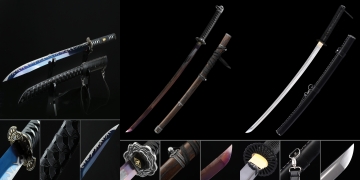
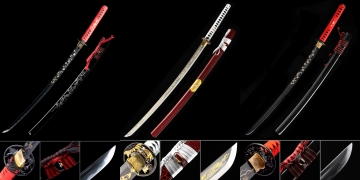
What makes a hamidashi different from a standard tanto?
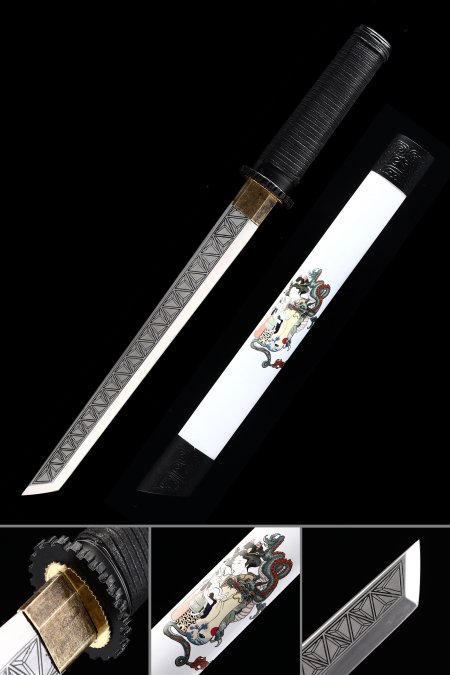
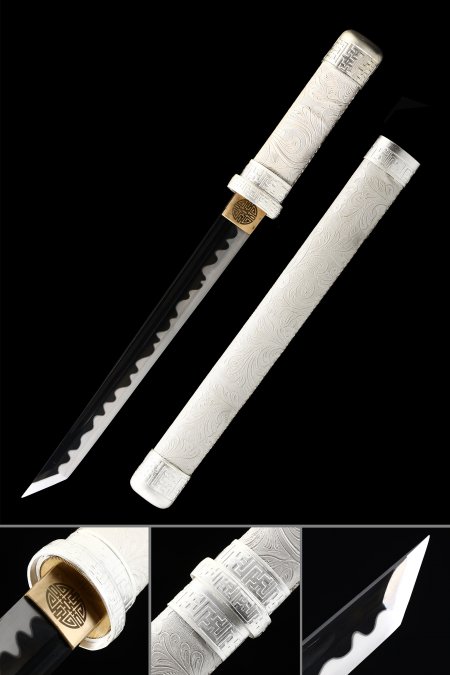
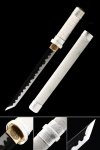
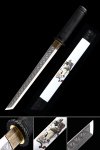
The defining feature of a hamidashi is its mimi-gata guard — a small, rounded tsuba that extends only slightly beyond the width of the handle, compared to the full circular or shaped tsuba found on a standard tanto. This minimal guard gives the hamidashi a cleaner, more streamlined silhouette. Historically, the form was associated with close-carry civilian use in Japan, where a large guard would have been impractical. In a display context, the hamidashi's profile reads as elegantly simple, allowing the blade geometry and saya finish to carry the visual weight of the piece rather than the fittings.
What type of steel is used, and how does it affect the engravings?
These pieces are constructed with manganese steel, an alloy known for its hardness and fine grain density. For decorative collectibles, manganese steel offers a key practical advantage: it holds engraved lines with exceptional sharpness and does not easily distort the cut during finishing processes. The geometric patterns and figural motifs on these blades — including skull and dragon designs — are engraved directly into the steel surface, not applied as paint or chemical transfers. This means the artwork retains its definition over time and can be appreciated as a physical texture when the blade is examined up close, a detail that distinguishes hand-engraved collectibles from mass-printed alternatives.
How should I care for a white lacquered hardwood saya?
White lacquer saya require slightly different care than natural wood or black-finish alternatives. Avoid prolonged exposure to direct sunlight, which can cause yellowing or micro-cracking in the lacquer over time. When storing, wrap the saya in a soft, lint-free cloth — microfiber works well — to prevent contact scratches that would show clearly against the light finish. Do not use oil-based cleaning products on the saya exterior, as oils can break down the lacquer bonding. A dry or very lightly damp cloth is sufficient for dusting. The blade itself should be lightly coated with a neutral mineral oil on the steel surfaces every few months to prevent surface oxidation, keeping it seated cleanly in its saya.
Are these tanto suitable as display gifts for collectors?
These hamidashi tanto are well-suited as gifts for collectors who appreciate Japanese short-blade forms with a strong visual presence. The white lacquered saya and contrasting black cord handle create an immediately striking presentation that photographs well and displays cleanly on a tanto stand or in a wall mount. The decorative engravings — skull art and dragon motifs — give each piece a distinct character that feels intentional rather than generic. For gifting, it is worth noting that each piece ships ready to display without requiring additional fitting work, which is a practical consideration when presenting it to someone who may be newer to the collecting hobby.
How does the black blade finish compare to a standard polished steel finish?
The black blade finish used on select pieces in this collection is achieved through an oxidation or chemical patination process applied to the manganese steel surface. Unlike a polished mirror finish, which reflects light and emphasizes the blade's geometry through brightness, a black finish absorbs light and creates a matte, low-reflective surface that makes engraved details read more dramatically by shadow contrast rather than reflection. From a display standpoint, a black blade against a white lacquered saya produces a high-contrast pairing that holds visual interest from a distance — an advantage in wall-mounted or shelf displays where the piece may be viewed from across a room. The finish does not require additional maintenance beyond standard steel care.