What makes a hamidashi different from a regular tanto?
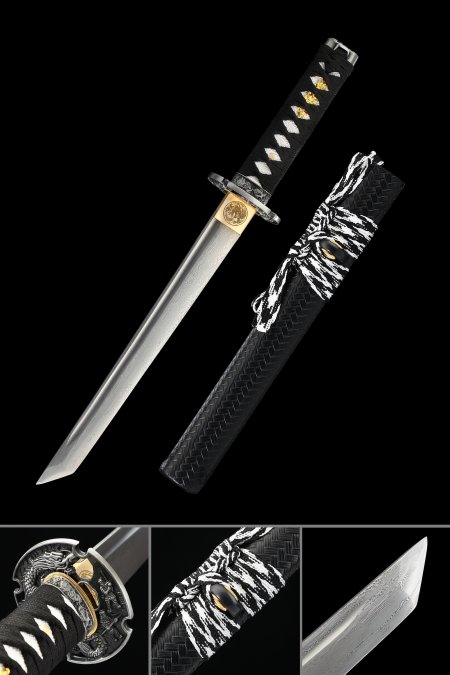
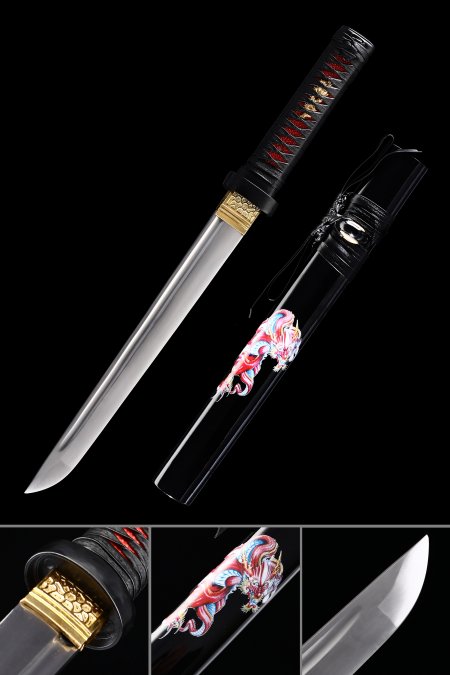
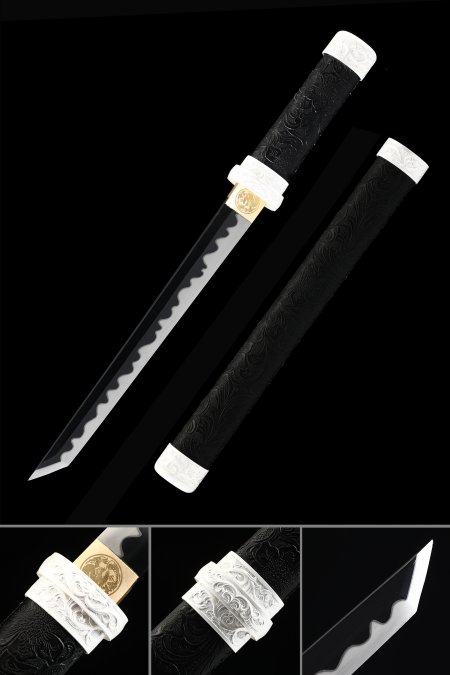
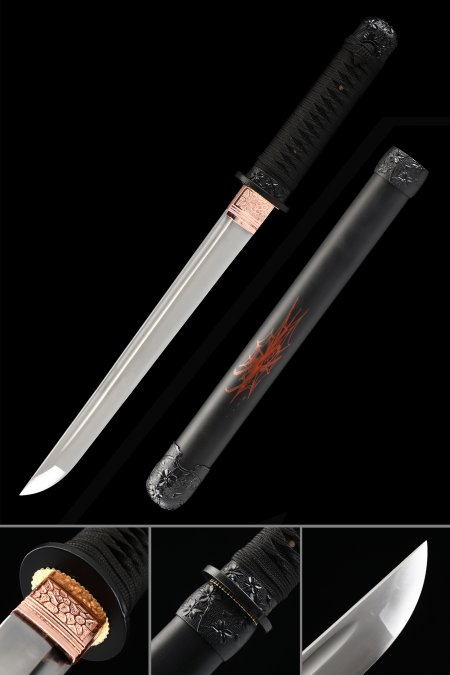
The defining difference is the guard. A standard tanto typically uses a rectangular or shaped tsuba of meaningful size, while a hamidashi uses an extremely small, coin-like guard that barely protrudes beyond the handle's width. The term hamidashi itself roughly translates to 'barely protruding,' referencing this minimal guard profile. Historically, this design was favored for close-quarters concealed carry under formal dress, but for today's collector, it represents a blade format with a uniquely refined silhouette. The smaller guard shifts visual focus entirely to the blade geometry and the quality of the handle wrapping and saya finish - every detail is exposed with nowhere to hide.
How does manganese steel differ from high-carbon steel in blades?
High-carbon steel like T10 or 1095 prioritizes hardness and edge retention, making it the standard for performance-oriented blades. Manganese steel takes a different approach - manganese as an alloying element primarily increases toughness and resistance to surface wear, and it responds well to blackening treatments, producing a stable dark finish rather than a bright polished surface. The result is a blade that holds its darkened appearance over time without the rust susceptibility of bare high-carbon steel. For a display-focused collectible where visual drama and long-term finish stability matter more than cutting geometry, manganese steel is a highly practical and aesthetically rewarding choice.
How should I store and maintain a black-finished tanto long-term?
Black-finished blades require slightly different care than traditionally polished steel. Avoid abrasive cloths or metal polishes, which can strip the oxidized surface layer and create uneven bright spots. Instead, wipe the blade periodically with a clean soft cloth to remove fingerprints - skin oils are the primary enemy of any steel finish. A very light application of camellia oil (choji oil) along the blade surface every few months provides a protective barrier against humidity without affecting the dark finish. Store the blade in its saya when not on display, and keep the display environment below 60% relative humidity. Silica gel packets placed near the display case are a simple and effective precaution.
Are these hamidashi pieces appropriate as gifts for collectors?
They are exceptionally well-suited as collector gifts, particularly for recipients who already own or appreciate full-length Japanese blades. The compact size makes unboxing and handling straightforward, and the visual impact - black lacquer saya, dragon-engraved tsuba, gold accents - reads as genuinely impressive rather than generic. Because the hamidashi format is less commonly represented in collector displays than the katana or wakizashi, gifting one adds something distinct to an existing collection. For a complete thematic presentation, pairing a hamidashi with a complementary display accessory from our Black Sake Set collection creates a gift that feels intentionally curated rather than casually chosen.
What does 'koshirae style' mean on a tanto listing?
Koshirae refers to the full set of decorative mountings on a Japanese blade - everything outside the blade itself, including the tsuba, fuchi, kashira, menuki, ito wrap, and saya. When a tanto is described as koshirae style, it means the fittings have been coordinated as a complete, cohesive set rather than assembled from unrelated components. In this collection, koshirae-style pieces typically feature matched dragon motifs across multiple hardware elements, unified color treatments, and lacquer work on the saya that ties the full assembly together visually. It is the equivalent of a tailored suit versus separates - individual components are fine alone, but the intentional coordination of a koshirae set elevates the piece into a complete aesthetic statement.