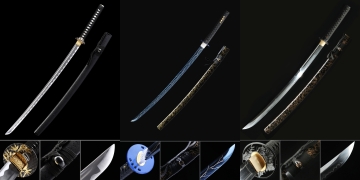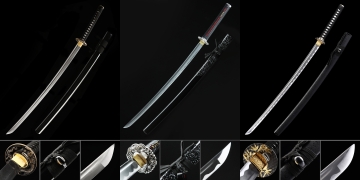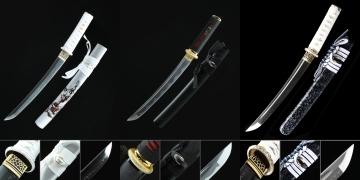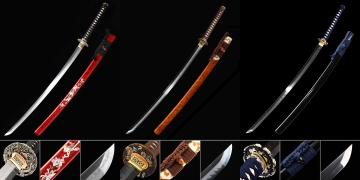
Trafalgar Law's Sword
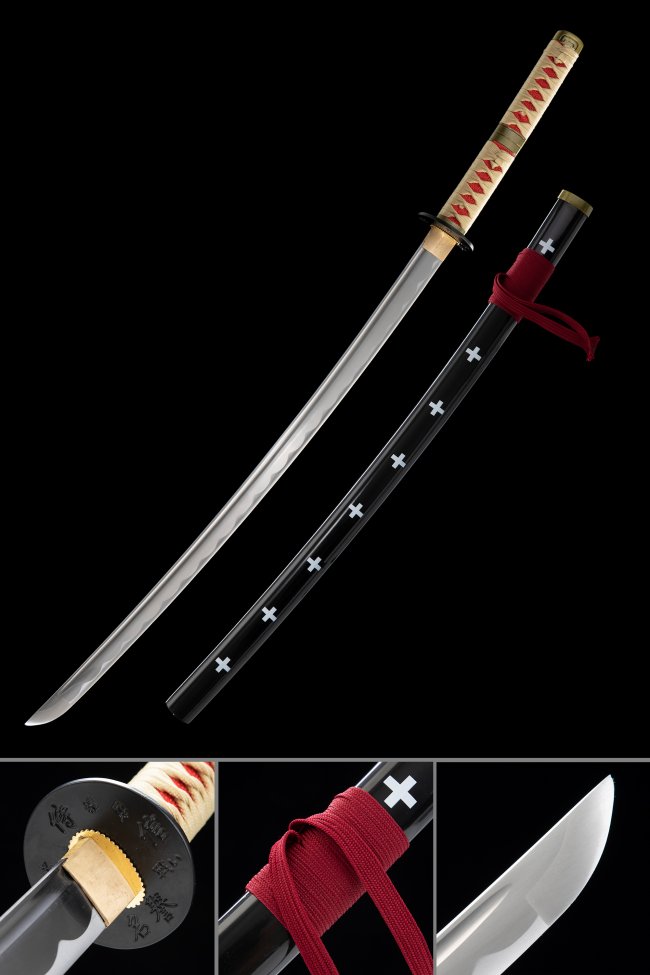
Trafalgar Law's Kikoku is one of the most recognizable blades in the One Piece universe — a cursed nodachi carried by the Surgeon of Death himself. Our hand-forged replicas are built from real 1060 carbon steel with full-tang construction, featuring Law's signature color scheme, white-fur tsuba, and a lacquered black saya. Whether you're adding to an anime sword collection or gearing up for cosplay, each piece is crafted to look accurate and feel solid in hand. Not a flimsy prop — a real steel tribute to one of the best character weapons in anime.

Related Collections
Frequently Asked Questions
What type of sword is Trafalgar Law's Kikoku?
Kikoku is a nodachi, also referred to as an ōdachi, which is a category of Japanese sword characterized by its significantly longer blade compared to a standard katana. In the One Piece series, Kikoku measures roughly 140 cm in total length, making it considerably taller than most swords carried by other characters. Beyond its size classification, Kikoku is also designated as a cursed sword — specifically, it's an ungraded Famous Blade whose curse manifests as the "Oni Wail," draining the life force of anyone who attempts to wield it without strong enough Haki. This is part of what makes it so feared within the One Piece world. For anyone looking at real-world replica versions, the nodachi classification matters because it affects the sword's proportions, balance, and display requirements. A proper Kikoku replica should reflect that extra length and the specific design details that set nodachi apart from katana: a longer grip to accommodate two-handed wielding, a wider blade profile, and in Kikoku's case, the distinctive round tsuba covered in white fur. At TrueKatana, our Kikoku sword replicas are available in both katana-scaled and full nodachi-length versions, so you can choose based on whether anime accuracy or practical display size is your priority. The cursed sword lore also makes Kikoku one of the more interesting pieces in any One Piece sword collection, since very few blades in the series carry that kind of supernatural backstory.
How did Trafalgar Law get the Kikoku sword?
The details of how Law acquired Kikoku were largely a mystery for most of the One Piece manga's run, but the novel "One Piece Novel: Law" — subtitled "The Hour of Kikoku" — finally explored this backstory. The novel follows a younger Law during his early adventures with the Heart Pirates, before the events of the main series, and reveals the circumstances under which he came to possess the cursed nodachi. What we know from the main canon is that Law already carried Kikoku when he first appeared as a rookie pirate at the Sabaody Archipelago, meaning he obtained it relatively early in his pirate career. The sword chose him in a sense — Kikoku's curse makes it nearly impossible for most people to wield, since a single swing can drain enough life force to knock someone unconscious. Only two people in known history have successfully wielded it: an ancient swordsman from Wano Country and Law himself. Law's ability to use it effectively ties to both his willpower and his Haki, suggesting a level of compatibility that goes beyond simple skill. For fans interested in the full story, the novel is worth reading as a companion piece to the manga. And for collectors, understanding this backstory adds another layer of meaning to owning a One Piece Law sword replica — it's not just a cool-looking blade, it's a weapon with a deep narrative connection to one of the series' most complex characters.
Is the Kikoku a real type of Japanese sword?
The Kikoku itself is fictional, but the sword type it's based on — the nodachi, or ōdachi — is absolutely real. Nodachi were historically used in feudal Japan, primarily during the Nanbokuchō period in the 14th century. These oversized swords featured blades typically exceeding 90 cm, and they were designed for use on battlefields against cavalry or in wide, sweeping strikes against infantry formations. Due to their extreme length and weight, nodachi were difficult to wield and eventually fell out of common military use as fighting styles evolved toward shorter, more versatile blades like the katana and tachi. In the One Piece universe, Eiichiro Oda took the real-world nodachi template and added fictional elements — the cursed blade properties, the supernatural Oni Wail, and the distinctive cross-shaped and fur-covered tsuba that don't correspond to any historical Japanese sword design. The result is something that feels grounded in real sword tradition while being unmistakably fantastical. For buyers considering a Kikoku replica, this real-world connection means the sword handles with the weight and proportions of an actual large Japanese blade, which is part of what makes a quality carbon steel replica so satisfying to hold compared to a lightweight foam or plastic version. If Japanese sword culture interests you beyond anime, exploring the broader anime katana and traditional sword collections can give you a sense of how these historical blade types translate into both fictional and functional modern replicas.
What is the Kikoku sword made of in real replicas?
Most quality Kikoku replicas — including those sold at TrueKatana — use 1060 carbon steel for the blade. This is a medium-high carbon steel that sits in a sweet spot for display swords: it's hard enough to hold an edge and resist casual dings, flexible enough that it won't snap under stress, and it accepts a decent polish for visual presentation. The "1060" designation refers to the carbon content — approximately 0.60% — which gives it better hardness than lower grades like 1045 while remaining easier to maintain than ultra-hard steels like 1095 or T10. Full-tang construction means the steel runs continuously from the tip of the blade through the handle and out to the pommel, rather than being a separate blade piece attached to a handle. This is critical for a nodachi-length weapon because the leverage forces on a long blade would quickly loosen or break a rat-tail tang. Beyond the blade, quality replicas use genuine ray-skin samegawa for grip texture, cotton or silk ito for the cord wrap, zinc alloy for the tsuba and fittings, and solid wood for the saya with a lacquer finish. Cheaper alternatives often substitute stainless steel, ABS plastic fittings, and hollow resin scabbards — these look passable in photos but feel obviously fake in person. If you're comparing options across different sellers, the steel grade and tang type are the two specs that matter most for a One Piece anime sword replica that's built to last.
Can you actually cut with a Trafalgar Law sword replica?
This is one of the most common questions from first-time buyers, and the honest answer is: it depends on the specific replica and what you mean by "cut." A properly forged 1060 carbon steel Kikoku replica with full-tang construction is technically capable of light cutting — think water bottles, pool noodles, or tatami mats if you know what you're doing. The steel is real, and if the edge has been sharpened or comes with a factory edge, it can cut soft targets. That said, these replicas are designed and sold primarily as collectibles and display pieces, not as functional cutting swords. The blade geometry, heat treatment, and edge profile are optimized for appearance and durability on a shelf, not for repeated cutting practice. Using one for serious tameshigiri would put unnecessary stress on the fittings and could loosen the handle assembly over time. Additionally, the nodachi length adds a layer of difficulty — proper cutting technique with a 140 cm blade requires training and space that most people don't have. Our recommendation is to treat your Kikoku as a premium display piece and cosplay prop, and if you're genuinely interested in cutting practice, invest in a dedicated anime katana or a purpose-built iaito. That way your collection piece stays pristine while you learn sword handling on something designed for the job.
How long is the Trafalgar Law Kikoku sword?
In the One Piece anime and manga, Kikoku is depicted as roughly 140 cm in total length — longer than Trafalgar Law is tall when you include the handle and guard, which is why he carries it slung diagonally over his shoulder. Real-world replicas come in different size options to accommodate different needs. Full-length nodachi replicas aim to match or closely approximate that 140 cm measurement, with blade lengths around 92 cm, overall length inside the sheath reaching about 141 cm, and the unsheathed sword measuring approximately 134 cm. These are impressive display pieces that make a strong visual statement, but they require adequate wall space or a tall sword stand. There are also katana-scaled versions that come in at around 103 cm overall, with a blade length near 66 cm — these are easier to handle, lighter to carry, and fit standard sword displays more comfortably, though they sacrifice some of the anime-accurate oversized presence. At TrueKatana, the full-tang Kikoku replica weighs about 2.7 lbs, making it relatively lightweight for a blade this long. If you're deciding between sizes, consider where you plan to display it and whether you'll be carrying it to events. For a dedicated display alongside other One Piece katana replicas, the full nodachi length delivers the most authentic look. For convention carry or limited display space, the katana-scaled option is more practical without losing the core design elements.
What does "Kikoku" mean and why is the sword cursed?
The name Kikoku translates roughly to "Demon's Cry" or, more literally, "the wailing of a restless ghost." In archaic Japanese, the characters combine "oni" (demon or ghost) with a term for crying out or wailing, which fits perfectly with the sword's supernatural nature in One Piece. The cursed designation is a formal classification within the series' sword ranking system — cursed swords are blades that carry some form of malevolent will or supernatural danger to their wielders. Kikoku's specific curse manifests as the Oni Wail: when someone attempts to swing the sword, it actively drains their life force. A single strike was enough to nearly knock a young Trafalgar Law unconscious when he first tried to use it, which gives you an idea of how aggressively the curse operates. Only someone with sufficiently powerful Haki can either overpower the sword's will or earn its cooperation — throughout known history, only two people managed this feat. The cursed sword lore in One Piece draws loosely from real Japanese sword mythology, where certain famous blades like the Muramasa were legendarily said to hunger for blood and bring misfortune to their owners. This cultural resonance gives the Kikoku an extra layer of depth that appeals to fans of both anime and Japanese history. For collectors, the cursed status makes Kikoku stand out in any One Piece sword collection — while Zoro's blades have their own rankings and stories, Kikoku's supernatural element is uniquely tied to the relationship between weapon and wielder.
How does Trafalgar Law use the Kikoku in combat?
Law's fighting style with the Kikoku is fundamentally different from any other swordsman in One Piece because he doesn't rely on the blade's cutting power alone — he uses it as a focal point within his Room, the spherical space generated by the Ope Ope no Mi devil fruit. Inside the Room, Law can cut anything regardless of physical durability, rearrange the pieces however he wants, and even swap the locations of objects and people. The Kikoku serves as his primary tool for directing these spatial manipulations, acting more like a surgeon's scalpel than a warrior's weapon. His signature techniques reflect this medical theme: Shambles lets him swap the positions of objects he's cut, Takt gives him telekinetic control over severed pieces, Gamma Knife creates an energy blade that destroys internal organs without external damage, and Counter Shock delivers a defibrillator-like electric attack. During the Wano arc, Law unlocked his devil fruit's awakening, allowing him to use techniques like K-Room (extending the Room's spatial abilities through the Kikoku itself) and Puncture Wille (a massive piercing attack that penetrated through an entire island). The sword-fruit combination makes Law one of the most versatile fighters in the series. For fans who appreciate this combat style, owning a Kikoku replica is about celebrating that entire package — not just a sword, but the symbol of one of the most creative fighting systems in anime sword fiction.
Where can I buy a quality Trafalgar Law sword and what should it cost?
Quality Kikoku replicas vary widely in price depending on materials, craftsmanship, and the seller's reputation. At the low end, you'll find foam and plastic versions for $20–50 — fine for casual cosplay but not suitable for serious display or collection. Mid-range wooden replicas typically run $40–80 and offer a decent balance of appearance and affordability. For a proper hand-forged carbon steel Kikoku with full-tang construction, real ray-skin grip, and a solid wood saya, expect to spend roughly $80–200 from a reputable seller. Anything significantly cheaper than that in the "carbon steel" category is likely cutting corners on materials or construction. When evaluating sellers, look for clear product photography showing the actual sword rather than renders, detailed material specifications (steel grade, tang type, fitting materials), and genuine customer reviews with photos. Shipping is another factor — a nodachi-length sword in a protective box is heavy, so free shipping offers represent real savings. At TrueKatana, our One Piece Law sword replicas include free US shipping and are backed by 30-day returns, which gives you a safety net if the sword doesn't match your expectations. We also have over 10,000 verified customer reviews across our product range, so you can see real feedback from other buyers before committing. Avoid sellers who use stock anime images as their only product photos or who can't provide specific material details — those are red flags for low-quality merchandise.
How do I display a Trafalgar Law Kikoku sword properly?
Displaying a nodachi-length sword takes a bit more thought than mounting a standard katana because of the extra length and weight. The most popular option is a horizontal wall mount — typically two hooks or a dedicated sword rack that supports the blade at two points roughly a third of the way in from each end. For a 140 cm Kikoku, you'll need at least 150 cm of clear wall space to give it some breathing room on either side. Make sure the wall mount is rated for the weight (a carbon steel Kikoku with saya can weigh 3–4 lbs total) and anchored into wall studs rather than just drywall. Vertical floor stands are another option and work well if you want the sword displayed alongside other pieces from your collection — Zoro's katanas on one stand, Law's Kikoku on another, for example. If you go vertical, ensure the stand has a wide enough base to prevent tipping, especially with a top-heavy nodachi. One important display consideration: keep the blade out of the saya for long-term display if possible. As mentioned in the maintenance section, storing carbon steel inside a scabbard traps moisture and promotes hidden corrosion. A mount that holds the bare blade with the saya displayed separately below it is both visually striking and better for preservation. Avoid displaying the sword in direct sunlight, which can fade the cord wrap and dry out wooden components, and keep it away from kitchens or bathrooms where humidity fluctuates frequently. With the right setup, a Kikoku makes a stunning centerpiece in any anime katana display.
What is the difference between Trafalgar Law's sword and Roronoa Zoro's swords?
This comparison comes up constantly among One Piece fans and collectors, and the differences are significant in both the story and in what you get as a replica buyer. Starting with the basics: Zoro carries three katana-length swords as part of his Santoryu (three-sword style), while Law carries a single nodachi. Zoro's blades — Wado Ichimonji, Sandai Kitetsu, and Enma — are all standard katana size, roughly 100–105 cm with the saya. Law's Kikoku at 140 cm towers over all of them. In terms of in-universe ranking, Zoro's collection includes a Great Grade sword (Enma, formerly wielded by Kozuki Oden) and a Grade sword (Wado Ichimonji), while Kikoku is classified as an ungraded Famous Blade — lower in the official ranking but carrying the unique distinction of being a cursed sword. The combat philosophy is completely different too: Zoro is a pure swordsman who relies on physical strength, Haki, and blade technique, while Law uses Kikoku as a conduit for his devil fruit surgical abilities. For collectors, this means Zoro's swords offer variety — three distinct designs with different color schemes and guard shapes — while Kikoku is a single statement piece with its own unique presence. Many One Piece fans collect both, and the visual contrast between Zoro's trio of katanas and Law's single oversized nodachi makes for a fantastic display arrangement. If you're building a complete One Piece sword collection, having both sets represented is the way to go.
Is a Trafalgar Law sword replica safe for cosplay at conventions?
Convention weapon policies vary significantly from event to event, and this is something you need to research before you show up with a 140 cm metal nodachi. Most large anime conventions — think Anime Expo, New York Comic Con, Dragon Con — have strict rules that generally prohibit live steel, meaning real metal blades regardless of sharpness. Some cons allow metal swords if they're peace-bonded (zip-tied into the scabbard so they can't be drawn), while others ban metal entirely and only permit foam, wood, or plastic weapons. Smaller local conventions may have more relaxed rules, but you should always check the specific event's cosplay weapon policy before attending. For maximum versatility, many Law cosplayers own two versions: a foam or wooden Kikoku for conventions where metal isn't allowed, and a carbon steel version for photoshoots, meetups, and home display where restrictions don't apply. If you do bring a metal replica to an event that allows peace-bonded steel, bring your own zip ties and arrive early for the weapons check — lines can get long. Also keep in mind the practical side: carrying a 140 cm sword through crowded halls all day is physically tiring and you'll bump into people constantly. A shoulder sling that mimics how Law carries the Kikoku in the anime helps distribute the weight and keeps it out of the way. Whatever version you choose, pairing it with a solid Law cosplay — the Heart Pirates' jolly roger hoodie, the spotted hat, the tattoo sleeves — really brings the full character to life alongside the anime sword.
Customer Reviews
This process has been great! SF-International shipping was amazing. I'm talking updates and whereabouts of the package at ALL times. If the delivery driver had to pull over to shit, I'd be told how many wipes he did, phenomenal. r
The swords themselves are SUPERB (Jeremy Clarkson voice). They respond quick to any questions I had. The swords are great quality. I can tell that they were crafted with precision and care. The blades are sharp and sleek. The scabbards have as much quality and care as the rest of the blade. r
The only way this experience and product could improve is if they gave me sword lessons from Roronoa Zoro himself.r
Thank you TrueKatana for caring about your products and your customers.
![]() |
Trafalgar Law Sword Kikoku - One Piece Surgeon of Death Nodachi 1060 Carbon Steel Red Yellow Handle |
The sword is beautiful. Well made and well packaged for a long trip to me. Shopping was quick, I never even got slightly anxious it wouldn’t arrive in time.
![]() |
Trafalgar Law Sword Kikoku - One Piece Surgeon of Death Nodachi 1060 Carbon Steel Red Yellow Handle |
I’m going to bust on this sword because of how beautiful it is.
![]() |
Trafalgar Law Sword Kikoku - One Piece Surgeon of Death Nodachi 1060 Carbon Steel Red Yellow Handle |
I am so happy with my sword. I'm so glad I found this site.
![]() |
Trafalgar Law Sword Kikoku - One Piece Surgeon of Death Nodachi 1060 Carbon Steel Red Yellow Handle |
The sword arrived with a few dents and bubbly paint but not noticeable unless you are looking for problems I like it would buy again.
![]() |
Trafalgar Law Sword Kikoku - One Piece Surgeon of Death Nodachi 1060 Carbon Steel Red Yellow Handle |
Very cool, looks exactly like what it did online and cool packaging box!
![]() |
Trafalgar Law Sword Kikoku - One Piece Surgeon of Death Nodachi 1060 Carbon Steel Red Yellow Handle |
Absolutely beautiful of a sword, the blade is so stunning and so eye catching, that its accuracy is unlike any other, if you ever meed a katana, these guys, are gonna be the one for you, but 10/10 most beautiful blade ever
![]() |
Trafalgar Law Sword Kikoku - One Piece Surgeon of Death Nodachi 1060 Carbon Steel Red Yellow Handle |