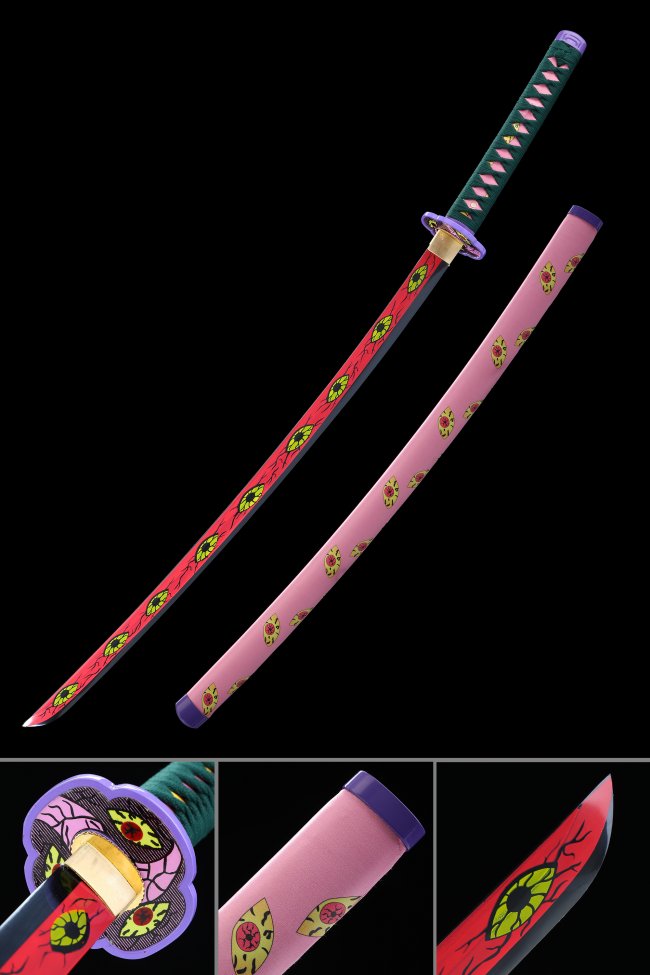
Kokushibo Sword
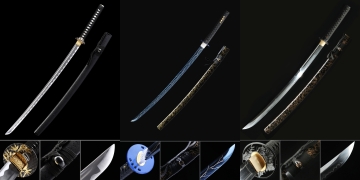
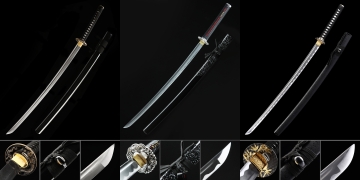
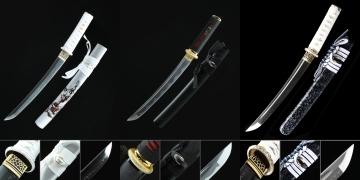
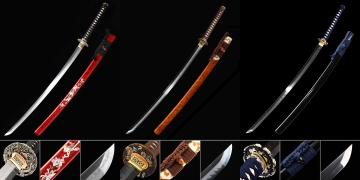
The most unsettling blade in Demon Slayer belongs to the most powerful demon under Muzan. Kokushibo's sword — a flesh-born katana covered in organic eyes, veined with blood-red ridges, and edged with crescent-moon serrations — looks nothing like any other Nichirin blade in the series. These hand-forged replicas capture that disturbing beauty in real carbon steel, from the eye-motif tsuba to the jagged wave profile that defines Moon Breathing's signature weapon.

Frequently Asked Questions
Who is Kokushibo and why is his sword so important in Demon Slayer?
Kokushibo is Upper Moon 1 of the Twelve Kizuki, the strongest demon serving directly under Muzan Kibutsuji and the second-most powerful antagonist in all of Demon Slayer: Kimetsu no Yaiba. In his human life, he was Michikatsu Tsugikuni, the older twin brother of Yoriichi Tsugikuni — the man who invented Sun Breathing and came closer than anyone to killing Muzan. That family connection is everything. Yoriichi was born a prodigy; Michikatsu was not. Watching his brother effortlessly surpass him drove Michikatsu to an unhealthy obsession with strength, and when death came for him as an old swordsman, he chose to become a demon rather than accept mortality.
His sword is important for three reasons. First, it represents the culmination of four hundred years of training — far longer than any living Demon Slayer has ever practiced. Second, it is the physical manifestation of Moon Breathing, the only Breathing Style directly descended from Sun Breathing besides Sun Breathing itself. Third, it transforms. During the Infinity Castle arc, Kokushibo uses his Blood Demon Art to turn the blade into a living "flesh sword" covered in muscle, tendons, and eyes — one of the most visually shocking moments in the manga.
For collectors, the sword carries all of that weight. Unlike a standard Demon Slayer Nichirin Sword, Kokushibo's blade tells a story of regret, jealousy, and the corrupting power of fear. Fans who buy this blade are not just picking up an anime weapon — they are picking up a symbol of the series' deepest character tragedy.
There is also a lineage angle that makes the sword meaningful. Because Kokushibo was Yoriichi's brother, his blade is technically the only surviving weapon in the story that connects back to the original Sun Breathing swordsman — Yoriichi's own Nichirin blade was destroyed long before the events of the series. Owning a Kokushibo replica is, in a real sense, holding the closest thing to Yoriichi's legacy that still exists in the world of Demon Slayer. That is why it consistently ranks among the top-requested Upper Moon weapons in our catalog, right alongside the original Tanjiro Sword and the entire Demon Slayer Sword lineup. Owning it is the closest thing to having a piece of Upper Moon 1's legacy sitting on your wall.
What does Kokushibo's sword actually look like compared to other Nichirin blades?
Kokushibo's sword stands out from every other blade in Demon Slayer for several specific reasons, and understanding the design details helps you pick the right replica. Start with the blade itself. Unlike the standard katana length used by most Hashira and Demon Slayers, Kokushibo's blade is noticeably longer — closer to an odachi than a traditional katana, which reflects his imposing height and four-hundred-year combat experience. The color is a deep, almost iridescent indigo-black, darker than Tanjiro's Black Nichirin Sword and carrying a faint purple sheen in certain lighting.
The tsuba (guard) is one of the most recognizable elements. Where most Nichirin blades use a round or square guard with simple openwork, Kokushibo's is an elongated, rectangular shape with a notched design, giving the sword a more elegant and archaic silhouette. The hilt wrap is dark — charcoal, black, or deep purple depending on the scene — and the pommel is understated to match the overall aesthetic. The scabbard follows the same palette: matte black with subtle detailing.
Then there is the flesh form, which is not something you see on any other blade in the series. In the second phase of his Infinity Castle fight, Kokushibo uses his Blood Demon Art to transform the sword into a living weapon — the steel sprouts muscle fibers, tendons, and dozens of blinking eyes along the length of the blade, becoming a grotesque extension of his own demonic body. Some TrueKatana replicas capture this flesh form with sculpted detail, while others stick to the classic polished blade for collectors who prefer the original look.
Compared to the standard Black Katana or the Black Katana line, Kokushibo's blade is longer, darker, and more ornate. It is designed to stand out in a collection, not blend in. If you have already bought a standard Handmade Katana, the Kokushibo sword will feel like a serious upgrade in presence.
One more detail that sets this blade apart is the proportion of the hilt to the blade itself. Most Nichirin swords in Demon Slayer use a handle sized for one or two-handed grip at standard katana ratios. Kokushibo's hilt is wrapped tighter and slightly shorter relative to the total length, emphasizing the reach of the blade. When you hold the TrueKatana replica, the weapon feels less like a katana and more like a hybrid between a katana and an odachi — a unique hand-feel that matches nothing else in the Demon Slayer catalog.
Is the Kokushibo sword battle-ready or just a display replica?
It depends on the model you pick. TrueKatana offers Kokushibo swords across the full spectrum — from decorative display pieces meant to look beautiful on a wall to genuinely battle-ready blades you can use for test cutting. The distinction comes down to steel grade, tang construction, and whether the blade has been heat-treated for performance.
Our entry-level Kokushibo replicas use 1045 carbon steel, sometimes with a darker finish to match the anime coloring. These are designed for display, cosplay, and light handling. They look great on a wall mount or behind glass, but they are not meant for actual cutting — the steel is not hard enough to hold a working edge under impact, and pushing them past their limits will damage the blade. If you want a showcase piece for your Demon Slayer collection, this tier works beautifully at a lower price point.
Our mid-tier Kokushibo swords use 1060 carbon steel with full-tang construction. These are the sweet spot for collectors who want a blade that can both display well and handle some light cutting practice on tatami mats or water bottles. The steel holds a working edge, the tang runs the full length of the handle, and the blade is balanced for actual use. This matches the standard we apply to our Battle Ready Katana line.
The premium tier uses T10 tool steel, often clay-tempered to produce a visible hamon line along the blade. Our T10 Carbon Steel Katana and Clay Tempered Katana collections include options at this level. T10 offers the highest hardness, the best edge retention, and the cleanest polish — ideal for serious cutters and collectors who want a heirloom-quality piece.
Every product page lists the specific steel grade, blade length, weight, and whether the sword is intended for display or cutting. Read carefully before ordering and pick the tier that matches how you plan to use the blade. If you want a safe unsharpened option for iaido or kata practice, a Training Katana is a better choice than a battle-ready replica.
One caveat: even the strongest Kokushibo replica is not indestructible. Hitting the wrong target — metal, concrete, hardwood, or another sword — will damage any blade, regardless of steel grade. Stick to the traditional test media like tatami omote, water-filled bottles, or green bamboo if you want to cut with your sword, and your blade will last a lifetime.
What is Moon Breathing, and how is it connected to Kokushibo's sword?
Moon Breathing is the signature sword style of Kokushibo, and it is one of the most important Breathing techniques in all of Demon Slayer: Kimetsu no Yaiba. It was created by Michikatsu Tsugikuni — the man who would become Kokushibo — after he failed to master his brother Yoriichi's Sun Breathing. Sun Breathing was the original style, the one from which every other Breathing Style in the series descends. Water Breathing, Flame Breathing, Thunder Breathing, Wind Breathing, Stone Breathing — all of them are simplified branches of Sun Breathing, created because no one else could wield the full technique Yoriichi invented.
Moon Breathing is different. It is the only Breathing Style besides Sun Breathing itself that descends directly from Yoriichi's teaching. When Michikatsu could not perform Sun Breathing properly, he took the forms he could do and built something new around them, shaping the style into his own image and naming it Moon Breathing — a counterpart to the sun that killed demons.
The connection to Kokushibo's sword is direct. Every Moon Breathing form requires his specific blade to execute properly. The extended length of the weapon allows the crescent-shaped slashes of Moon Breathing to fan out farther than any standard katana could manage. Forms like "Moon-Dyed Eyes" and "Catastrophe: Moonlit Night" produce dozens of crescent blade projections that sweep across the battlefield, which is why the technique looks almost like an aura of moonlight during fights.
Kokushibo has 16 known Moon Breathing forms, making it one of the most technically elaborate Breathing Styles in the series. Compare that to Flame Breathing's 9 forms (see our Rengoku Sword page) or Water Breathing's 11. The extra depth reflects Kokushibo's four centuries of practice — he has had more time to develop and refine techniques than any living swordsman in the series.
Owning his sword is the closest way to connect with that style. TrueKatana's replica is built to match the anime's proportions, so when you hold it, you get the same reach and feel that the character uses in his signature techniques. Cosplayers practicing Moon Breathing stances for conventions or photoshoots often comment that the length and balance of our replica make the iconic poses look noticeably more authentic than with a standard katana.
What is the "flesh sword" form, and does TrueKatana sell that version?
The flesh sword is one of the most unforgettable visuals in the entire Demon Slayer manga and anime. During the Infinity Castle arc, Kokushibo realizes that the Hashira attacking him are growing too coordinated for his standard swordsmanship to handle alone. To push the fight in his favor, he activates his Blood Demon Art on the sword itself, causing the blade to undergo a grotesque transformation.
The steel begins to sprout living tissue. Muscle fibers wrap around the edge, tendons stretch along the spine, and dozens of blinking human-like eyes appear at intervals down the blade — the same "six eyes" motif that covers Kokushibo's face. The sword is no longer an object he holds; it becomes an extension of his own demonic body, growing and adapting in real time. This form also boosts its destructive power, allowing Kokushibo to slice through defenses that had previously stopped his standard attacks.
It is a moment that reshapes how readers understand the character. Until that scene, Kokushibo was portrayed as a disciplined, almost samurai-like demon who clung to his swordsmanship because it was the last human thing he had left. The flesh sword transformation strips that away, showing how far gone his humanity really is. He is no longer a swordsman with a katana — he is a demon whose weapon is literally part of his own flesh.
Yes, TrueKatana does carry versions of the Kokushibo Kokushibo Sword that capture the flesh form. These models feature sculpted detail on the blade surface — painted muscle patterns, molded eye sockets along the edge, and darker coloration to simulate the organic transformation. They are popular with serious Demon Slayer collectors who want to capture a specific scene from the manga or anime in their display. For fans who prefer the original polished blade, we also carry the standard pre-transformation version, which looks more like a traditional Nichirin blade and fits in better next to other Hashira replicas in a mixed display.
Both versions are hand-forged, full tang, and backed by the same 30-day satisfaction guarantee. Pick the form that matches the moment in the story you connect with most.
How long is a Kokushibo sword compared to a standard katana?
Length is one of the defining features of Kokushibo's sword, and it has real implications for how the replica feels in your hand. A standard katana has a blade length of about 27 to 30 inches, with a handle of around 10 to 12 inches, giving a total length of roughly 39 to 42 inches. That is the size you will find on most Handmade Katana and Battle Ready Katanalistings.
Kokushibo's sword breaks that mold. In the manga and anime, his blade is drawn noticeably longer than the weapons carried by the Hashira or Tanjiro. Most estimates put his in-universe blade length at 32 to 36 inches, with an overall length of around 48 inches or more once you add the hilt. That extra reach is a deliberate design choice — it reflects Kokushibo's towering human-form height (over six feet before his demon transformation), his four centuries of combat experience, and the extended crescent slashes required by Moon Breathing forms.
TrueKatana's replica follows this proportion. Our Kokushibo swords are longer than our standard katana lines, closer to the size of an odachi or field sword. When you hold one, the balance point sits slightly farther forward than on a regular katana, and the overall weight is higher — typically 2.5 to 3.5 pounds depending on steel grade. That means the sword feels more substantial, which is part of its appeal for display, but it also means two-handed use feels more natural than one-handed swinging.
For buyers with limited display space, the extra length is worth considering. You will need a wall mount or stand that can accommodate at least 48 inches of total length. Our Katana Wall Mount hardware comes in several sizes, and we recommend the larger mount for Kokushibo replicas and the matching size for companion pieces like the Muichiro Swordif you are building a Hashira-versus-Upper-Moon display.
If you are buying a Kokushibo sword as your first anime katana, be aware that it is a bigger sword than you may be used to — and that size is exactly what makes it special.
How should I display my Kokushibo sword at home?
A sword this distinctive deserves a display that shows it off properly. Here are the main options most collectors use for their Kokushibo replica.
Horizontal wall mount. This is the most popular choice and works best for long blades like Kokushibo's. Mount the sword edge-down on a set of wall brackets, ideally at eye level or slightly above. The horizontal orientation lets you see the full curve and length of the blade, and the dark blade color contrasts beautifully against a light-colored wall. A Katana Wall Mount rated for longer blades is ideal — standard mounts may be too short. Anchor the mount to wall studs, not just drywall, because a 3-pound sword at wall-mount height needs real support.
Vertical wall mount. Less common but dramatic. Mounting the sword vertically with the tip up gives the impression that Kokushibo has just drawn it. This style works best in a frame or shadow box where dust does not settle on the upward-facing edge.
Tabletop sword stand. If you do not want to drill into walls, a wood or metal stand sitting on a shelf or desk is the flexible option. You can rotate swords in and out of rotation, keep the piece within arm's reach, and transport it easily. The tradeoff is that tabletop displays collect dust faster and are more vulnerable to being knocked over.
Shadow box or glass case. The premium option for serious collectors. A sealed case protects the blade from dust, humidity, and fingerprints, and it doubles as a photo-worthy centerpiece. Shadow boxes work especially well for the flesh form version, where the detailed blade deserves extra protection.
Pair it with other Demon Slayer weapons. Kokushibo is more impactful when displayed alongside the Hashira he fought. A wall showing his blade next to the Muichiro Sword, Sanemi Sword, and other Hashira weapons tells a visual story about the Infinity Castle arc. Matching mounts in consistent colors tie the collection together.
Lighting matters too. Avoid direct sunlight — UV will fade the dark finish over time. Warm LED spotlights above the blade bring out the hamon line and the subtle purple sheen that Kokushibo's replica often has.
How do I take care of my Kokushibo sword to prevent rust and damage?
High-carbon steel is the right choice for a quality sword replica, but it comes with one tradeoff: it rusts. Without proper care, your Kokushibo sword will develop orange spots within weeks, especially in humid climates. The good news is that maintenance is simple, cheap, and only takes a few minutes a month.
Step 1: Always wipe down after handling. Fingerprints contain oils and salt that will etch carbon steel overnight. Whenever you touch the blade, wipe it down with a soft microfiber cloth or a cotton rag before putting it away. Do this every single time — no exceptions.
Step 2: Oil the blade regularly. Use a light mineral oil, traditional camellia oil (choji), or a modern synthetic like Ballistol. Put a few drops on a clean cloth and wipe a thin, even layer across the entire blade from tang to tip. For display swords that live on a wall, oil once every 2–3 months. For swords you handle frequently, oil weekly. In humid climates or coastal areas, oil more often.
Step 3: Manage the scabbard. A saya can trap moisture against the blade, accelerating rust. Do not leave the sword fully sheathed for months at a time without inspecting it. Once a month, draw the blade, wipe it down, oil it, and re-sheath. If you notice rust spots forming inside the scabbard, air it out and add a silica gel desiccant packet to the storage area.
Step 4: Control your storage environment. Keep the sword in a climate-controlled room — ideally 60–75°F and under 60% humidity. Avoid basements, garages, attics, and any space with temperature swings. Condensation is the enemy of carbon steel. A wall mount in a climate-controlled living room is better than a locked case in a humid basement.
Step 5: Handle the hilt carefully. The wrapped handle (cotton, silk, or leather cord) absorbs sweat and dirt over time. Wipe it with a dry cloth after handling, and do not use blade oil on the wrap — oil breaks down cord wrappings. If the wrap loosens or frays, a sword restorer can re-wrap it for a reasonable fee.
If rust does appear, treat it early. Light surface rust can be cleaned with a brass brush or a bamboo skewer with a drop of oil. Deeper pits need professional polishing. Catch it early and your Kokushibo sword will stay pristine for decades.
Can I legally own a Kokushibo sword in my country?
In most places, the answer is yes — anime replica swords like Kokushibo's are legal to own as collectibles or decorative items. In the United States, federal law does not restrict sword ownership, and the vast majority of states allow adults to buy, own, and display katanas without any permit or license. Carrying a sword in public is a different matter, with rules varying by state and city, but owning one at home is almost always unrestricted.
International rules vary more. The United Kingdom has specific restrictions on curved swords with blades over 50 cm under the Offensive Weapons Act, but there is an exemption for hand-forged replicas produced using traditional methods, which is why TrueKatana still ships to UK customers while many cheap imports do not. Canada, Australia, and most of continental Europe allow sword ownership for adults, though transport, concealment, and import rules apply. Japan has some of the strictest sword laws in the world due to the historical and cultural significance of nihonto — importing a sword into Japan can be complicated even if the sword itself is perfectly legal to own elsewhere.
Age is a universal requirement. TrueKatana sells only to verified adults 18 or older, and some jurisdictions require age verification at delivery. If you are buying a Kokushibo sword as a birthday gift for a younger fan, the order should be placed by a parent or guardian, and the sword should remain under adult supervision. For conventions and cosplay events, most organizers allow sheathed anime replicas as part of a costume, with the rule that the blade must stay peace-bonded (zip-tied into the scabbard) during the event. Demon Slayer cosplay is hugely popular at anime cons, and a properly peace-bonded Kokushibo sword is usually welcomed without issue.
Customs clearance can add wrinkles for international orders. Some countries classify replica swords as restricted imports, requiring additional paperwork or duties at the border. TrueKatana ships internationally with tracking, but customs fees are the buyer's responsibility and vary by country. Check your local import rules before ordering to avoid surprises. When in doubt, start with the laws in your specific state, province, or country — we cannot give legal advice, but most collectors find anime sword ownership to be one of the easiest categories of edged weapon to own legally.
How is each Kokushibo sword made?
Every Kokushibo sword at TrueKatana is forged by hand, not stamped out of a machine. Here is how the process works, from raw steel to finished blade.
Step 1: Steel selection. The smith starts with a bar of high-carbon steel — 1045 for entry-level display blades, 1060 for working swords, 1095 or T10 for premium clay-tempered versions. The Kokushibo sword is usually forged at the longer end of our blade sizes, so the starting billet is sized accordingly.
Step 2: Rough forging. The steel is heated in a coal or propane forge until it glows bright orange, around 1500°F. The smith then hammers it into the rough shape of the blade, establishing the curve, the taper, and the distinctive longer length that matches Kokushibo's proportions. This stage can take hours of repeated heating and hammering.
Step 3: Heat treatment and clay tempering. For premium models, the smith applies a layer of clay slurry to the spine of the blade before quenching. The clay insulates the spine, so when the blade is plunged into oil, only the exposed edge hardens into martensite. This creates the classic hamon line — a wavy visual boundary between hard edge and soft spine that marks a true clay-tempered sword like those in our Clay Tempered Katana collection.
Step 4: Tempering. The hardened blade is reheated to around 400°F to reduce brittleness. This is what gives the sword its combination of edge retention and impact resistance — skipping tempering leaves a blade that is hard but fragile.
Step 5: Polishing. A team of polishers works the blade through progressively finer stones, revealing the grain of the steel and sharpening the visible hamon line. This is the stage that separates cheap mass-produced swords from real handcrafted pieces. Hand polishing can take 20 hours or more per blade.
Step 6: Fittings. The smith matches the blade to a carved tsuba, a lacquered wooden saya, and a wrapped handle. For the Kokushibo sword, the fittings are dark and elongated to match the character's anime design — a charcoal or deep purple hilt wrap, rectangular tsuba, and black scabbard.
Step 7: Final inspection. Every finished sword is hand-inspected before shipping, checking for fit, edge geometry, hilt tightness, and blade straightness. Only then does it ship.
What other Demon Slayer swords pair well with Kokushibo's in a display?
Kokushibo is the most powerful Upper Moon demon Kokushibo fights, and that makes for dramatic display options when you pair his blade with the right companion weapons. Here are the combinations that work best for building a Demon Slayer collection.
The Hashira who fought him. The Infinity Castle battle pitted Kokushibo against four Hashira at once. Displaying his sword alongside the Muichiro Sword (Mist Hashira), Sanemi Sword (Wind Hashira), and Gyomei's stone weapon creates a visual narrative of that fight. The contrast between Kokushibo's long, dark blade and the Hashira's colored Nichirin swords makes the display pop.
Tanjiro and the red Nichirin. Kokushibo is ultimately defeated in the manga because of lineage — Tanjiro's line carries the blood of Yoriichi, Kokushibo's own brother. Pairing the Kokushibo sword with a Tanjiro Sword in its black or red form captures that thematic connection between the two characters across centuries.
A full Upper Moon set. If you are going for the full villain collection, pair Kokushibo with replicas of the other Upper Moon weapons. While not every Upper Moon used a katana, the ones who did make up the most iconic demon lineup in the series.
All the Hashira. Some collectors go for the full Hashira display as a counterpoint to Upper Moon 1. TrueKatana carries the Rengoku Sword, Shinobu Sword, Mitsuri Sword, Giyuu Sword, and Inosuke Sword to round out the Demon Slayer Corps side of the display.
Colored Nichirin variants. For fans who want the pure Nichirin aesthetic, combining Kokushibo's blade with the Black Nichirin Blade Sword, Red Nichirin Blade Sword, and White Nichirin Blade Sword creates a gallery of colored blades representing every Breathing Style.
A Katana Set display stand with two or three slots is the easiest way to group swords visually, while larger collectors go for full wall racks.
Scale and spacing matter. Because Kokushibo's blade is longer than most Demon Slayer weapons, place it at the center or top of your display so its size makes visual sense. Flanking it with shorter Hashira blades on either side creates a symmetrical arrangement that emphasizes the power differential between Upper Moon 1 and the Corps. If you are still building the collection, start with Kokushibo and Tanjiro as anchor pieces, then add other characters as budget allows. Over time, you will end up with one of the most complete Demon Slayer displays any fan can assemble.
Customer Reviews
Good quality, pretty heavy, not too sharp. Definitely good for displaying. Definitely will get more from here, when I can
![]() |
Kokushibo Sword - Kimetsu No Yaiba Upper Moon One Nichirin, 1045 Carbon Steel, Eye Tsuba |
Shipped fast. It’s a beautiful Katana. My daughter added a Katana to her birthday wishlist and said I could only get it for True Katana. Hopefully she loves it.
![]() |
Kokushibo Sword - Kimetsu No Yaiba Upper Moon One Nichirin, 1045 Carbon Steel, Eye Tsuba |
Great product, my son was stoked! And it got here quicker than local post....🤔
![]() |
Kokushibo Sword - Kimetsu No Yaiba Upper Moon One Nichirin, 1045 Carbon Steel, Eye Tsuba |
It’s incredible and I do plan to come back for more just based on how beautiful these katanas are.
![]() |
Kokushibo Sword - Kimetsu No Yaiba Upper Moon One Nichirin, 1045 Carbon Steel, Eye Tsuba |
Arrived fast to the U.S had trouble opening it the first time due to the wrap on the blade but other then that 5/5 would purchase again and probably will :)
![]() |
Kokushibo Sword - Kimetsu No Yaiba Upper Moon One Nichirin, 1045 Carbon Steel, Eye Tsuba |
Thank you. Quick delivery got here a day after her birthday and I ordered it three days before
![]() |
Kokushibo Sword - Kimetsu No Yaiba Upper Moon One Nichirin, 1045 Carbon Steel, Eye Tsuba |
Great quality, it looks amazing and the shipping was speedy.
![]() |
Kokushibo Sword - Kimetsu No Yaiba Upper Moon One Nichirin, 1045 Carbon Steel, Eye Tsuba |
It’s perfect and very well balanced I love it a lot thank you guys
![]() |
Kokushibo Sword - Kimetsu No Yaiba Upper Moon One Nichirin, 1045 Carbon Steel, Eye Tsuba |