What makes a hamidashi different from a standard tanto?
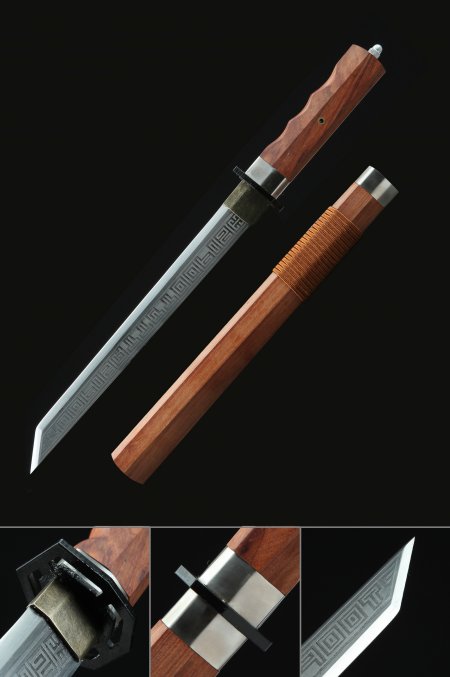
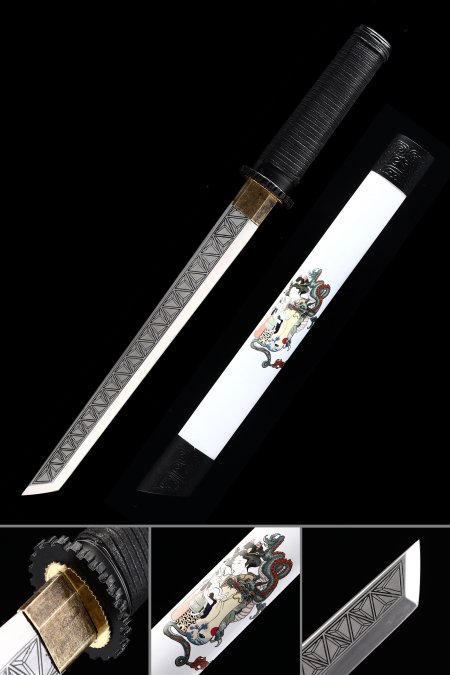
The defining characteristic of a hamidashi is its ko-tsuba — a very small guard that barely protrudes beyond the handle collar, unlike the more prominent tsuba found on a standard tanto or katana. This minimal guard gives the hamidashi a cleaner, more streamlined profile while still providing the traditional visual separation between handle and blade. For collectors, this subtle distinction matters: it signals a specific subcategory of Japanese short-blade design that prioritizes refined proportions over decorative embellishment at the guard. The hamidashi silhouette reads as quieter and more austere, which makes it an excellent format for showcasing blade-level artistry like geometric engravings without visual competition from elaborate fittings.
What is T10 steel and why do collectors value it?
T10 is a high-carbon tool steel with a carbon content of approximately 1.0%, placing it in the upper range of blade steels commonly used in Japanese-style collectibles. What distinguishes T10 for collectors is its fine grain structure and its responsiveness to clay tempering — a process where the spine is coated in refractory clay before the heat treatment, causing the edge and spine to cool at different rates. This differential hardening produces a genuine hamon, the visual boundary line between hard and softer steel zones. On a display piece, a real clay-tempered hamon has a depth and activity — subtle cloudlike formations called nie and nioi — that a polished or acid-etched imitation simply cannot replicate. T10 clay tempered collectibles are valued precisely because the metallurgical process is authentic, not cosmetic.
How are geometric patterns engraved onto a tanto blade?
Geometric blade engravings are typically produced through hand engraving or precision mechanical engraving after the blade has been ground and polished. The engraver works directly into the steel surface, cutting repeating angular forms, line sequences, or tessellated motifs with specialized burins or rotary tools. On high-carbon steel like T10, the engraving must be performed with care to avoid introducing stress risers into the blade structure, making craftsmanship quality a meaningful differentiator. Once engraved, the geometric patterning interacts with the polished steel surface to create shifting visual effects under different lighting conditions — one of the reasons geometric blade tantos are particularly rewarding as display collectibles viewed from multiple angles.
How should I store and maintain a hamidashi tanto for display?
High-carbon steel like T10 is reactive to moisture and fingerprint oils, so regular light maintenance is essential for keeping a display piece in optimal condition. Apply a thin coat of food-grade mineral oil or traditional choji oil to the blade every two to three months using a soft, lint-free cloth. When handling the blade for cleaning or repositioning, wear cotton gloves to avoid transferring skin oils directly to the polished surface. Store the tanto in its saya when not displayed, and keep the display environment away from high-humidity areas or direct sunlight, which can accelerate oxidation and cause lacquer finishes on the saya to fade or crack over time. If condensation is a concern in your display area, a silica gel desiccant packet placed nearby will help stabilize the ambient moisture level.
Does the saya material affect the collectible value of a tanto?
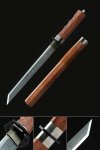
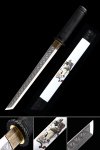
Yes, the saya is considered an integral part of a tanto's overall presentation and contributes meaningfully to how the piece is assessed as a collectible. Rosewood saya carry natural grain variation that gives each piece a degree of uniqueness, and the warm tones of the wood provide organic contrast to engraved or polished blade surfaces. White lacquer saya, on the other hand, offer a more formal, high-contrast aesthetic that suits gallery-style display arrangements and pairs naturally with bold decorative themes like dragon motifs. From a care standpoint, lacquered saya require protection from impact and temperature fluctuation to prevent crazing or chipping, while wood saya benefit from occasional light conditioning to prevent drying. Collectors who prioritize visual coherence in a display often select saya finish as deliberately as they select blade style.