What does "vine tsuba" mean in Japanese blade collecting?
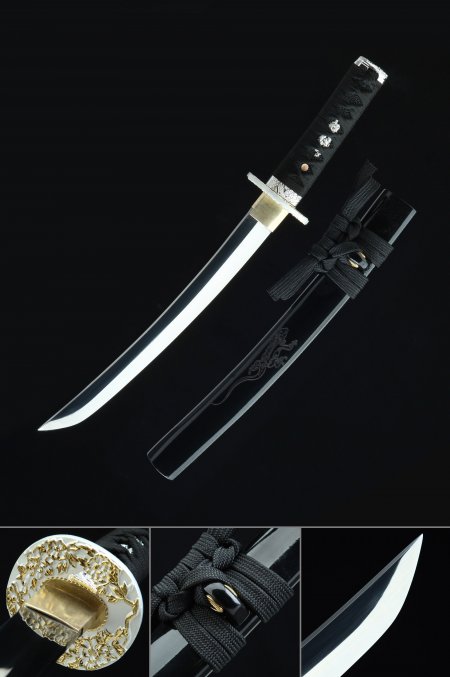
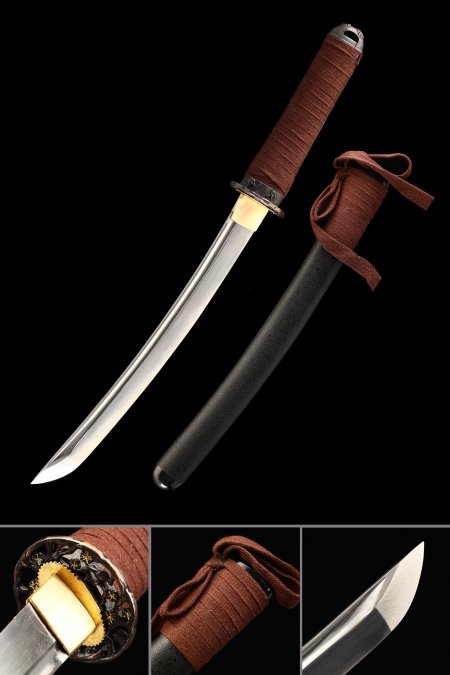
The tsuba is the guard fitted between a blade's handle and its blade section, and it functions as the primary decorative statement of a mounted Japanese blade. A "vine tsuba" refers specifically to a guard featuring carved or cast interlaced vine and foliage motifs - a pattern with deep roots in Japanese decorative arts borrowed partly from Chinese and Korean artistic traditions. In the context of tanto collecting, a vine-motif tsuba signals a preference for organic naturalism over geometric abstraction or figural scenes. Copper is the most common base metal for this style, often enhanced with gilt or shakudo inlay to add tonal contrast against the flowing vine relief. Collectors prize vine tsuba for their visual movement - the eye naturally follows the curving lines - and for the way they complement the compact, purposeful silhouette of a tanto without overwhelming it.
How does 1045 steel differ from high manganese steel in a tanto?
1045 carbon steel is a medium-carbon alloy with roughly 0.45% carbon content, offering a reliable balance of surface hardness and core toughness. It holds a well-defined geometry through the forging and grinding process, making it a dependable choice for tanto blades where profile precision - the kissaki shape, the shinogi angle - matters as much as material performance. High manganese steel introduces a significantly higher manganese content, which increases hardenability and gives the finished blade a slightly brighter, more responsive surface when polished. For display purposes, high manganese steel tends to show hamon-adjacent surface variation more visibly, which many collectors find aesthetically appealing. The practical difference for a collectible tanto is primarily visual: manganese steel often presents a livelier surface character, while 1045 delivers a cleaner, more uniform aesthetic suited to classic koshirae mountings.
What is koshirae style and why does it matter for display?
Koshirae refers to the complete set of external mountings that dress a Japanese blade - the saya (scabbard), tsuka (handle), tsuba (guard), habaki (blade collar), fuchi and kashira (handle fittings), and menuki (ornamental grip accents). A tanto presented in full koshirae style is displayed as a complete cultural artifact rather than a bare blade, and this completeness is precisely what makes it compelling as a display collectible. The visual coherence of matching lacquer saya, coordinated cord wrapping, and fitted copper fittings transforms individual components into a unified object with genuine presence. For collectors arranging a display case or wall mount, a fully mounted tanto in koshirae commands attention in a way that a blade alone cannot. It also reflects historical accuracy - Japanese blades were almost never displayed unmounted outside of formal appraisal contexts.
How should I maintain a tanto with copper fittings for long-term display?
Copper fittings - especially those with gold-gilt surfaces - require gentle, consistent care to preserve their finish. Avoid touching the tsuba surface with bare hands whenever possible, as skin oils accelerate tarnishing and can leave permanent fingerprint marks on gilt surfaces over time. For routine upkeep, a soft microfiber cloth is sufficient to remove dust and light oxidation. If tarnishing develops on untreated copper areas, a small amount of Renaissance Wax applied with a cotton pad provides both a mild polish and a protective barrier without damaging the underlying metal. The blade itself benefits from a light application of choji oil or mineral oil every few months to prevent surface oxidation, applied with a soft cloth and wiped to a thin, even film. Store the tanto horizontally in its saya inside a low-humidity environment - a display case with a small silica gel packet is ideal for long-term preservation.
Is a vine tsuba tanto a good choice as a collectible gift?
A vine tsuba tanto makes an unusually thoughtful gift for collectors with an appreciation for Japanese art history, metalwork, or decorative objects in general. The vine motif carries symbolism - continuity, organic growth, endurance - that translates well as a gift concept without requiring deep knowledge of blade typology to appreciate. The compact scale of a tanto also makes it more practical for display in smaller spaces compared to a full katana, and the combination of black lacquer saya and gilt copper tsuba creates an immediate visual impression that reads as genuinely refined rather than novelty. For recipients new to Japanese blade collecting, a tanto in full koshirae mountings offers a complete introduction to the aesthetic vocabulary of the form - every component has a name, a function, and a design history worth exploring, making it a gift with lasting educational value.