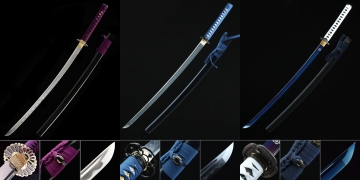
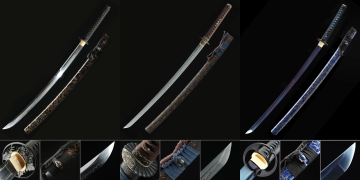
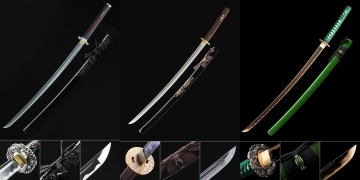
What defines a hamidashi compared to a standard tantō?
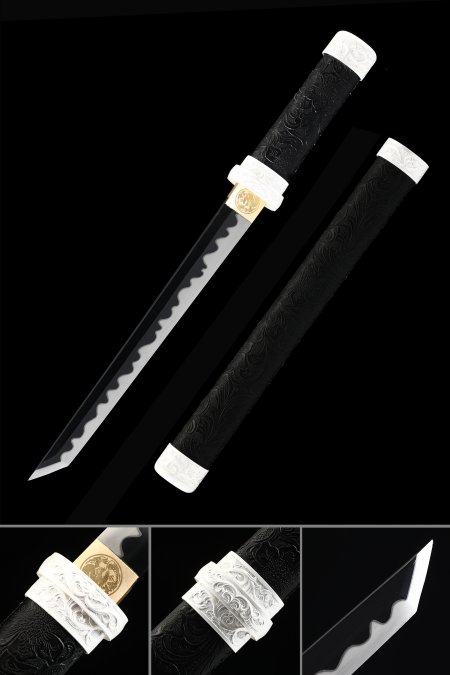
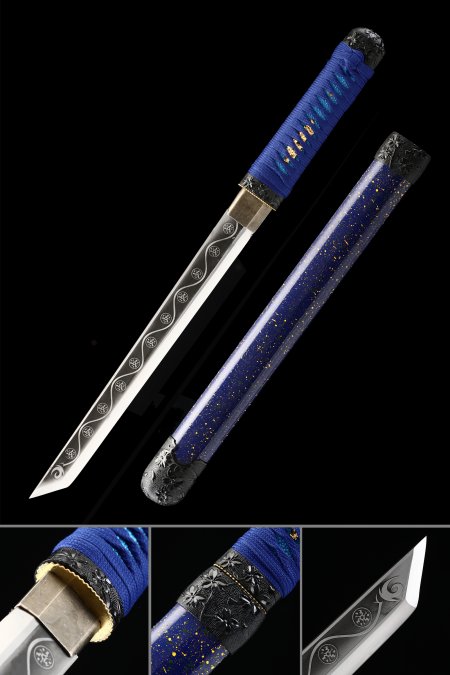
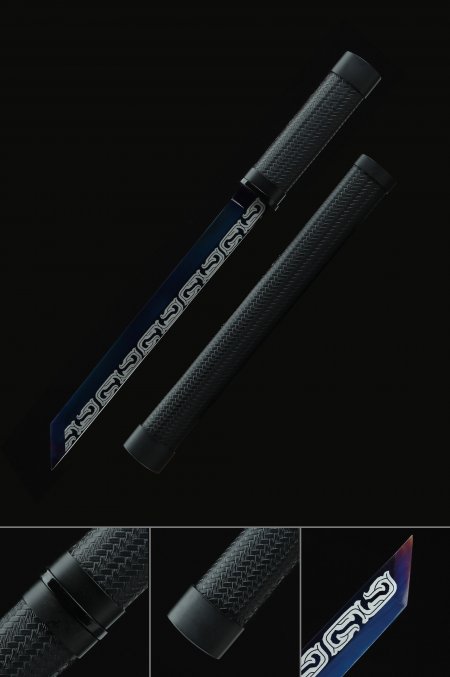
The hamidashi is distinguished by its ko-tsuba, a very small guard that barely extends past the blade's width. A conventional tantō can be fitted with either no guard at all (aikuchi style) or a full-sized tsuba similar to those found on longer blades. The hamidashi occupies a middle ground: the guard is present and visible, contributing to the overall composition of the koshirae, but it remains deliberately understated. This makes the hamidashi a favored format among collectors who want the visual completeness of a guarded blade without the heavier hardware that a full tsuba introduces. The result is a clean, elongated profile that lets the blade and saya carry the aesthetic conversation.
How is the wave hamon formed on manganese steel blades?
The hamon is the visible temper line created when a blade is differentially heat-treated — the edge is quenched more rapidly than the spine, causing the steel to harden at different rates across its width. The shape of the hamon is controlled by the clay coating applied before quenching: a thicker clay layer on the spine slows cooling there, while the edge, left with minimal or no clay, hardens quickly. A wave or notare hamon is produced by applying the clay in an undulating pattern, which translates directly into the flowing, tide-like line visible on the finished blade. On manganese steel specifically, the contrast between the hardened edge zone and the softer spine reads with particular clarity due to the steel's natural dark tone and the frosted texture the hamon zone develops after polishing.
Does manganese steel require any special care for long-term display?
Manganese steel, like most carbon-containing steels, is susceptible to surface oxidation if left untreated in humid environments. For display pieces, a light application of blade oil or camellia oil every few months is the standard practice — apply a small amount with a clean cloth and buff away any excess. Avoid direct contact with bare hands on the polished blade surface, as skin oils accelerate patina formation unevenly. If displaying in a case, include a small silica gel packet to manage ambient humidity. Store or display away from direct sunlight, which can fade lacquered saya over time. These simple steps preserve both the hamon's contrast and the finish of the koshirae fittings for years of stable display.
What makes a dragon-carved saya different from a lacquered one?
A lacquered saya achieves its finish through successive applications of urushi or synthetic lacquer, building a smooth, even surface with depth of color. The craftsmanship lies in the evenness of the coat and the richness of the final tone. A carved saya, by contrast, involves relief carving directly into the wood substrate before finishing, creating raised or recessed imagery — in this case, a dragon motif — that can be felt as well as seen. Carved saya add a tactile dimension to display and tend to be more visually assertive, functioning almost as sculptural objects in their own right. Both approaches are legitimate expressions of Japanese scabbard craft; the choice between them generally reflects whether a collector gravitates toward refined restraint or expressive narrative in their display pieces.
Is a wave blade hamidashi a good starting piece for new collectors?
The hamidashi format is an excellent entry point for collectors interested in Japanese short blades. Its compact size makes display straightforward — it fits comfortably on a tabletop stand or a modest wall mount without requiring dedicated furniture. The wave hamon gives new collectors an immediate visual introduction to one of the most discussed elements of Japanese blade aesthetics, and manganese steel's dark tone makes that hamon easy to read even under ordinary room lighting. For those building a broader display, a hamidashi pairs naturally with full-length pieces to illustrate how Japanese blade culture treated length as a variable rather than a fixed convention. Starting with a single, well-appointed hamidashi also allows a collector to learn the basics of koshirae assembly, oil maintenance, and display positioning before expanding to larger or more complex acquisitions.