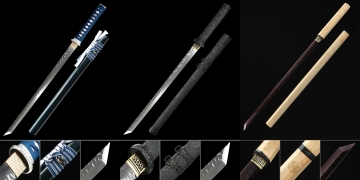
Black Damascus Steel Ninjato

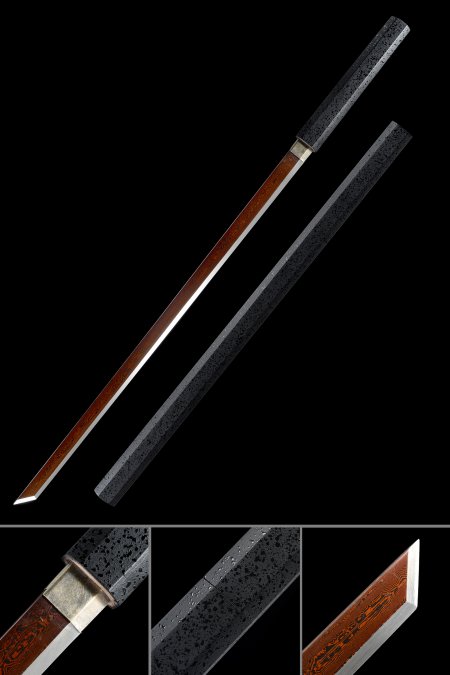
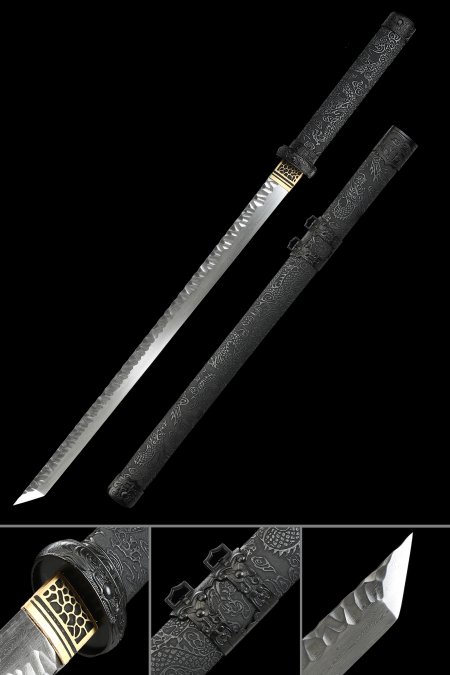
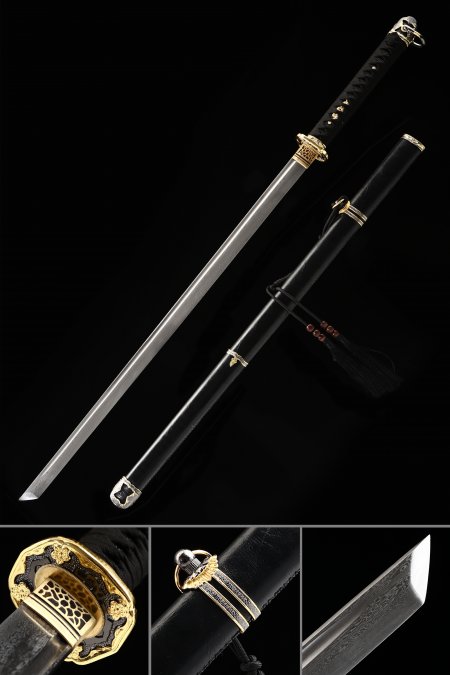
Black Damascus Steel Ninjato blends centuries-old layered-steel artistry with the sleek, straight-bladed silhouette favored by feudal Japan's shadow operatives. Each piece in this collection is hand-forged from genuine Damascus steel, finished in a striking black patina that accentuates the flowing grain pattern unique to every blade. Crafted for discerning collectors and display enthusiasts who demand authenticity in both form and finish. Enjoy free shipping on your order, backed by our hassle-free return policy.
Showing 3 Products

Related Collections

Damascus Ninja Sword19 items


19 Reviews

Black Damascus Sword86 items


113 Reviews

Black Damascus Samurai Sword120 items


274 Reviews

Frequently Asked Questions

What makes Damascus steel visually distinct on a ninjato?
Damascus steel is produced by layering and folding two or more types of high-carbon steel repeatedly before forging the blade to shape. This process creates the characteristic flowing, wave-like grain pattern visible across the flat and along the edge of the finished blade. On a ninjato — with its straight, uninterrupted profile — that pattern has nowhere to hide, making it far more visible than on a curved blade where the geometry itself competes for attention. When a black patina or acid-etching treatment is applied over the Damascus surface, the contrast between the lighter and darker layers intensifies, turning the grain into a pronounced visual feature. Because the fold count and layering sequence vary by artisan and heat, no two Damascus blades share an identical pattern, which is a key part of their appeal as display collectibles.
How does a ninjato differ from a katana as a collectible?
The most immediate difference is blade geometry. A katana features a pronounced curvature — the sori — that is central to its classical Japanese aesthetic and to the tradition of tamahagane swordsmithing. A ninjato has a straight or near-straight blade, a square or simple tsuba, and a generally shorter overall length, reflecting its association with covert operatives rather than samurai ceremony. For collectors, this means the ninjato occupies a distinctly different visual and historical niche. It displays with a sharper, more architectural silhouette, and pairs well with dark finishes like black Damascus or lacquered sheaths. Those building a Japanese-inspired collection often acquire both forms, since they complement rather than duplicate each other. You can explore curved Damascus counterparts in the Black Damascus Steel Katana collection for direct comparison.
Is a full-tang build important for a display ninjato?
Yes, and for reasons beyond structural strength alone. A full-tang construction means the steel of the blade extends as a continuous piece through the entire length of the handle, secured by pins or a threaded pommel rather than glued or inserted only partway. For a display collectible, this matters because it reflects authentic construction standards — the same approach used in historically significant Japanese blades. It also ensures the handle and blade remain firmly joined over years of display without loosening at the collar. When examining a black Damascus ninjato as a potential addition to a collection, confirming full-tang construction is one of the most reliable indicators that the piece was built to a meaningful standard rather than produced as a decorative-only novelty.
How should I maintain a black Damascus ninjato in storage?
The black surface treatment on a Damascus blade — whether achieved through acid etching, heat bluing, or oxide application — provides some passive protection, but it is not a substitute for routine care. Every two to three months, apply a thin coat of choji oil or pharmaceutical-grade mineral oil to the blade using a soft, lint-free cloth, working from the base toward the tip. Wipe away any excess to avoid pooling near the habaki collar. Store the piece horizontally or with the edge upward inside the saya. Avoid display positions that expose the lacquered scabbard to prolonged direct sunlight, as UV exposure degrades lacquer finishes over time. In coastal or high-humidity environments, a sealed display case with a silica gel desiccant packet provides an added layer of protection against surface oxidation.
Can a black Damascus ninjato be displayed as part of a matched set?
Absolutely — and thematic cohesion is one of the most satisfying aspects of Japanese blade collecting. A black Damascus ninjato pairs naturally with pieces from the Damascus Steel Ninja Sword collection for a unified ninja-aesthetic display, or it can anchor a broader Japanese-inspired grouping alongside a wakizashi from the Black Damascus Steel Wakizashi collection. When assembling a matched set, look for consistency in finish tone, fitting style, and saya material. Pieces that share a black lacquer saya and similar tsuba metalwork in gold or iron tones will read as intentional rather than mismatched when displayed together on a horizontal sword stand or mounted on a wall rack.

Customer Reviews