Blue Handle Hamidashi
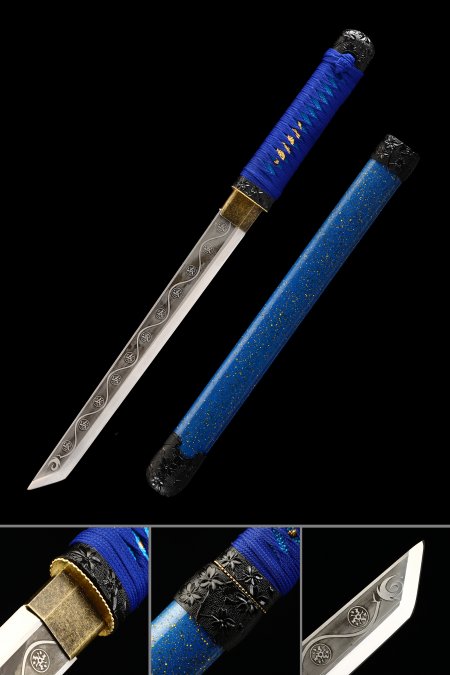
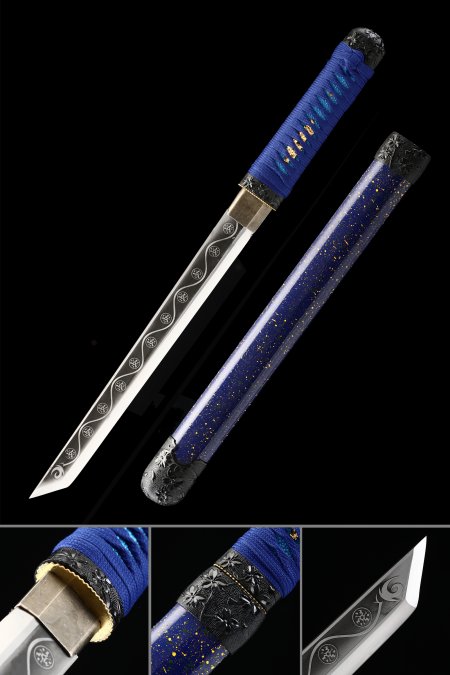
Blue Handle Hamidashi brings together two defining elements of Japanese short-blade artistry — the understated hamidashi guard and the striking visual depth of blue-wrapped handles. Each piece in this collection is crafted with engraved manganese steel blades, finished with lacquered blue saya and carefully bound handles that reward close inspection. Every order ships free with hassle-free returns, so adding a refined tanto to your display is effortless.
Related Collections
Frequently Asked Questions
What makes a hamidashi guard different from a standard tsuba?
A standard tsuba is a full round or shaped guard that extends well beyond the blade's profile on all sides. A hamidashi guard, by contrast, is intentionally minimal — it protrudes only slightly past the handle, creating a cleaner visual line between tsuka and blade. This design was historically favored on tanto intended for close-quarters carry where a large guard would catch on clothing. On display pieces, the hamidashi lends an understated, almost architectural quality to the overall silhouette, making it a preferred guard choice among collectors who value subtlety over ornamentation.
What type of engravings appear on these manganese steel blades?
The blades in this collection feature two distinct engraving styles. One piece carries chrysanthemum motifs alongside the wave-engraved surface, drawing on the kiku — Japan's imperial flower — as a decorative symbol of longevity and nobility. The other uses flowing wave patterns across the blade flat, referencing the seigaiha and water imagery common in Japanese decorative tradition. Manganese steel is particularly receptive to this kind of surface work because its grain structure holds engraved lines cleanly without the blurring that can occur in lower-carbon alloys. The result is fine detail that remains legible across the full length of the blade.
How should I store a lacquered blue saya to prevent damage?
Lacquered saya require slightly more care than unfinished wood sheaths. Avoid exposing them to direct sunlight for extended periods, as UV exposure can fade the pigment and cause surface crazing over time. Store the tanto horizontally on a padded rack rather than vertically, which reduces stress on the lacquer at the koiguchi opening. Humidity fluctuations are the primary enemy of lacquerwork — aim for a stable indoor environment between 45 and 55 percent relative humidity. A light wipe with a soft, dry cloth removes dust without introducing moisture. Never use silicone-based polishes on lacquered surfaces, as they can create a film that obscures the finish depth.
Do the blue handle wrappings require any maintenance over time?
Cord-wrapped handles — known as tsuka-ito — can loosen marginally with temperature and humidity changes if the underlying same (ray skin) shifts. For display pieces, the best practice is to avoid handling the tsuka frequently with bare hands, as skin oils gradually break down natural cord fibers. If you display the piece in a low-humidity environment, occasional very light misting of the surrounding air (not the handle directly) helps prevent the cord from drying and becoming brittle. Inspect the wrap annually for any loosening near the end caps. Rewrapping is possible if needed, and the diamond pattern on these handles — known as hishi-maki — is one of the more straightforward wrapping styles to replicate if restoration becomes necessary.
Are these tanto a good starting point for a Japanese blade collection?
Blue Handle Hamidashi tanto are well-suited as entry points into Japanese short-blade collecting for several reasons. Their compact size makes display practical even in limited spaces — a single tanto stand takes up far less room than a katana rack. The engraved manganese steel blades provide a visually rich surface that teaches new collectors to read blade geometry and surface treatment, which builds the eye for evaluating future acquisitions. The hamidashi guard style also introduces collectors to the vocabulary of Japanese blade furniture in an approachable format. Thematically, the blue saya and handle create an immediately cohesive piece, which is useful when you are still developing the broader aesthetic direction of your collection.