What makes a tanto a hamidashi rather than a standard tanto?
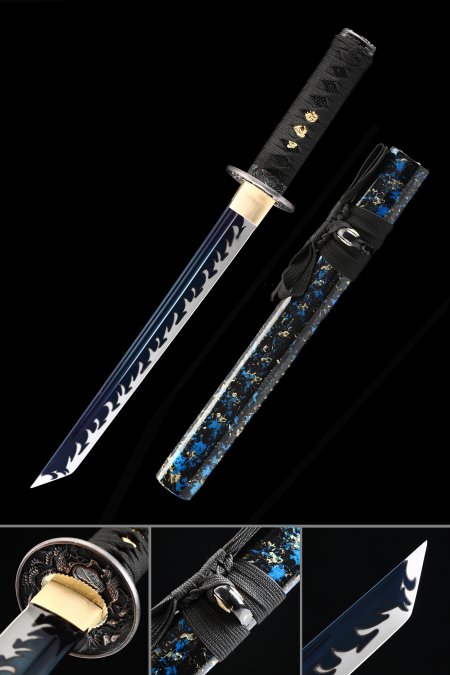
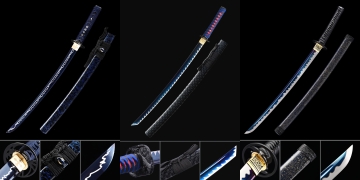
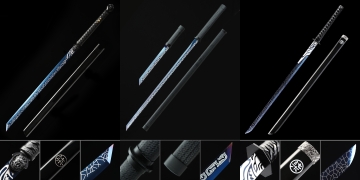
The distinction lies in the guard configuration. A standard tanto typically mounts a full tsuba — a disc-shaped guard that extends well beyond the handle width. A hamidashi uses a much smaller, partially recessed guard that barely protrudes past the collar (habaki and seppa area), giving the handle an almost uninterrupted silhouette from pommel to blade. Some hamidashi pieces are described as having "no tsuba" in the Western market, though technically a very small guard is present. This compact guard style was historically associated with civilian dress wear, where a low-profile hilt was more practical under layered garments. For display collectors, the hamidashi profile reads as understated and refined — a contrast to the more assertive visual weight of a fully guarded blade.
How is the blue color on manganese steel blades created?
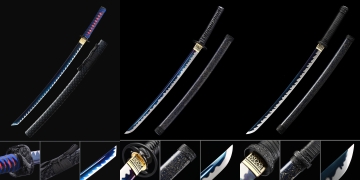
The blue tone on these blades is produced through controlled chemical patination or heat oxidation — not paint or coating. In chemical patination, the polished manganese steel surface is exposed to an acidic or alkaline solution that reacts with iron content in the alloy, producing an iron oxide layer that refracts light into blue, blue-black, or violet hues depending on the thickness of the oxidation layer. Heat bluing works similarly: the blade is carefully heated to a precise temperature range (roughly 550–650°F) at which the steel's surface oxide layer reaches the specific thickness that produces blue light interference. Because manganese steel's alloy composition differs from plain high-carbon steel, the resulting color tends to be particularly saturated and even. The finish is not merely decorative — the oxide layer also provides a modest degree of surface protection, which is one reason blued finishes have historical precedent on functional hardware.
How does manganese steel differ from high-carbon steel for display pieces?
High-carbon steels like 1045, 1060, or 1095 are the traditional benchmarks for hand-forged Japanese-style blades, prized for their hardness-toughness balance when differentially hardened. Manganese steel (commonly Mn65 or similar grades) adds manganese as a primary alloying element, which increases hardenability and surface hardness while giving the blade different aesthetic responses to heat and chemical treatment — most notably the vivid blue and black tones that define this collection. For display collectors who prioritize visual character over differential hardening aesthetics (hamon), manganese steel's richer patination response and consistent finish make it a compelling choice. The tradeoff is that manganese steel typically does not produce the same clay-hardened hamon patterns associated with traditional tamahagane-style work, so collector preferences tend to split along aesthetic lines.
Is carbon fiber saya historically accurate, and does it affect collectibility?
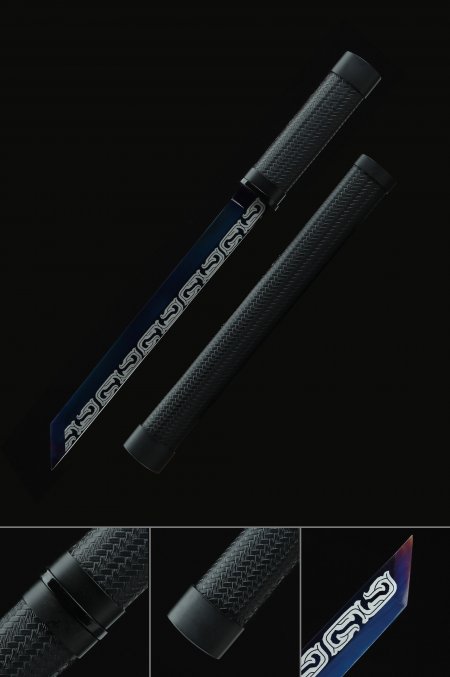
Carbon fiber saya is not historically accurate to Edo-period or earlier Japanese blade furniture — it is a modern material introduced by contemporary craftsmen who appreciate its structural rigidity, light weight, and striking visual texture. For collectors, this matters primarily as a question of curatorial intent. A hamidashi mounted in a lacquer saya represents a more traditionally coherent assembly, appropriate for displays focused on historical verisimilitude. A carbon fiber saya signals an intentional fusion aesthetic — traditional blade geometry and fittings married to 21st-century materials science. Neither approach diminishes collectibility in absolute terms; each appeals to a different collector sensibility. Many advanced collectors deliberately acquire both styles to represent the breadth of how contemporary craftsmen engage with classical Japanese forms.
What is the best way to display a hamidashi tanto at home?
Horizontal katana-style stands (katana-kake) work well for tanto-length pieces, but a dedicated tanto stand with a shallower resting angle often displays the blade geometry more elegantly. Position the piece out of direct sunlight — UV exposure can gradually dull lacquer finishes and alter patinated surfaces over years. Avoid placing the display near heating vents or air conditioning outlets, as repeated humidity cycling accelerates oxidation on bare metal fittings. If showcasing both the blade and saya together, a two-tier stand allows you to display the mounted and unmounted forms simultaneously, which is a popular approach for pieces with visually distinctive saya like the carbon fiber weave or blue-black lacquer examples in this collection. Applying a thin coat of camellia oil to the blade every three to four months maintains the surface and preserves the integrity of the blue finish.