What makes the snake engraving on the saya a collectible feature?
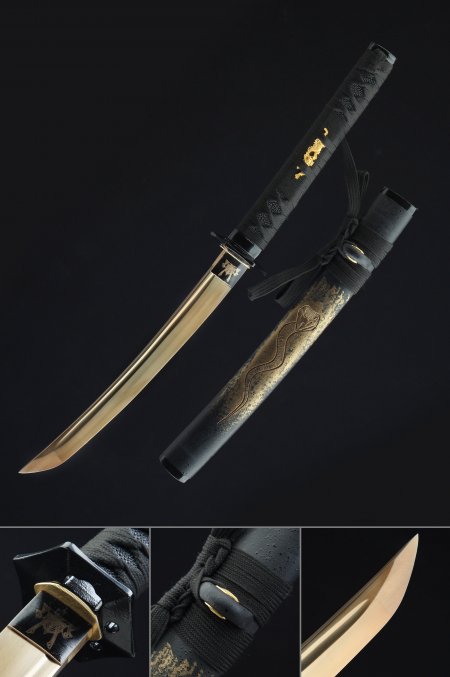
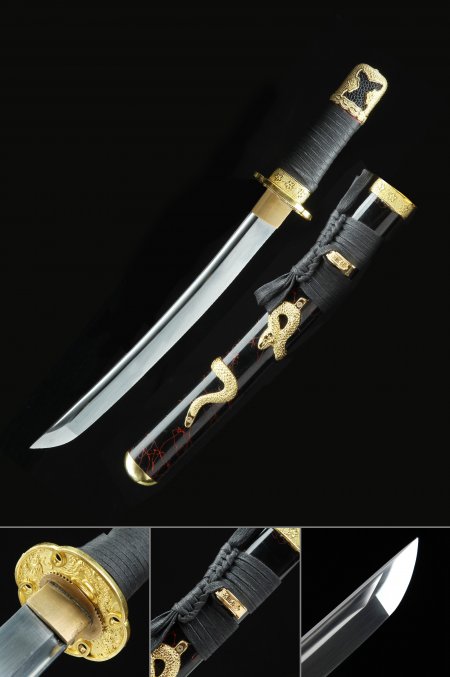
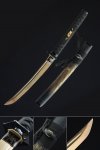
The saya on these tanto is not simply painted — it carries engraved or relief-detailed serpent imagery finished over a lacquered black ground. In Japanese craft tradition, saya decoration was treated as seriously as blade forging; a lacquered scabbard could take weeks of layered work to complete. The hebi (serpent) motif specifically carried associations with protection, longevity, and cyclical renewal in Edo-period iconography, making it a recurring subject in sword fittings and tsuba art. On a display-focused tanto, that culturally grounded imagery adds a dimension of storytelling that plain wood or synthetic saya simply cannot offer. For collectors, provenance of design matters as much as material — and a saya with a coherent, historically resonant motif increases the visual and contextual value of the piece as a whole.
How does T10 steel differ from 1045 carbon steel in a tanto blade?
Both T10 tool steel and 1045 carbon steel are high-carbon materials, but they differ meaningfully in composition and behavior. T10 contains a small addition of tungsten alongside its elevated carbon content (approximately 1.0%), which promotes a finer grain structure and allows the steel to retain a well-defined hamon after clay tempering. 1045 steel sits at a lower carbon percentage (around 0.45%), making it somewhat tougher and less prone to surface stress, which suits the O-tanto format where blade geometry is broader. For display collectors, the practical difference shows up in the hamon clarity and surface texture: T10 blades typically exhibit a more dramatic, high-contrast temper line, while 1045 pieces often present a cleaner, more uniform surface. Neither is definitively superior — the choice comes down to the aesthetic character you want foregrounded in your display.
What is clay tempering and can I see it on a finished blade?
Clay tempering, known as tsuchioki in Japanese smithing practice, involves applying a mixture of clay, ash, and sometimes stone powder unevenly across the blade before the quench. The thickly coated spine cools more slowly, retaining toughness, while the lightly coated or exposed edge cools rapidly, achieving higher hardness. The visible result is the hamon — a line of crystalline transition called nie and nioi running along the edge. On the Snake Saya Tanto pieces in this collection, the hamon is clearly visible under direct light and serves as a permanent record of the tempering process. When displaying the blade, positioning a focused light source at a low angle to the edge surface will bring the hamon’s activity and texture into full relief, making it one of the most compelling visual features for informed collectors.
How should I store and maintain a lacquered saya at home?
Lacquered saya are more sensitive to environmental conditions than the blade itself. Avoid storing the tanto in direct sunlight or near heat sources, as prolonged UV exposure and temperature fluctuations can cause the lacquer to yellow, crack, or delaminate over time. Humidity extremes are equally damaging — aim for a stable indoor environment between 45–60% relative humidity. When handling the saya, hold it by the body rather than the kojiri (end cap) to avoid stressing the fitting joints. For routine care, wipe the exterior with a dry or very lightly dampened microfiber cloth; do not apply oils or polishes to the lacquered surface, as these can cloud or soften the finish. The blade inside the saya should be lightly coated with choji oil before storage to prevent oxidation, and the saya interior should be kept dry at all times.
Is a tanto a good starting point for a Japanese blade collection?
The tanto format is genuinely well-suited to new collectors for several practical reasons. Its compact length makes display and storage straightforward — a tanto fits comfortably on a small stand, in a display case, or mounted on a wall bracket without requiring the dedicated space a full katana demands. The price range is typically more accessible, which allows a first-time collector to acquire a piece with high-quality materials — hand-forged carbon steel, clay tempering, articulated fittings — without the investment required for a full daisho set. Thematically appointed pieces like the Snake Saya Tanto also provide an immediate visual focus point, which makes them easier to contextualize and present when displaying to others. For collectors who later expand into longer blades, the tanto serves as an excellent reference point for understanding proportions, geometry, and fitting conventions that carry through the entire Japanese blade tradition.