What makes a snake-motif tsuba significant in Japanese blade collecting?
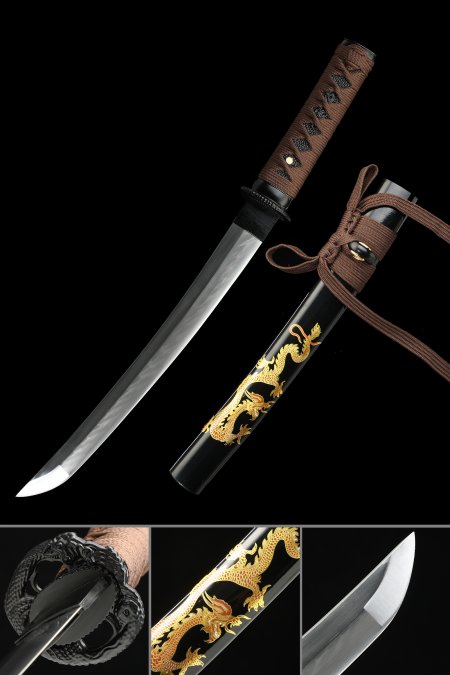
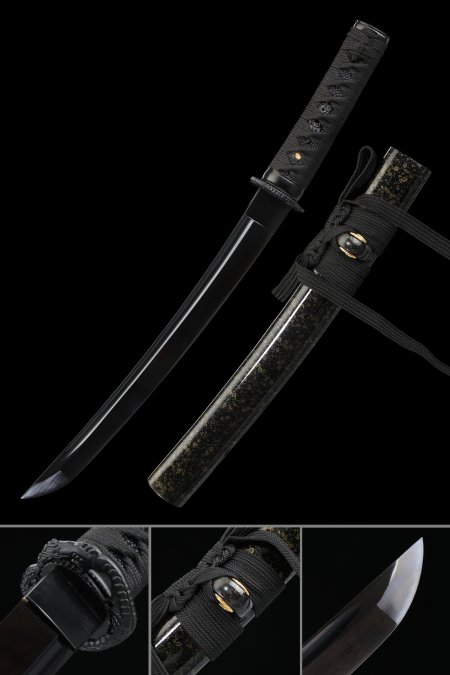
In traditional Japanese iconography, the snake (hebi) carries layered meaning - it is associated with transformation, cyclical renewal, and protective instinct. When rendered on a tsuba, the serpent motif transforms an already functional guard into a piece of cultural narrative. Collectors value snake tsuba not just for their visual drama but for this symbolic depth, which connects the piece to a broader tradition of Japanese metalwork where every design choice carried intentional meaning. Alloy tsuba in this style are cast or carved to capture scale texture and coil geometry, making them one of the most visually detailed fittings on the blade.
How does T10 carbon steel differ from 1045 steel in a tanto?
1045 steel is a medium-carbon alloy with roughly 0.45% carbon content. It offers solid structural integrity, machines consistently, and takes surface finishes - including black oxide coatings - very well. It's a practical, dependable steel for display collectibles. T10 carbon steel, sometimes called T10 tool steel, contains approximately 0.95-1.05% carbon and a small amount of silicon, giving it a finer carbide structure. This allows for more precise geometry during grinding and a visually sharper profile along the blade's edge and shinogi line. For collectors focused on blade aesthetics and steel pedigree, T10 is generally considered the more premium option. Both steels benefit from the same storage and maintenance practices.
How should I store and maintain a tanto with a lacquered saya?
Lacquered saya require a slightly different care approach than natural wood or ray-skin finishes. Avoid prolonged storage in high-humidity environments, as moisture can cause lacquer to crack or lift at the seams over time. Store the tanto horizontally on a display stand or in a padded case with the blade inside the saya to protect both surfaces. Apply a thin coat of choji oil or mineral oil to the blade every few months using a soft cloth - this prevents oxidation without affecting the lacquer exterior. Never use silicone-based sprays near the saya, as they can dull the lacquer finish. Keep the piece away from direct sunlight, which yellows lacquer over years of exposure.
Is full-tang construction important for a tanto display collectible?
Yes, and for reasons that go beyond structural function. Full-tang construction means the steel extends continuously from the blade tip through the entire length of the handle, secured by the fuchi, menuki, and kashira fittings. In a display context, this matters because it reflects the same construction standard used in historically documented Japanese blades - which is precisely what separates a craft-quality collectible from a decorative assembled piece. It also ensures long-term dimensional stability: the handle won't loosen, shift, or separate at the habaki over years of display. Collectors who intend to pass pieces down or build appraised collections should treat full-tang construction as a baseline criterion.
Can a Snake Tsuba Tanto work as a gift for a Japanese culture enthusiast?
It's an excellent choice, particularly for someone who appreciates Japanese aesthetics beyond surface-level novelty. The combination of a thematic tsuba, hand-selected ito wrap, and steel-specific blade geometry gives the recipient something genuinely informative to engage with - there's a story in every fitting. For gifting purposes, the Python Theme tanto with its gold-speckled saya makes a visually dramatic presentation, while the T10 piece with brown ito and black lacquer saya appeals to collectors who prefer a more austere, traditional aesthetic. Pairing the tanto with a display stand and a brief card explaining the symbolism of the snake motif elevates the gift considerably.