What makes a tachi different from a katana?
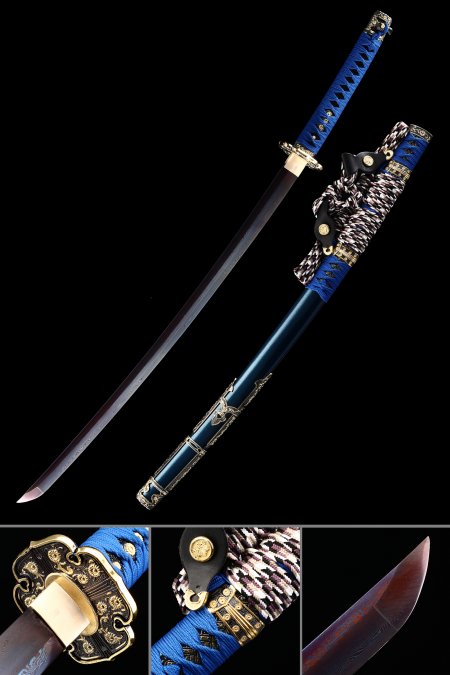
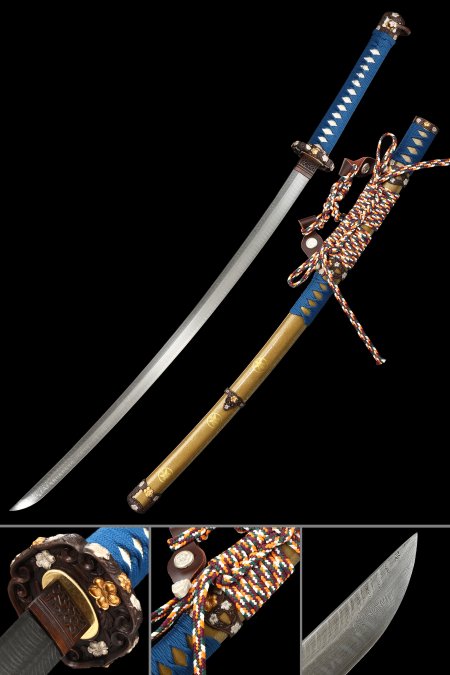
The tachi predates the katana by several centuries and differs in both geometry and carry convention. A tachi typically has a longer blade — often exceeding 70 cm — with a more pronounced curvature (sori) distributed along the full length rather than concentrated near the tip. Historically, it was worn suspended edge-down from the belt, in contrast to the katana's edge-up thrust-through carry. This difference in mounting orientation influenced blade geometry: the tachi's curvature was optimized for drawing from a suspended position, often by a mounted warrior. For collectors, the tachi's longer, more graceful profile and its association with Japan's classical court and military traditions make it a distinct and historically significant display category separate from the more commonly collected katana.
How is Damascus steel different from monosteel in these tachi blades?
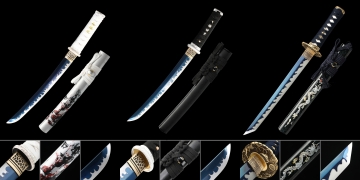
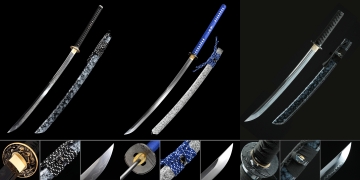
Damascus steel — also called pattern-welded steel — is produced by forge-welding multiple layers of high- and low-carbon steel, then folding and drawing them out repeatedly. The alternating carbon content creates the distinctive flowing grain pattern visible on the finished blade. In practical terms for a collectible, this means the surface character is structural rather than cosmetic: the pattern you see reflects the actual internal layer architecture of the steel. Monosteel blades, by contrast, are forged from a single homogeneous bar and achieve their visual interest primarily through the hamon produced during clay tempering. Both methods are legitimate expressions of Japanese blade craft; Damascus construction tends to emphasize visual complexity and layered texture, while clay-tempered monosteel emphasizes the hamon line as the focal point of the blade's aesthetic. Collectors often distinguish between the two based on which visual language appeals to their display preference.
What does clay tempering do to a blade, and can you see it?
Clay tempering — known in Japanese as tsuchioki — is a heat-treatment process in which a clay mixture is applied to the blade before it is heated and quenched. The clay insulates the spine, causing it to cool more slowly than the exposed edge. This differential cooling produces two distinct crystalline structures within the same blade: a harder edge (martensite) and a tougher spine (pearlite or bainite). The boundary between these zones forms the hamon — the visible temper line that appears as a mist-like or wave-like pattern along the blade's length. No two hamon are identical because subtle variations in clay application, furnace temperature, and quench timing all influence the outcome. For collectors, a genuine clay-tempered hamon is one of the most valued visual and technical features a blade can carry, serving as both aesthetic focal point and evidence of traditional craft process.
How should I store and maintain a tachi for long-term display?
For long-term preservation, a tachi should be stored horizontally on a dedicated sword stand, edge facing upward to replicate traditional display convention. The blade requires a light application of choji oil — or a neutral mineral oil alternative — every few months to prevent oxidation, applied with a soft, lint-free cloth in smooth strokes along the blade's length. Avoid touching the blade surface with bare hands, as skin oils accelerate rust formation on high-carbon steel. The lacquered saya should be kept away from direct sunlight and extreme humidity fluctuations, both of which can cause lacquer to crack or lift over time. Periodically check that the blade seats cleanly in the saya without binding; a properly fitted saya protects the blade from contact with ambient moisture. In humid climates, silica gel packets placed near — not inside — the saya can help regulate the microenvironment around your display.
Is a blue handle tachi a good choice as a display gift?
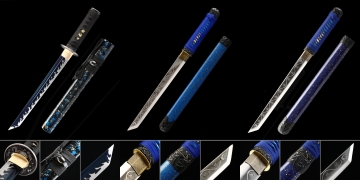
A blue handle tachi makes a particularly strong display gift precisely because its aesthetic is immediately legible even to someone unfamiliar with Japanese sword collecting. The contrast between the vivid blue tsuka, the patterned blade, and a lacquered saya creates a visual composition that reads as deliberate and refined rather than generic. For recipients who are history enthusiasts, Japanese culture admirers, or collectors of decorative arts, the tachi's long, elegant profile displays more dramatically than a katana on a wall mount or sword stand. The specific combination of Damascus layering or clay-tempered hamon with hand-fitted alloy tsuba means the piece rewards closer inspection over time — which is the hallmark of a gift that continues to hold interest. Pairing the tachi with a quality horizontal stand completes the presentation and allows immediate display without additional purchases.