What makes a naginata different from a katana?
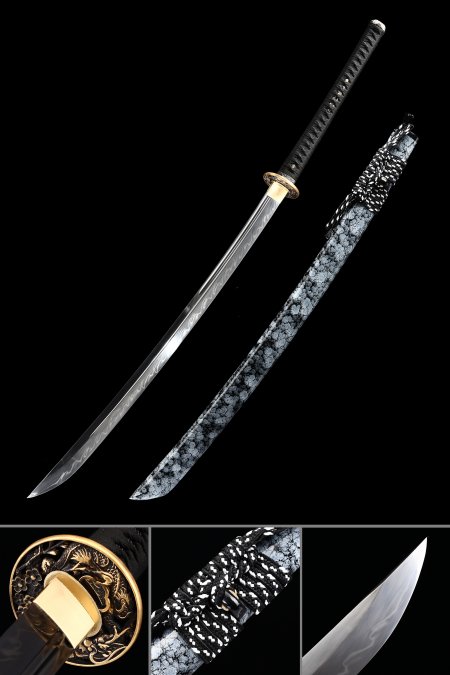
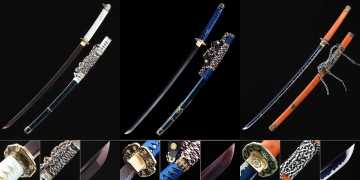
While both are traditional Japanese bladed collectibles, the naginata is a polearm - its curved blade is mounted on a long hardwood shaft, typically bringing the total length to around 118 cm or more. This extended form was designed for reach and sweeping technique, giving it a dramatically different silhouette compared to the hand-held katana. For collectors, this distinction matters because the naginata occupies its own display space, demands wall mounts or floor stands sized for its length, and represents a separate lineage of Japanese smithing. The blade geometry - often wider at the base and tapering toward the tip - also differs from the katana's more uniform profile, making it a visually distinct centerpiece in any Japanese blade collection.
What is a real hamon and why do collectors value it?
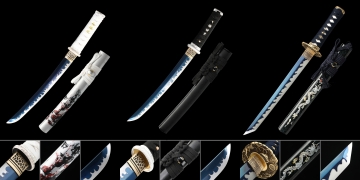
A hamon is the visible transition line that forms along a blade when it undergoes differential hardening - a process where the smith coats the spine with clay before the quench, causing the edge and spine to cool at different rates. The resulting boundary between hardened steel and softer steel appears as a misty, wavy, or notched line running the length of the blade. On T10 clay-tempered pieces, this hamon is entirely authentic: it is a direct record of the smith's technique and cannot be replicated by machine grinding or acid etching. Collectors prize genuine hamon because it confirms the blade went through a proper heat treatment process and because each pattern is unique to that individual piece. Under directional light, the activity within the hamon - called nie and nioi - creates a depth and movement that polished steel alone cannot produce.
How does Damascus pattern steel differ from T10 on a naginata?
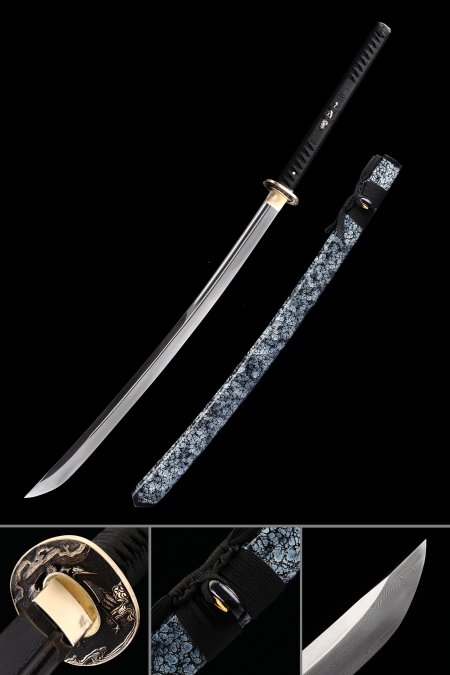
Damascus pattern-welded steel is created by forge-welding multiple steel alloys together, then repeatedly folding and drawing out the billet. The contrasting carbon content of each layer produces the flowing, wood-grain or water-wave surface patterns visible after etching. T10, by contrast, is a single high-carbon tool steel prized for its fine grain structure and responsiveness to clay tempering. Damascus excels in surface visual complexity and the organic uniqueness of its pattern, while T10 excels in producing a clearly defined, authentic hamon with visible crystalline activity. For a collector choosing between the two, Damascus tends to prioritize aesthetic surface drama, while a T10 clay-tempered piece prioritizes the technical authenticity of traditional Japanese heat-treatment craft.
How should I store and maintain a blue saya naginata?
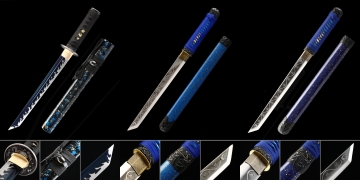
The lacquered blue saya protects the blade from incidental contact and moderate humidity, but proper long-term storage still requires a few deliberate steps. Keep the naginata in a low-humidity environment - ideally below 60% relative humidity - to prevent moisture from working its way into the saya's wooden core or causing rust on the blade. Every few months, remove the blade from the saya, wipe the steel with a clean cotton cloth, and apply a thin even coat of choji oil or food-grade mineral oil using a soft cloth. Avoid touching the blade surface with bare hands, as skin oils accelerate oxidation. When displaying the piece on a wall mount, position it away from direct sunlight, which can fade lacquer over time. If storing long-term, a padded horizontal rack keeps the shaft straight and prevents warping.
Is a blue saya naginata a good gift for a Japanese culture enthusiast?
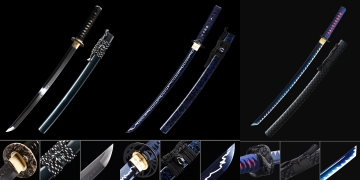
A blue saya naginata makes a genuinely memorable gift for someone who appreciates Japanese craftsmanship, history, or blade arts as a collector's interest. Unlike mass-produced decorative pieces, a hand-forged naginata with a lacquered saya carries tangible craft value - the steel type, hamon activity, and fitted hardware are details that a knowledgeable recipient will recognize and appreciate immediately. The blue saya adds a color-specific aesthetic that suits collectors who display their pieces as part of a themed wall or stand arrangement. For gift-giving, it pairs well with a coordinated piece such as a matching blue katana to create a display set. Since these are collectible and display-oriented pieces, they ship in protective packaging suited for presentation, and our return policy ensures peace of mind if sizing or style adjustments are needed.