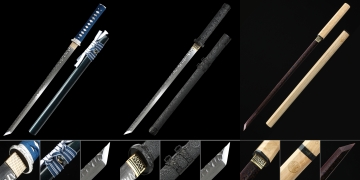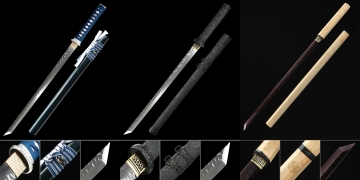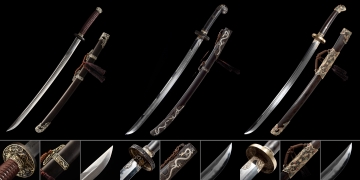
Gold Damascus Steel Katana

Gold Damascus Steel Katana blends the ancient art of pattern-welded steel with richly ornamented fittings — a pairing that speaks directly to serious collectors who value both metallurgical craft and visual drama. Each sword in this collection features a hand-forged Damascus blade displaying its signature flowing grain alongside gold-accented tsuba, saya, and kashira that elevate the piece far beyond an ordinary display sword. Free standard shipping is included on every order, and returns are accepted within 30 days so you can collect with complete confidence.

Showing 3 Products

Related Collections

Frequently Asked Questions

What makes Damascus steel visually different from other blade types?
Damascus steel — more accurately called pattern-welded steel in modern sword-making — gets its distinctive surface appearance from the forge-welding of multiple steel alloys with differing carbon content. As the smith repeatedly folds and draws out the billet, the two steels intermingle in flowing bands. An acid etch applied after final polishing causes the high-carbon layers to darken while the lower-carbon layers remain bright, revealing the full pattern. Depending on how the billet was manipulated, the result can resemble flowing wood grain, water ripples, or tight ladder-rung lines. Because no two billets are twisted, folded, or etched in exactly the same way, every finished blade carries a surface pattern that is genuinely unrepeatable — a quality that makes Damascus katana particularly prized as display collectibles.
Why do gold fittings pair so well with Damascus blades on a katana?
The visual logic comes down to contrast and period accuracy. Damascus blades, after etching, display a dark, richly textured surface — typically deep grey to near-black in the low areas with bright steel peaks. Gold-toned fittings (tsuba, kashira, fuchi) create a warm contrast against that cool, muted blade surface that draws the eye naturally from one component to the next. Historically, high-ranking samurai and presentation swords during the Edo period featured gilded or gold-lacquered furniture precisely because it signaled status and craftsmanship investment. Choosing gold hardware on a hand-forged Damascus blade therefore aligns with a legitimate historical aesthetic tradition while also producing a sword that photographs and displays with exceptional visual impact.
What should I check when evaluating full-tang construction on a collectible katana?
Full-tang means the steel of the blade extends as a continuous piece through the entire length of the handle rather than ending at the habaki collar with a threaded rod or short stub inserted into the tsuka. When evaluating a katana, look for mekugi — the small bamboo or brass peg(s) that pass through aligned holes in both the tsuka and the tang, locking everything together. A properly fitted full-tang katana should show no wobble or lateral play between blade and handle when gripped firmly. On display pieces in this collection, the ito wrap sits over a same (rayskin or quality synthetic equivalent) base layer, which adds grip texture and further stabilizes the tsuka assembly. Full-tang construction is the single most important structural factor for long-term display durability.
How should I maintain a Damascus katana stored on a display stand?
Three factors degrade a displayed Damascus katana over time: oxidation from fingerprint oils, humidity, and UV exposure. After each handling session, wipe the blade with a soft, lint-free microfiber cloth using smooth strokes from habaki toward the tip to remove skin oils before they can etch the steel unevenly. Every three to six months — more frequently in humid climates — apply a very thin coat of choji oil or food-grade mineral oil, spread evenly and then buffed almost completely off so no pooling occurs. Store the sword horizontally in a room with relative humidity between 40–55%; if your display area is near a window, use UV-filtering glass or reposition the stand to prevent the lacquer saya from fading or checking. The gold-lacquered saya on these pieces should be wiped with a dry cloth only — never oil the scabbard exterior.
Is a Gold Damascus Katana a good centerpiece gift for a sword collector?
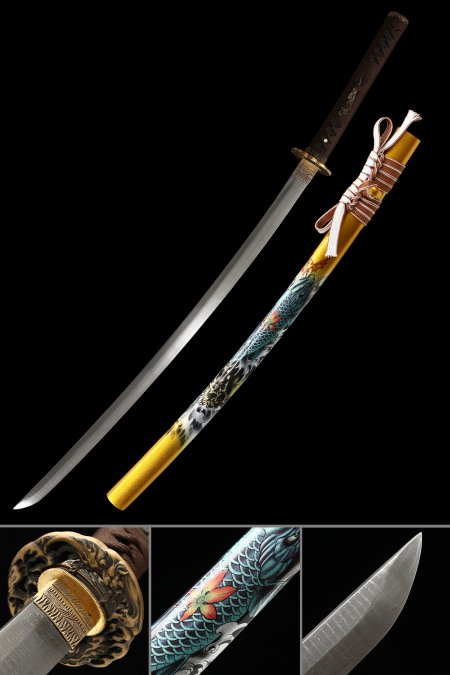
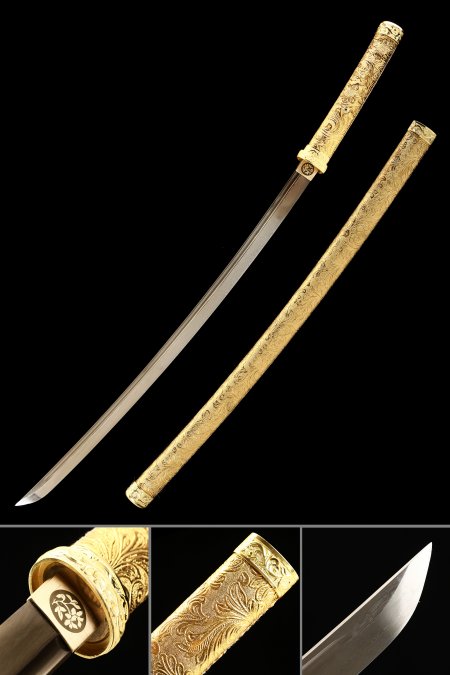
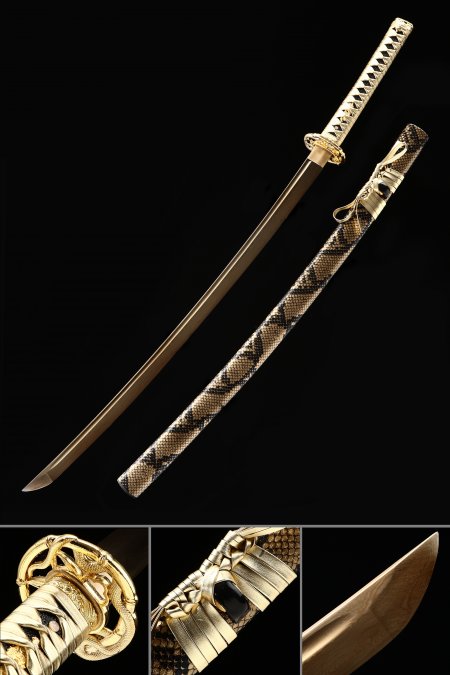
It is one of the stronger gift options in the collectible sword category precisely because it delivers on multiple levels simultaneously. The pattern-welded blade satisfies collectors interested in metallurgical craft, the gold-accented fittings give the piece visual presence on any wall mount or display stand, and the full-tang construction means the recipient can handle and appreciate the sword without worrying about structural fragility. Thematic coherence across the hardware — such as the matched snake motif on tsuba and saya in one model, or the cherry blossom kashira paired with engraved gold saya in another — signals that real design thought went into the piece rather than off-the-shelf parts assembly. For collectors who already own standard carbon-steel or mono-steel katana, a Damascus version with ornamental gold fittings represents a meaningful step up in both visual complexity and display impact.

Customer Reviews

Randy Cece New Jersey, United States

The sword is beautiful. I bought two swords on Amazon and they both broke within a week. My son (who is into Katana Swords) was devastated. This sword is built so much better and it’s very sleek. He’s only 6 so he’s not allowed to touch it without Mommy or Daddy right next to him. I’m teaching him to respect the sword and to understand it’s a very powerful weapon. We love it. Thanks for making such a great product.

Golden Damascus Steel Katana with Snake Tsuba and Python-Pattern Saya - Full Tang Collectible Sword Golden Damascus Steel Katana with Snake Tsuba and Python-Pattern Saya - Full Tang Collectible Sword