Purple Wakizashi
The Purple Wakizashi collection brings together hand-forged short swords distinguished by their deep violet tsuka wraps, lacquered saya finishes, and precisely fitted fittings - each piece a testament to the enduring craft of traditional Japanese blade making. From 1045 carbon steel to T10 high-carbon construction, every blade is built on a full-tang foundation and finished with hardware that rewards close inspection. Collectors receive free shipping and hassle-free returns on every order.
Related Collections
Frequently Asked Questions
What steel types are used in purple wakizashi blades?
The purple wakizashi collection spans three distinct carbon steel types, each with different characteristics. 1045 carbon steel is the most approachable - tough, moderately hard, and well-suited for display pieces that will be handled regularly. 1095 carbon steel increases the carbon content, producing a harder edge geometry and a more defined hamon line visible along the blade's temper transition. T10 carbon steel adds a small amount of tungsten to the alloy, which refines the grain structure and improves wear resistance, making it a preferred choice among collectors who prioritize metallurgical detail. Damascus steel, achieved through a folding and welding process, creates a layered surface pattern where no two blades are visually identical. Each steel type is finished with a full-tang construction, meaning the blade steel extends completely through the handle - a structural detail that matters both for display integrity and long-term durability.
How does a wakizashi differ from a tanto or short katana?
The wakizashi occupies a specific length range - traditionally between 30 and 60 centimeters of blade length - that distinguishes it from both the tanto (generally under 30 cm) and the katana (over 60 cm). What separates the wakizashi from a tanto is not just size but also its curvature profile and handle proportion, which more closely mirror katana construction. A tanto typically features a straighter spine and more angular tip geometry. The term 'short katana' is sometimes used loosely to describe wakizashi-length blades that use katana-style mounts, and several pieces in this collection bridge that description. For display purposes, the wakizashi's proportions make it more versatile than a tanto - large enough to command visual presence on a stand, yet compact enough to fit arrangements where a full katana would feel oversized.
How should I store and maintain a display wakizashi?
Carbon steel blades require consistent care to prevent oxidation, especially in humid environments. The most important routine step is applying a thin coat of choji oil - traditionally used in Japanese blade maintenance - to the blade surface every two to three months, or more frequently in coastal or high-humidity climates. Use a soft, lint-free cloth to apply the oil in smooth strokes along the blade's length, following the grain direction. Avoid touching the polished surface with bare hands, as skin oils accelerate surface oxidation. When storing the wakizashi in its saya, ensure the inside of the saya is clean and dry - moisture trapped between blade and saya is a common cause of surface pitting. For long-term storage, a horizontal position on a padded rack inside a controlled-humidity environment is ideal. Silica gel packets placed near the display area help regulate moisture without direct contact with the blade.
Is a purple wakizashi a good choice as a collector's gift?
The purple wakizashi is an unusually strong gift choice for collectors who appreciate both craft and visual distinction. The violet tsuka wrap and coordinated lacquer saya create an immediately striking presentation that stands apart from the more conventional black or natural-wrap configurations found in most entry-level collections. For a recipient who already owns katana pieces, a wakizashi in a matching or complementary color palette adds a historically grounded companion piece - the daisho pairing of katana and wakizashi was the recognized mark of samurai status in feudal Japan. For a newcomer to Japanese blade collecting, the wakizashi's shorter profile is less imposing to display and store, making it a practical starting point. Full-tang construction and carbon steel materials signal genuine quality to anyone familiar with blade collecting, ensuring the gift reads as thoughtful rather than decorative-only.
What should I look for in tsuba and fittings on a wakizashi?
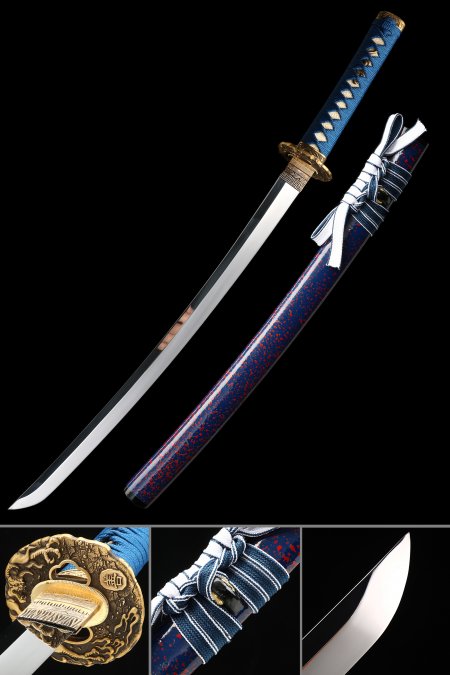
The tsuba - the circular or shaped guard between blade and handle - is one of the most visually informative components on any Japanese-style blade. On a quality collectible wakizashi, the tsuba should fit snugly with no lateral play, and its surface finish should be consistent with the overall aesthetic of the piece. Engraved or cast designs, such as the dragon motif and gold crane options available in this collection, reflect specific historical decorative traditions and add thematic depth to a display. Beyond the tsuba, the habaki (blade collar), fuchi (handle collar), and kashira (pommel cap) should all align tightly with no visible gaps. The menuki - the ornamental elements fitted beneath the tsuka wrap - contribute to both grip texture and visual detail when the ito wrap is partially unraveled for inspection. Collectors evaluating fittings quality should look for even wrap tension in the ito, consistent spacing in the diamond pattern, and clean lacquer edges on the saya without bubbling or chipping.
Customer Reviews
Armando
Illinois, United States
Very clean sword very well made love everything about wish it was a little more sharp but otherwise super dope blade!!!!
 |
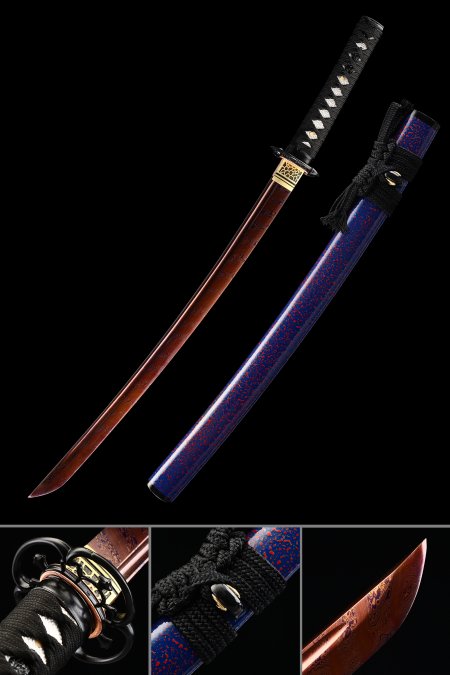
Damascus Steel Wakizashi with Dark Red Blade, Blue Lacquer Saya & Gold-Black Tsuba - Dragon Engraved |