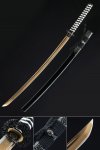
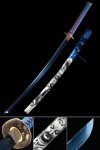
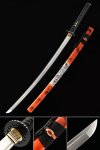
What does 'handmade' mean in the context of katana production?
In katana production, handmade refers specifically to the process of forging, shaping, tempering, and fitting the sword through hand skill rather than automated or machine-assisted production. The key hand processes in a genuine handmade katana are the forging - the smith works the heated steel under hammer by hand, making judgments about temperature, working direction, and material behavior through feel and visual assessment rather than through programmed machinery. Clay tempering is applied by hand: the specific pattern and thickness of the clay coating is applied by the smith's hand with a spatula or similar tool, and the outcome of the quench depends on the accuracy of this hand application. The polish is done by hand through progressive abrasive stones, a process that requires significant skill to execute without introducing scratches, uneven surfaces, or disruption to the hamon's surface character. Fitting work - habaki, tsuba, fuchi, kashira, tsuka - involves individual fitting of each component to the specific blade's dimensions rather than assembly of standardized parts. A handmade katana shows the accumulated skill of these processes in ways that a machine-produced equivalent cannot.
How much individual variation exists between handmade katana of the same style?
Meaningful individual variation exists between handmade katana of the same style, material, and production origin - and this variation is one of the primary reasons collectors find handmade swords more interesting than production pieces. The most significant variable is the hamon on clay-tempered blades. Clay is applied by hand, which means the specific undulation, the nie and nioi activity, and the overall character of the hamon is different between every blade even when the same smith applies the same clay pattern. The hamon on two T10 katana made by the same person from the same batch of steel will be recognizably similar but individually distinct, like two signatures from the same hand. Damascus blades show even more dramatic individual variation: the grain pattern created by folding and twisting the billet is determined by the specific working process of each piece, and no two Damascus blades share the same pattern. Handle materials and saya finish show less variation in a production range but retain individual fitting character - each tsuka is fitted to its specific blade's nakago dimensions. For collectors, these variations are what make acquisition decisions interesting and what give each piece a specific individual identity.
Is a handmade katana more durable than a machine-produced one?
A handmade katana is not automatically more durable than a well-made machine-produced equivalent, but the process of hand production creates quality indicators that are reliable markers of durability when executed well. In hand forging, the smith assesses the steel's condition at each stage and can identify and address defects - cold shuts, inclusions, inconsistencies in the working - that automated production may miss. The clay tempering applied by hand produces a differential hardness profile that is the correct performance structure for a katana: hard at the edge, tough at the spine. Machine heat treatment can replicate this in a general sense but rarely achieves the nuance of a well-executed hand clay tempering. The fitting work of a handmade katana - properly fitted habaki, correctly pegged tsuka, accurately matched saya - contributes to durability by ensuring the assembled sword functions as a cohesive unit without stress at component junctions. The durability of a specific handmade katana depends on the skill of the maker, while the durability of a machine-produced katana depends on the quality control of the production line. Both can produce durable swords; the difference is in where the quality assurance resides.
What should I look for when examining a handmade katana in person?
When examining a handmade katana in person, focus on several specific quality indicators across the blade and fittings. On the blade, the hamon should be clearly visible as a physical change in the steel's surface character - a misty, active zone along the edge rather than a sharp painted line. Run your eye along the blade from habaki to kissaki and assess the geometry: the shinogi ridge line should be consistent, the curve should flow evenly without flat spots or abrupt changes, and the kissaki point geometry should be cleanly executed with the yokote line - the boundary between the blade body and the point section - clearly defined. The habaki should fit the blade snugly without wobble or visible gaps at the contact points. The tsuka should feel solid when gripped firmly - no wobble of the blade within the handle. The saya should accept the blade smoothly with consistent resistance through the draw and return without binding or excessive looseness. The tsuba should be fitted to the blade without visible gaps at the habaki and without movement when the blade is held. These are the quality markers that a skilled examination of a handmade katana reveals, and they apply equally across all steel types and mounting styles.