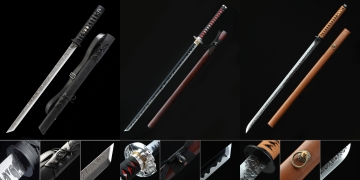
What makes an aikuchi different from a tanto?
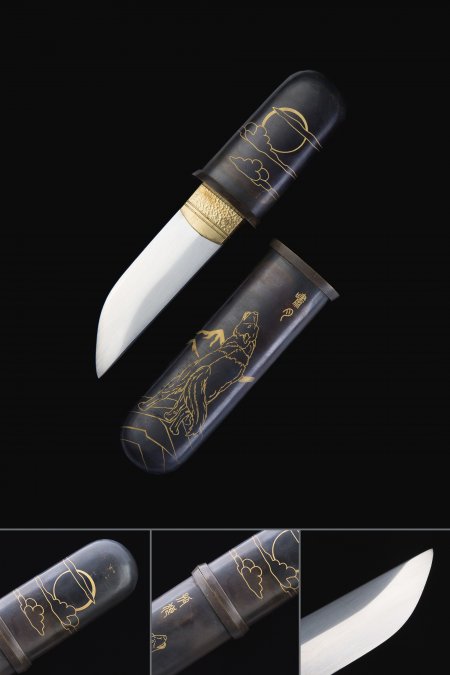
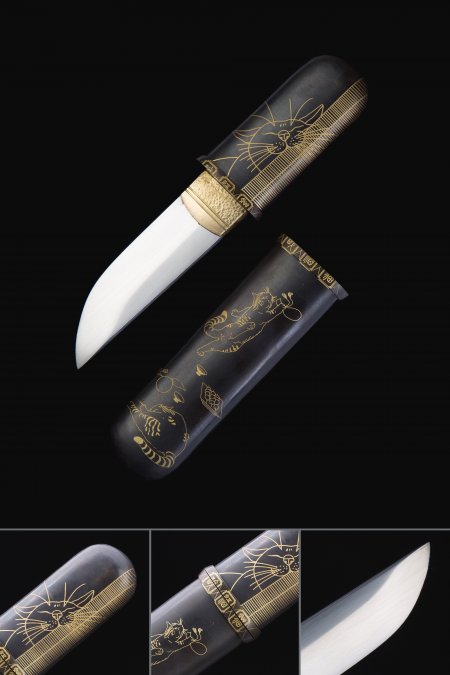
Both the aikuchi and the tanto share a similar short-blade format, but the defining distinction is the complete absence of a tsuba - the hand guard - on an aikuchi. A standard tanto typically includes a tsuba as part of its fittings, whereas the aikuchi presents an uninterrupted profile from pommel to saya tip. This guardless design originated as a style favored by Heian-period court nobility who prioritized a sleek, concealed carry aesthetic over protective fittings. For collectors, the aikuchi's flush-fitting handle and saya create a more sculptural, unified object that displays exceptionally well as a standalone piece.
What are the display and storage advantages of a compact aikuchi?
The short overall length of an aikuchi - generally under twelve inches - makes it one of the most versatile formats for indoor display. It sits cleanly on a two-tiered Japanese sword stand without overhanging, fits comfortably inside a shadowbox frame, and can be positioned horizontally in a curio cabinet without occupying the depth a longer blade would require. For storage, the lacquered wood saya provides genuine protection for the blade surface against dust and humidity fluctuation. Keep the piece in a climate-stable environment, avoid direct sunlight on the lacquered saya to prevent fading, and occasionally inspect the saya's interior fit to ensure no moisture has accumulated - especially important in coastal or high-humidity climates.
How does manganese steel differ from high-carbon steel in display pieces?
High-carbon steels such as T10 or 1095 are valued for their ability to hold a fine edge and their responsive heat-treatment characteristics. Manganese steel achieves its durability through a different mechanism - manganese content increases work-hardening properties, meaning the material resists surface deformation under stress. For collectible display pieces, the practical consequence is a blade that maintains a consistent surface finish over time and is somewhat more forgiving of the handling and repositioning that naturally occurs during display. The hand-forged construction used in this collection also means the steel grain has been refined through repeated thermal and mechanical work, producing a blade surface with more character than cast or stock-removal alternatives.
Are the engraved motifs on the saya hand-applied or machine-stamped?
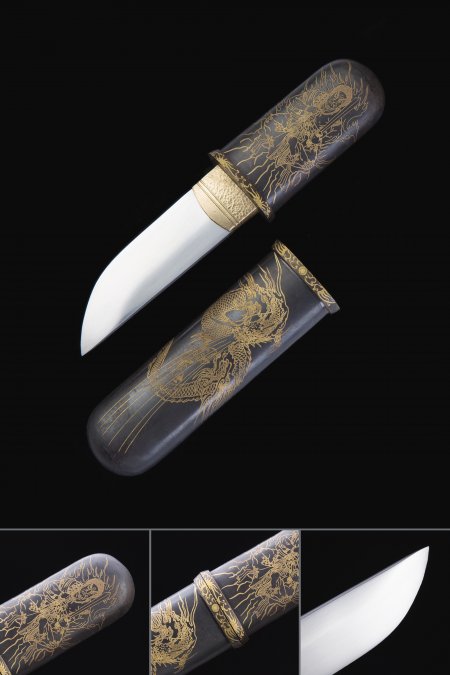
The engraved motifs in this collection - including the gold wolf, gold cat, and gold dragon designs - are applied through a combination of hand engraving and hand-fitting of metal hardware onto the saya surface. Machine-stamped decorative elements tend to have uniform depth and sharp, slightly mechanical edges. Hand-applied engraving by contrast shows subtle variation in line weight and depth that is only visible under close inspection but gives the piece a distinctly artisanal quality. The copper saya versions in particular reflect light differently across their engraved surfaces depending on viewing angle, which is a characteristic of hand-finished metalwork that mass-produced decoration cannot replicate.
Is an aikuchi a good first collectible for someone new to Japanese blades?
An aikuchi is an excellent entry point precisely because its design is self-contained and immediately readable, even to someone unfamiliar with Japanese sword taxonomy. Unlike a full katana, which involves a complex assembly of multiple fittings and a lengthy blade requiring dedicated display space, the aikuchi presents a complete, coherent aesthetic in a compact format. The brown lacquered saya with engraved hardware in this collection communicates clear craft intent without requiring any background knowledge to appreciate. For a first-time buyer who wants a meaningful, handcrafted Japanese collectible that displays beautifully and invites closer inspection, the aikuchi format offers a lower barrier to entry in terms of both budget and display logistics.