Hattori Hanzo Sword

The Hattori Hanzo Sword collection pays tribute to one of cinema's most iconic blades, faithfully recreating the legendary swords from Kill Bill with hand-forged carbon and Damascus steel construction, authentic fittings, and meticulous attention to historical Japanese sword-making traditions. Each piece is crafted as a premium display collectible that honors both the cinematic legacy and the real Sengoku-era master whose name it carries. Free standard shipping is included on all orders, and we stand behind every sword with a hassle-free return policy.

Showing 3 Products

Related Collections

Antique Ninjato111 items


612 Reviews

Natural Katana102 items


292 Reviews

Vintage Katana128 items


2373 Reviews

Aikuchi Tanto120 items


580 Reviews

Frequently Asked Questions

What steel is used in Hattori Hanzo sword replicas?
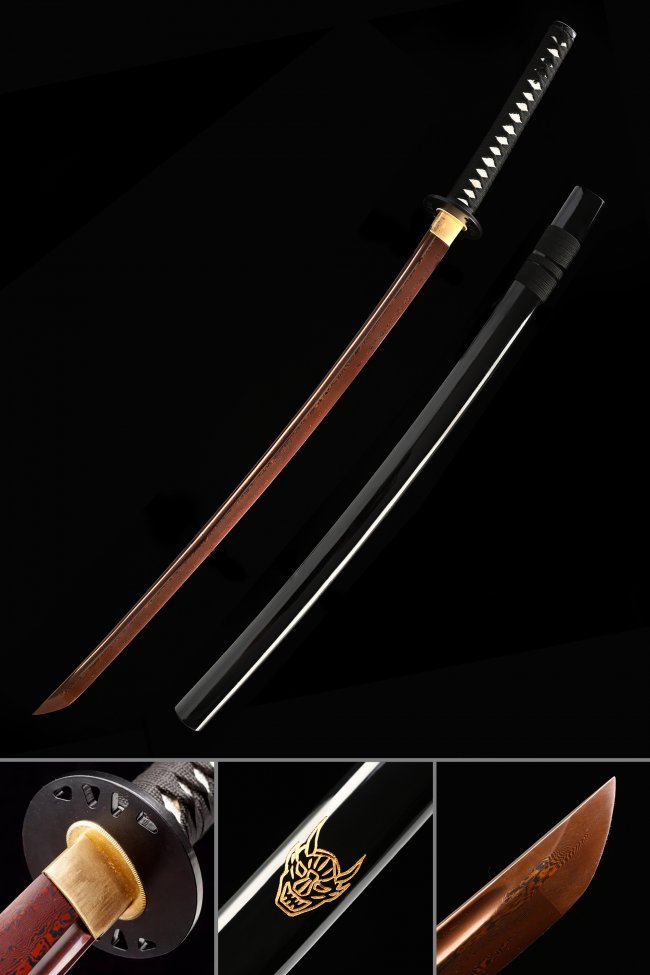
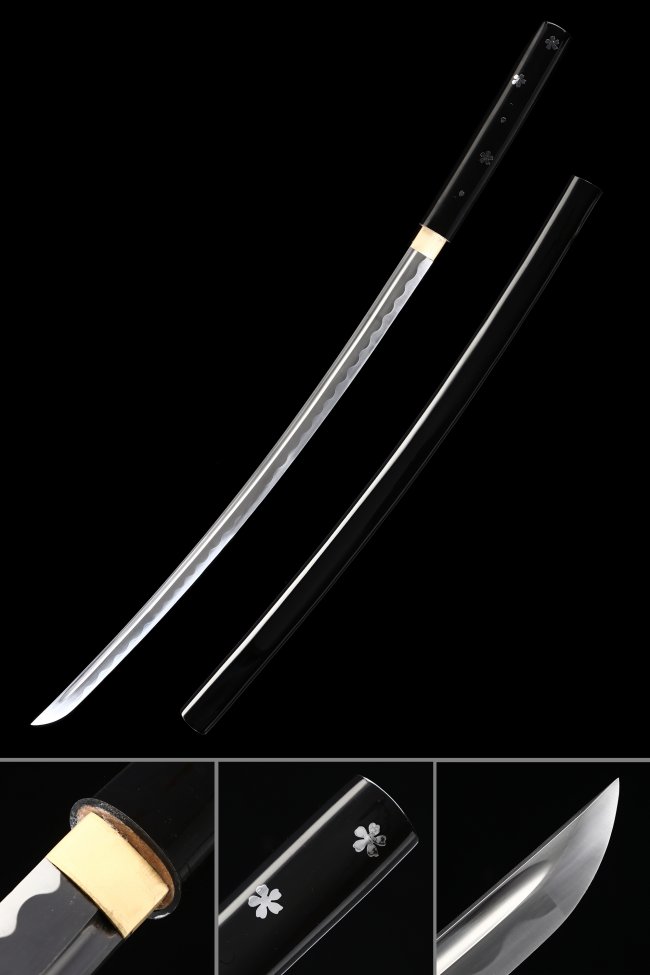
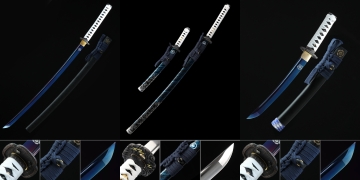
The swords in this collection use three distinct steel types depending on the specific piece. The Red Blade Katana is built from hand-folded Damascus steel, where repeated folding creates thousands of alternating layers visible as a flowing grain pattern on the blade surface — a hallmark of traditional Japanese smithing. The Bride Katana uses 1045 high-carbon steel with a clay-tempering process, which produces a genuine hamon (temper line) along the edge. The O-Ren Ishii Shirasaya uses 1065 carbon steel, which has a slightly higher carbon content for a finer grain and crisper edge geometry. Each steel choice reflects a different tradition within Japanese sword-making, giving collectors meaningful variation across the lineup.
What does clay tempering mean on a display katana?
Clay tempering — called tsuchioki in Japanese smithing — is a heat-treatment technique where a mixture of clay, ash, and water is applied unevenly to the blade before quenching. The edge receives a thinner clay coat and cools rapidly during the water quench, hardening into a dense martensitic structure. The spine retains a thicker clay layer, cools slowly, and stays comparatively tough and flexible. The boundary between these two zones creates the hamon — the wavy or straight temper line visible along the blade. On collectible-grade pieces, a visible hamon is one of the most prized aesthetic markers, signaling that real differential hardening occurred during production rather than being chemically etched for appearance only.
How is a shirasaya different from a standard katana mounting?
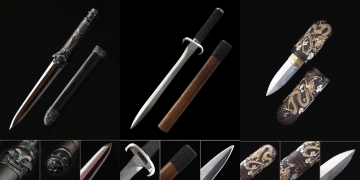
A standard katana mounting — called a koshirae — includes a decorative tsuba (hand guard), ito (handle wrap), menuki (ornamental fixtures), and a lacquered saya. A shirasaya, by contrast, is a plain, unadorned wooden mounting consisting only of a fitted wooden handle and scabbard, with no guard or wrap. Historically, Japanese swordsmiths and collectors used shirasaya mountings to store blades long-term because the bare wood allows the steel to breathe and resists moisture better than lacquered fittings over extended periods. In today's collector context, a shirasaya presentation signals a focus on the blade itself as the primary object — minimal, refined, and rooted in preservation tradition. The O-Ren Ishii piece in this collection uses this format, complemented by a silver floral handle that references the character's aesthetic.
Are these swords suitable as display pieces and gifts?
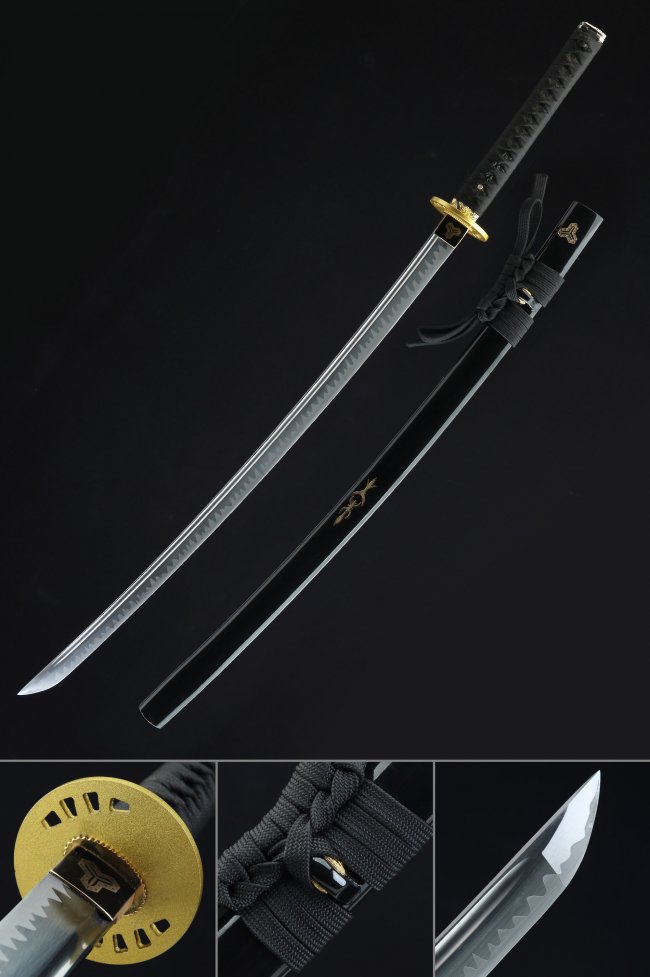
Yes — every piece in this collection is designed and sold as a collectible display item. They are well-suited for wall mounting, glass case display, themed film collections, or as a distinctive gift for someone passionate about Japanese sword culture, Kill Bill, or cinematic memorabilia. The Damascus and clay-tempered pieces offer strong visual impact from multiple viewing angles, making them particularly effective as centerpiece display items. For gifting, the Bride Katana is often a standout choice due to the recognizable black saya and film-accurate silhouette. Each sword ships with its full mounting and saya, ready for immediate display without additional accessories.
How should I care for a carbon steel katana in storage?
Carbon steel — whether 1045, 1065, or Damascus — will develop surface oxidation if left unprotected, so regular maintenance is essential for long-term display quality. Apply a light coat of choji oil (a mineral oil traditional to Japanese sword care) or high-quality camellia oil to the blade every one to three months, depending on your local humidity. Before applying fresh oil, remove the previous coat with a soft, lint-free cloth or traditional nugui-gami paper. Store the sword horizontally in its saya when not on display, and avoid environments with high humidity or direct sunlight exposure. If storing long-term, wrapping the blade in a clean cloth after oiling adds an extra layer of protection. Never leave fingerprints on the steel — the salt and oils in skin contact accelerate oxidation noticeably on high-carbon blades.

Customer Reviews

Troy Szabo British Columbia, Canada

Super nice and good looking display piece, that's why i got it, probably not good at cutting and it doesn't really look stable enough to do so. but the wax in the saya is awful. Everytime you sheath it and take it out you gotta clean half a pound of wax off which is super annoying especially after you clean it. r
r
I personally wont be buying any blades from this website if i actually want to cut something harder than like a cantaloupe haha. r
r
Sorry for the bad talk but this is just the truth, also if you wanna see if a company has good stuff or not, check reddit.

O-Ren Ishii Sword - Kill Bill Shirasaya Katana Hattori Hanzo 1065 Carbon Steel Silver Flower Handle O-Ren Ishii Sword - Kill Bill Shirasaya Katana Hattori Hanzo 1065 Carbon Steel Silver Flower Handle